Managing diabetes doesn’t mean giving up your favorite foods. It means learning how to work with them. One of the most effective tools for doing that is carbohydrate counting. It’s not about cutting out carbs entirely. It’s about knowing exactly how much you’re eating so you can match it with your insulin or medication-and keep your blood sugar where it needs to be.
Why Carbohydrate Counting Matters
Carbs are the main nutrient that raises your blood sugar. Every slice of bread, every apple, every spoon of rice turns into glucose after you eat it. If you have diabetes, your body either doesn’t make enough insulin or can’t use it well. That means glucose builds up in your blood instead of getting into your cells for energy. Over time, high blood sugar damages nerves, kidneys, eyes, and your heart. Carb counting helps you take control. Instead of guessing whether a meal will spike your sugar, you measure it. You learn how much carb is in your food, and then you adjust your insulin accordingly. Studies show that people who track their carbs consistently see their HbA1c levels drop by 0.5% to 1.0%-a big deal when your goal is under 7%. This isn’t just for people with type 1 diabetes. If you have type 2 and take insulin, carb counting gives you real power over your numbers. Even if you don’t use insulin, knowing your carb intake helps you understand why your sugar spikes after lunch or drops after a walk.How It Works: The 15-Gram Rule
The basic unit of carb counting is the 15-gram serving. That’s the amount of carbs that typically raises blood sugar by about the same amount in most people. Think of it like a building block. Here’s what one 15-gram serving looks like:- 1 small apple (about the size of a tennis ball)
- 1 slice of bread
- 1/2 cup of cooked rice or pasta
- 1/2 cup of beans or corn
- 1 cup of milk
- 1/3 cup of oatmeal
Reading Labels Like a Pro
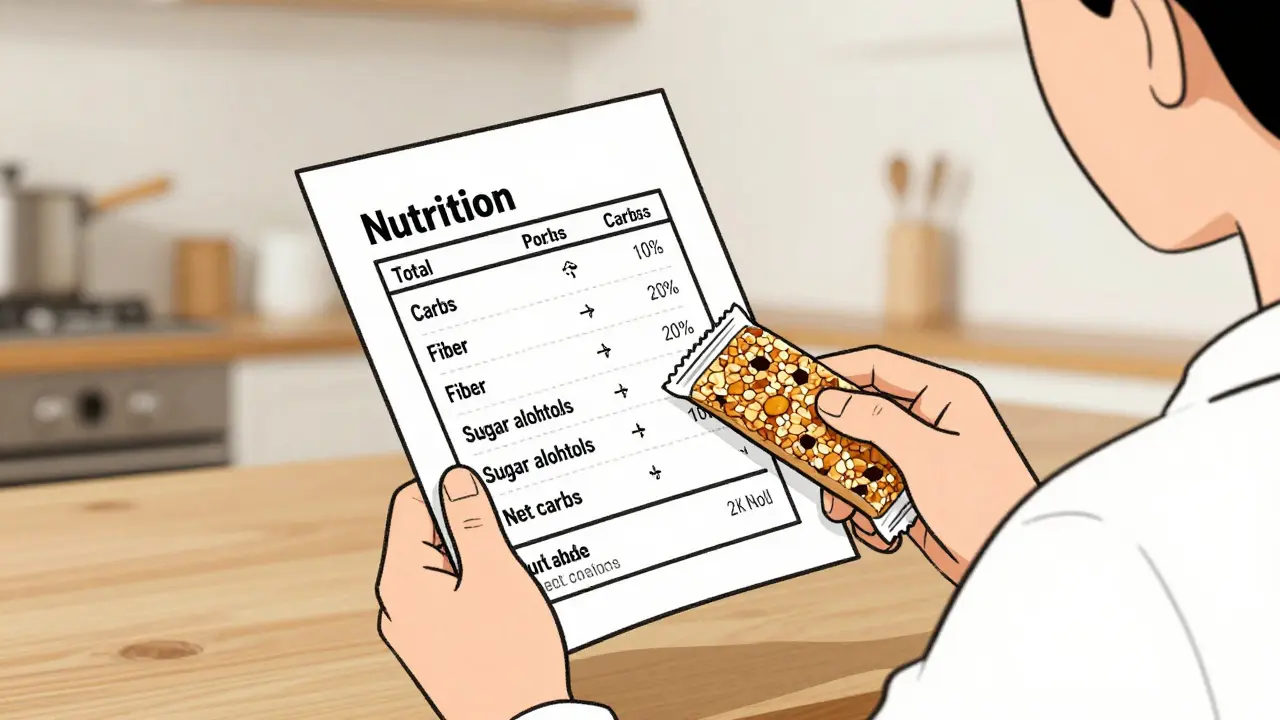
Nutrition labels are your best friend. Look for the line that says “Total Carbohydrates.” That number includes sugars, starches, and fiber. You don’t need to add them up separately-it’s already done for you. But here’s the trick: fiber and sugar alcohols change the math. - If a food has more than 5 grams of fiber per serving, subtract the full amount of fiber from the total carbs. Fiber doesn’t turn into sugar, so it doesn’t raise your blood glucose. - Sugar alcohols (like erythritol, maltitol, xylitol) are used in sugar-free products. They have about half the calories of regular sugar. So if a product has 10 grams of sugar alcohols, subtract 5 grams from the total carb count. Example: A granola bar says 22 grams total carbs, 8 grams fiber, and 6 grams sugar alcohols. You’d calculate: 22 - 8 - 3 = 11 grams of net carbs.Matching Carbs to Insulin: The Ratio System
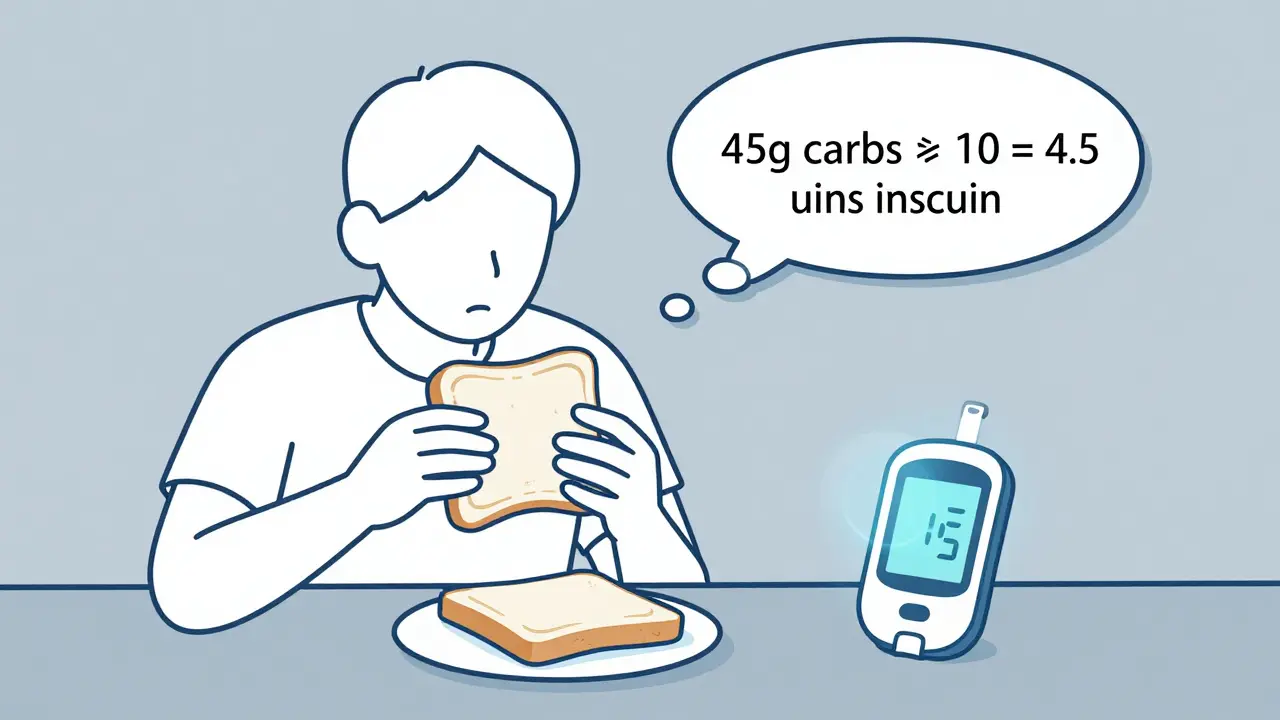
If you take insulin, you likely have a carb-to-insulin ratio. This tells you how much insulin to take per gram of carbs. Let’s say your ratio is 1:10. That means 1 unit of insulin covers 10 grams of carbs. If you’re eating a sandwich with 45 grams of carbs, you’d need 4.5 units of insulin (45 ÷ 10 = 4.5). Your ratio isn’t set in stone. It changes based on:- Time of day (many people need less insulin at breakfast than dinner)
- Activity level (exercise makes you more sensitive to insulin)
- Illness or stress (they can make you resistant)
What Makes Carb Counting Different
You might have heard of other methods: - The plate method says fill half your plate with non-starchy veggies, a quarter with protein, and a quarter with carbs. It’s simple but doesn’t give you numbers. - The glycemic index (GI) ranks foods by how fast they raise blood sugar. But a low-GI food can still have a lot of carbs. A banana has a lower GI than white bread, but it still has 27 grams of carbs. Carb counting beats both because it gives you precise control. You can eat a high-GI food like white rice if you know how much insulin to take. You can have a slice of cake if you count the carbs and adjust your dose.Tools You Need to Start
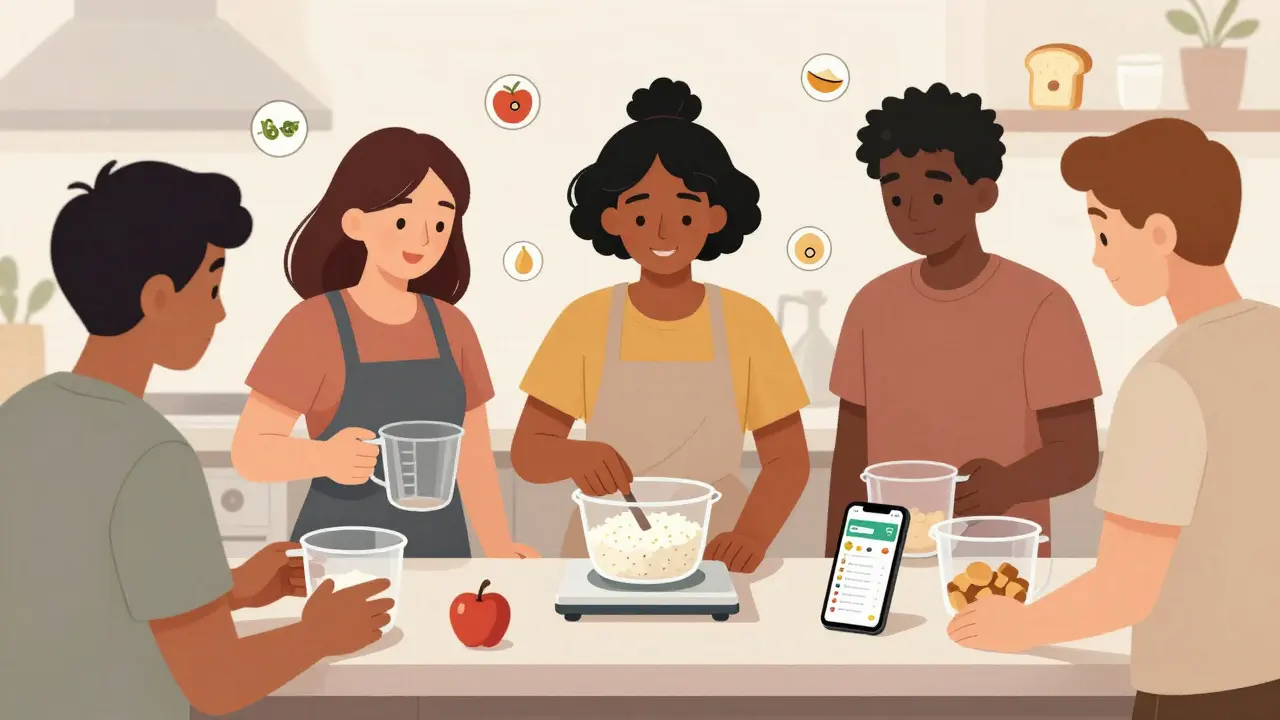
You don’t need fancy gear, but you do need tools to get accurate.- A food scale - This is the gold standard. Weighing your pasta or rice beats estimating.
- Measuring cups and spoons - For liquids, cereals, and cooked grains.
- A calculator or app - Apps like MyFitnessPal or Carb Manager let you scan barcodes or search foods. They auto-calculate net carbs.
- A food diary - Write down everything you eat, even if it’s just a handful of nuts. You’ll spot patterns you never noticed.
Common Mistakes (And How to Avoid Them)
New carb counters make the same errors over and over. Here’s what to watch for:- Forgetting hidden carbs - Milk, yogurt, fruit, tomato sauce, and even some medications have carbs. They add up fast.
- Guessing restaurant meals - A “small” order of fries can have 60+ grams of carbs. Use chain restaurant websites-they often list nutrition info.
- Not adjusting for activity - If you walk 30 minutes after dinner, you might need less insulin. Talk to your provider about correction factors.
- Ignoring fiber - If you don’t subtract fiber, you’ll take too much insulin and risk low blood sugar.
Real-Life Success Stories
One person on Reddit shared that after 2 weeks of consistent carb counting, their post-meal spikes dropped from 250+ to 160-180. Another, diagnosed with type 1 diabetes at 17, brought their HbA1c from 8.9% down to 6.2% in 18 months using carb counting and a CGM. It’s not magic. It’s math. And practice.When It’s Not the Right Fit
Carb counting isn’t for everyone. If you manage type 2 diabetes with just diet and metformin, you might not need it. The plate method or portion control might be enough. But if you take insulin-whether by injection or pump-carb counting gives you the precision you need. It’s taught in 92% of ADA-recognized diabetes education programs. And with newer tools like AI-powered food scanners (like Carb Manager’s SmartScan), it’s getting easier than ever.What’s Next?
Start small. Pick one meal a day to count. Maybe lunch. Use your food scale. Write it down. Check your blood sugar 2 hours later. See how it responds. Repeat. After a week, add another meal. Soon, you’ll know how many carbs are in your favorite foods without measuring. That’s when the real freedom begins. You’re not just managing diabetes. You’re learning to live with it-on your terms.Can I still eat bread and pasta if I’m counting carbs?
Yes, absolutely. Carb counting isn’t about eliminating foods-it’s about matching them with the right amount of insulin. One slice of bread is about 15 grams of carbs. If your insulin ratio is 1:10, you’d take 1.5 units for that slice. The key is consistency: always count the carbs, and always take the right insulin dose.
Do I need to count fiber and sugar alcohols?
Yes, if you want accurate numbers. Fiber doesn’t raise blood sugar, so subtract the full amount if it’s over 5 grams per serving. Sugar alcohols only raise blood sugar by about half, so subtract half their grams from the total. For example, if a food has 20g total carbs, 7g fiber, and 4g sugar alcohols: 20 - 7 - 2 = 11g net carbs.
How long does it take to get good at carb counting?
Most people reach 85% accuracy after 30 days of consistent practice. The first week is the hardest-you’ll spend 30 to 60 minutes per meal. But after a few weeks, you’ll start recognizing portion sizes and estimating without measuring. Tools like food scales and apps speed up the learning curve.
Do I need a continuous glucose monitor (CGM) to count carbs?
No, but it helps a lot. A CGM shows you exactly how your body reacts to different foods. You’ll see if your 1:10 ratio works for pizza or if you need to adjust. Many people use CGMs to fine-tune their carb-to-insulin ratios. If you’re on insulin, a CGM is one of the best tools you can use.
Is carb counting only for people with type 1 diabetes?
No. It’s especially helpful for anyone on insulin, whether type 1 or type 2. If you take multiple daily injections or use an insulin pump, carb counting gives you the control you need. Even if you only take long-acting insulin, knowing your carb intake helps you understand why your sugar levels change.
All Comments
tamilan Nadar March 16, 2026
Carb counting changed my life in Chennai. No more guessing. I eat dosa, idli, even biryani - just count and match insulin. My HbA1c dropped from 9.1 to 6.8 in 6 months. No magic, just math. And yes, fiber matters. Always subtract it. My grandma says ‘eat like your ancestors’ - but I eat like my glucose monitor tells me to.
Adam M March 17, 2026
Stop overcomplicating it. 15g = 1 unit. Measure. Inject. Move on.
Rosemary Chude-Sokei March 18, 2026
Thank you for this thoughtful, well-structured guide. As someone who manages type 2 diabetes with metformin and lifestyle, I appreciate the nuance you’ve offered - especially clarifying that carb counting isn’t mandatory for everyone. I’ve found that portion control and mindful eating suit my needs better, but I admire those who find precision empowering. Knowledge is power, and you’ve made it accessible.
Noluthando Devour Mamabolo March 19, 2026
OMG YES. 🙌 I just got my CGM last month and it’s a GAME CHANGER. 📈 I used to think ‘net carbs’ was a scam - but now I’m like, ‘fiber = free vibes, sugar alcohols = half the drama.’ My post-meal spikes? Gone. My HbA1c? Down 1.4%. This isn’t dieting. It’s biohacking. 🧬✨
Leah Dobbin March 19, 2026
How can you possibly endorse this? The ADA has been pushing this for decades - and yet, the industry still profits off glucose monitors, apps, and ‘special’ diabetic foods. You’re just feeding the machine. Real health is in whole foods, not spreadsheet math. I’ve seen people go mad counting carbs. It’s not liberation - it’s another form of control.
Ali Hughey March 20, 2026
WAIT - YOU DIDN’T MENTION THE GOVERNMENT’S SECRET CARB TAX?!?!?!?! 🚨🚨🚨 I’ve been researching this for 3 years - the CDC, Big Pharma, and the USDA are all in cahoots to make diabetics dependent on insulin and apps! They want you to think ‘15g servings’ are ‘normal’ - but that’s just the gateway to lifelong dependency! I’ve got documents! I’ve got screenshots! The FDA knows - but they’re silent! 🕵️♂️💊📉
rakesh sabharwal March 22, 2026
Carb counting? In India? Please. We’ve been eating rice, roti, dal for millennia without this nonsense. Your ‘15g serving’ is a Western construct. My aunt with type 2 diabetes eats 3 chapatis daily - no insulin, no CGM - and her sugar is stable. You’re overengineering a problem that traditional diets solved long ago. This isn’t science - it’s cultural imperialism disguised as education.
Aaron Leib March 23, 2026
This is gold. I’ve been coaching newly diagnosed folks for 5 years - and this guide nails it. Start with one meal. Use a scale. Log it. Don’t stress perfection. Progress > precision. I love how you emphasized that it’s not about restriction - it’s about agency. You’re not giving up food. You’re reclaiming your body. Keep going. You’ve got this.