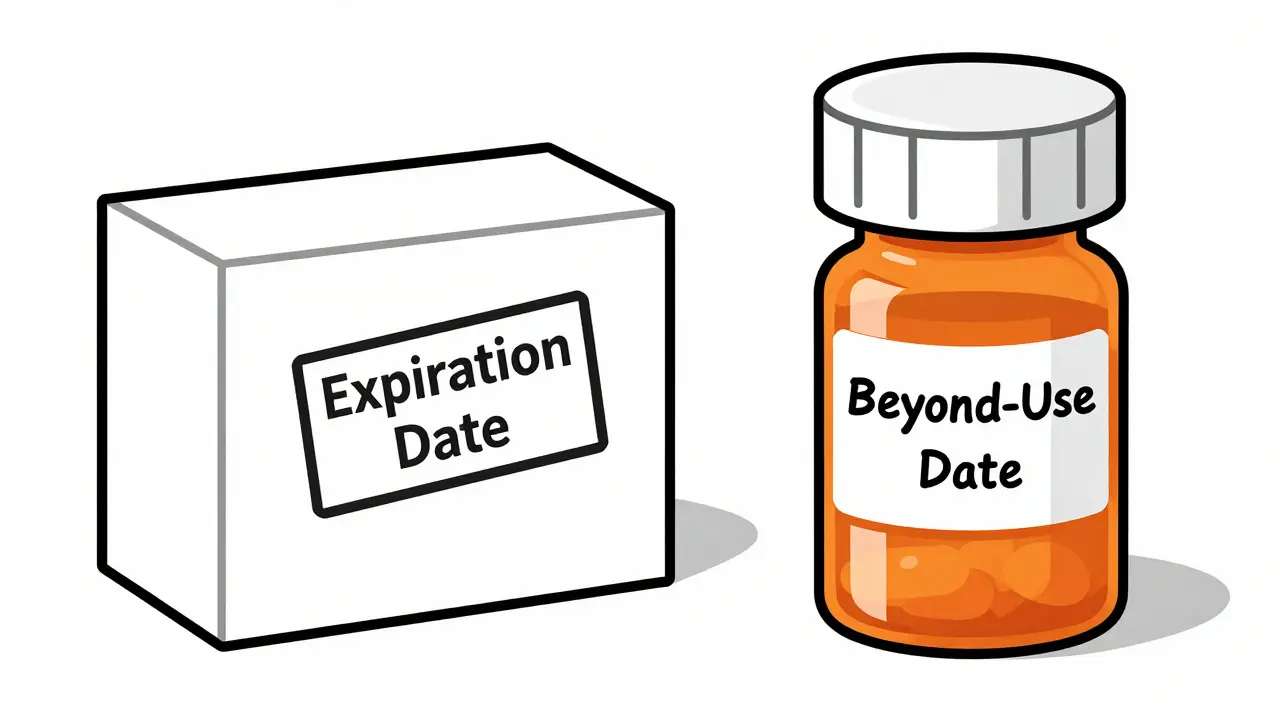
You’ve probably noticed two different dates on your medication: one printed on the original box from the factory and another handwritten or stickered on by your pharmacist. It’s confusing. Does the date from the company that made the drug override the date the pharmacist wrote? Or is it the other way around? Understanding the difference between these two systems can save you from wasting expensive medicine or, more importantly, taking a drug that has lost its punch.
The most important thing to know is that expiration dates and beyond-use dates (BUDs) aren't the same thing. One is a guarantee of potency from a giant laboratory, while the other is a safety window created after a human has handled or changed the drug. If you're using a standard pill from a bottle, you're likely looking at an expiration date. But if you have a custom cream, a liquid version of a pill, or a repackaged generic, you're dealing with a BUD.
What Exactly is a Manufacturer Expiration Date?
Think of a Manufacturer Expiration Date as a guarantee of full potency, safety, and quality provided by the drug maker. This date is the result of years of stability testing. Before a drug hits the shelves, the FDA (U.S. Food and Drug Administration) requires companies to prove that their medicine stays effective under specific conditions-usually around 25°C and 60% humidity-for a set amount of time.
Typically, these dates range from 12 to 60 months from the day the drug was made. When a manufacturer says a drug expires on March 31, 2026, they are stating that until that day, the drug will maintain at least 90% of its labeled potency. Once that date passes, the manufacturer can no longer guarantee that the chemical structure is stable or that the drug will work as intended, regardless of whether you've opened the bottle or not.
Decoding the Pharmacy Beyond-Use Date (BUD)
A Beyond-Use Date is the last date a compounded or altered medication can be safely used after it has been manipulated by a pharmacy. While the manufacturer's date is about the product in its original, sealed state, the BUD is about what happens after the pharmacist touches it.
Why does this happen? Many patients need medications that the big factories don't make. Maybe a child can't swallow a pill, so the pharmacist turns it into a liquid. Or perhaps a patient is allergic to a specific dye in a commercial tablet, so the pharmacist creates a custom version. This is called Compounding. Because these custom mixes don't have the same preservatives or sterile industrial processing as commercial drugs, they degrade much faster. A BUD is usually much shorter than a standard expiration date-sometimes just 14 days if it's a water-based mixture stored in the fridge.
Key Differences: Side-by-Side Comparison
It's easier to see the contrast when you look at the technical requirements. Commercial drugs are tested in controlled labs for years. Compounded drugs are assigned dates based on USP Standards (United States Pharmacopeia), which provide guidelines based on the risk level of the mixture.
| Feature | Manufacturer Expiration Date | Beyond-Use Date (BUD) |
|---|---|---|
| Who sets it? | The Drug Manufacturer | The Compounding Pharmacist |
| Based on... | Long-term stability studies | USP guidelines & ingredient stability |
| Typical Duration | 1 to 5 years | 14 days to 1 year |
| Application | Unopened commercial products | Custom mixes, reconstituted liquids, or repackaged pills |
| Primary Risk | Gradual loss of potency | Contamination & rapid degradation |
When Does the BUD Override the Expiration Date?
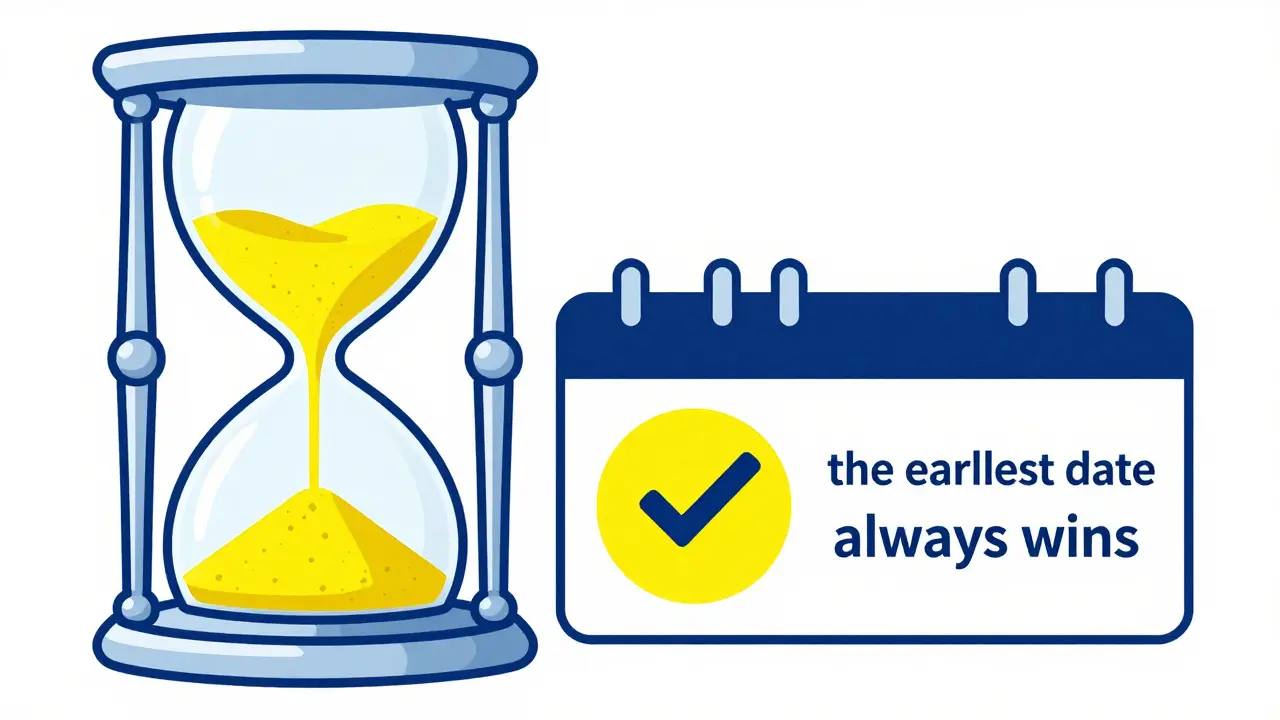
This is where most people get tripped up. The golden rule is: the earliest date always wins.
If you have a commercial medication that was repackaged by the pharmacy into a plastic vial, the pharmacist must assign a BUD. According to USP Chapter <17>, this is typically the earlier of the original manufacturer's date or one year from the date of repackaging. If the manufacturer's date is December 2027, but the pharmacist repackaged it today, your BUD might be April 2027. You must stop using it by April.
The same applies to reconstituted medications. Imagine an antibiotic powder that the pharmacist adds water to. The original powder might have had an expiration date years in the future, but once water is added, the drug becomes vulnerable to bacteria and chemical breakdown. At that point, the manufacturer's date is irrelevant; the BUD (which might be only 10-14 days) is the only date that matters.
Real-World Risks: Why You Shouldn't Ignore the Dates
You might have heard stories about drugs being effective decades after their expiration date. It's true-some studies show that 90% of certain drugs remain potent long after the date on the box. However, this happened in a lab under perfect conditions. In your bathroom cabinet, things are different. Temperature swings and humidity can destroy a drug's effectiveness far faster than a lab test would suggest.
With compounded medications, the risk is even higher. Because they lack industrial preservatives, they are prone to microbial contamination. Using a custom cream past its BUD isn't just about it "not working" as well; it's about potentially introducing bacteria into your skin or bloodstream. This is why many patients end up wasting medication-a survey by the International Academy of Compounding Pharmacists found that 68% of compounding patients discard medicine because the BUD expires before they finish the course.
Pro Tips for Managing Your Medications
To avoid wasting money and ensure your treatment is safe, try these practical steps:
- Ask at the counter: When picking up a prescription, specifically ask, "Is this the manufacturer's date or a beyond-use date?" If it's a BUD, ask why it's shorter than usual.
- Check storage requirements: Many BUD medications require refrigeration even if the original drug didn't. A custom-mixed liquid often needs a fridge to keep it stable for those 14 days.
- Don't trust the box alone: If a pharmacist puts a sticker on a bottle that contradicts the box, follow the sticker. The pharmacist is accounting for the fact that the seal was broken and the drug was exposed to air and light.
- Dispose of safely: Never throw expired meds in the trash. Most pharmacies have take-back programs to ensure chemicals don't leak into the water supply.
Can I still use a drug a few days after the expiration date?
While many drugs don't become toxic immediately after the date, they do lose potency. For something like a vitamin, it might not matter. For critical medications like insulin, nitroglycerin, or certain liquid antibiotics, even a small drop in potency can be dangerous. The FDA strictly recommends against using drugs past their expiration date because home storage conditions vary too much to guarantee safety.
Why is my compounded medication's BUD so short?
Compounded medications are custom-made and usually lack the heavy-duty preservatives and airtight industrial sealing that commercial drugs have. This makes them more susceptible to oxygen, light, and bacteria. Depending on the ingredients, some mixes are chemically unstable and start breaking down within days, which is why pharmacists set conservative BUDs to protect you.
What happens if I use a medication past its Beyond-Use Date?
The main risks are reduced efficacy (the drug doesn't work) and contamination. In sterile compounds, the risk of bacterial growth is a serious concern. In non-sterile compounds, the active ingredients may degrade into inactive or even irritating substances, meaning you're getting the side effects without any of the therapeutic benefits.
Does the BUD change if I store the medicine in the fridge?
Yes, storage conditions are a primary factor in determining the BUD. Some medications are stable at room temperature for 30 days but can last longer if refrigerated, while others MUST be refrigerated to reach their maximum BUD. Always follow the specific storage instructions on your pharmacy label, as changing the temperature can actually accelerate the breakdown of certain chemicals.
Who is responsible for setting the BUD?
The compounding pharmacist is responsible for assigning the BUD. They do this by looking at the expiration dates of every single ingredient used in the mix and then applying USP (United States Pharmacopeia) guidelines based on the formulation type (e.g., aqueous vs. non-aqueous) and the risk level of the compound.
All Comments
mimi clouet April 11, 2026
Actually, it's super important to mention that for some medications, especially liquid ones, the degradation isn't just about potency but can actually create toxic by-products 💊 It's not just "not working," it's potentially harmful! Always check those labels twice! 😊✨
Clint Humphreys April 12, 2026
It's funny how they talk about safety windows and stability testing as if these giant pharmaceutical companies actually have our best interests at heart when in reality these dates are often just a convenient way to ensure we keep coming back to the pharmacy to buy more of the same stuff while the government regulators just nod along and pretend the system is transparent for the average person who doesn't realize that a pill made in a sterile lab doesn't magically turn into poison the second the calendar flips to a new month, but hey, who am I to question the "science" provided by the people making billions off our health, right?
Haley Moore April 12, 2026
Ugh, imagine not knowing this basic stuff 🙄 Like, obviously the pharmacist's date is the one that matters because they're the ones actually touching the meds. I can't believe some people actually struggle with this lol 💅
Jasmin Stowers April 12, 2026
makes sense. thanks for the info
Mary Johnson April 14, 2026
This is all a scam to make us waste money on new prescriptions! They tell you it's about "contamination" but it's really about keeping the profits high by shortening the BUD. I bet the FDA is in on it too, just pushing people toward the most expensive compounding pharmacies that force you to discard half your medicine! It's absolutely disgusting how they manipulate these dates to scare us into spending more!
Shaylia Helland April 15, 2026
i've always felt like the pharmacy labels are just a bit overwhelming for people who aren't used to the medical system especially if english isn't their first language and they're just trying to make sure their kids are healthy without worrying about the technical difference between a stability study and a usp guideline which just sounds like a lot of jargon to most of us just trying to get through the day
john chiong April 17, 2026
absolute poppycock to suggest we just blindly trust these corporate suits and their arbitrary dates when common sense tells us a dry pill in a sealed bottle isnt suddenly garbage because of a sticker. total fleece job if you ask me
melissa mac April 17, 2026
I think it's really helpful to look at it from the pharmacist's perspective. They are trying to keep us safe by being conservative with those dates. It's better to be safe and waste a little bit of medicine than to risk a serious infection from a contaminated compound.
Rim Linda April 18, 2026
OMG imagine the horror of using a cream that's like... two days past the BUD 😱 I would literally spiral!! 😭
Tabatha Pugh April 19, 2026
Actually, the USP guidelines specifically categorize non-sterile compounding into different risk levels, and most people fail to realize that the water-based ones are the most volatile. Most of you probably don't even know what a non-aqueous vehicle is, but that's why some BUDs are longer than others.