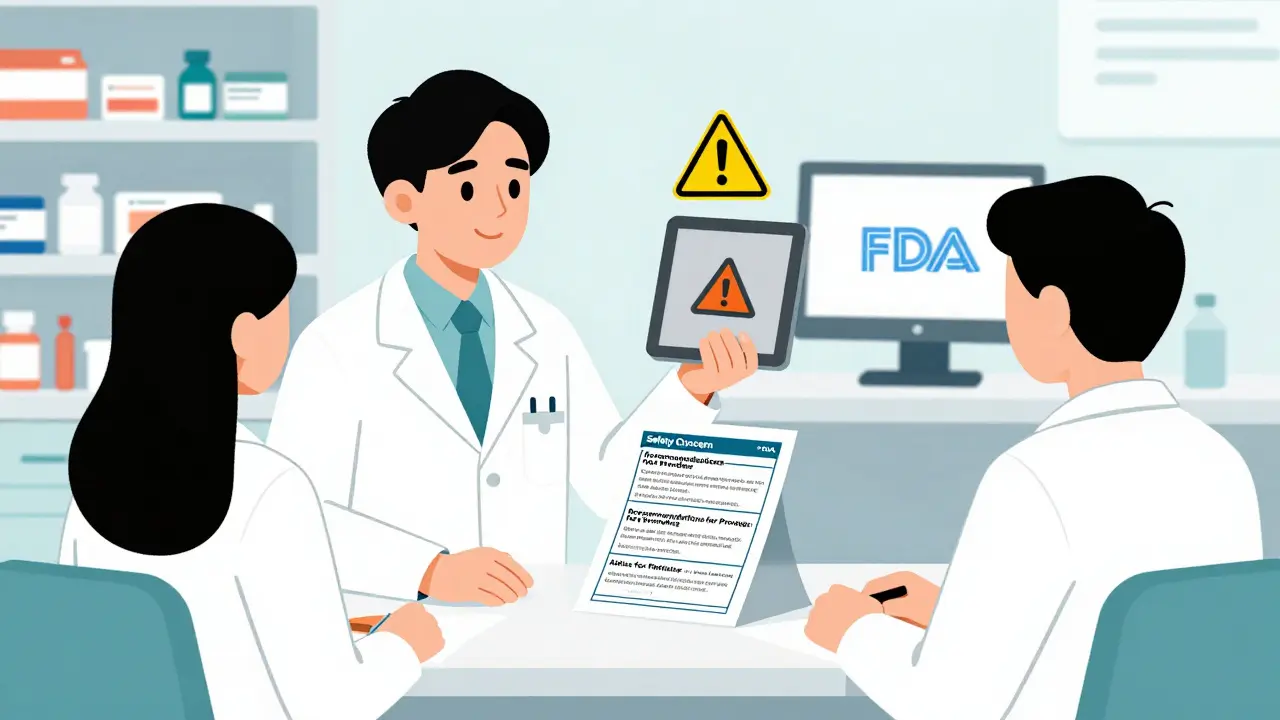
Every year, the U.S. Food and Drug Administration (FDA) sends out hundreds of alerts about prescription drugs that are already on the market. These aren’t recalls. They aren’t warnings from your pharmacist. They’re Drug Safety Communications - official notices that tell doctors, pharmacists, and patients about new or changing risks tied to medications. If you’ve ever heard about a drug causing heart rhythm problems, liver damage, or unexpected side effects in older adults, chances are it came from one of these communications.
What Exactly Is a Drug Safety Communication?
A Drug Safety Communication (DSC) is the FDA’s way of telling the public about safety issues that emerge after a drug has been approved and is being used by millions of people. Think of it like this: when a drug is first approved, the FDA reviews clinical trial data. But those trials usually involve a few thousand people over months or a couple of years. Real-world use involves millions of people over decades. That’s where unexpected problems show up.
The FDA defines a DSC as any safety issue that could change how doctors and patients weigh the benefits and risks of a drug. That means if a drug that helps control diabetes is later found to raise the risk of a rare but serious kidney injury, that’s a DSC-worthy issue. It doesn’t mean the drug is pulled off the market. It means the FDA is updating the information so people can make better choices.
These aren’t random emails or press releases. Each DSC follows a strict format. You’ll always see:
- What Safety Concern Is FDA Announcing? - The specific issue, backed by data.
- Recommendations for Health Care Professionals - What doctors and pharmacists should do differently.
- Recommendations for Patients - What you should ask your provider or watch for.
- Additional Information - Links to studies, regulatory actions, or related alerts.
For example, in July 2025, the FDA issued a DSC about long-acting opioid painkillers. The alert didn’t say stop using them. It said: “These drugs carry a higher risk of addiction and overdose than previously known, especially with long-term use. Prescribers should reassess pain management plans and consider non-opioid alternatives.” That’s a DSC - clear, specific, and designed to change behavior without causing panic.
How Does the FDA Find These Risks?
The FDA doesn’t just wait for reports. It uses multiple systems to detect problems after a drug is on the market.
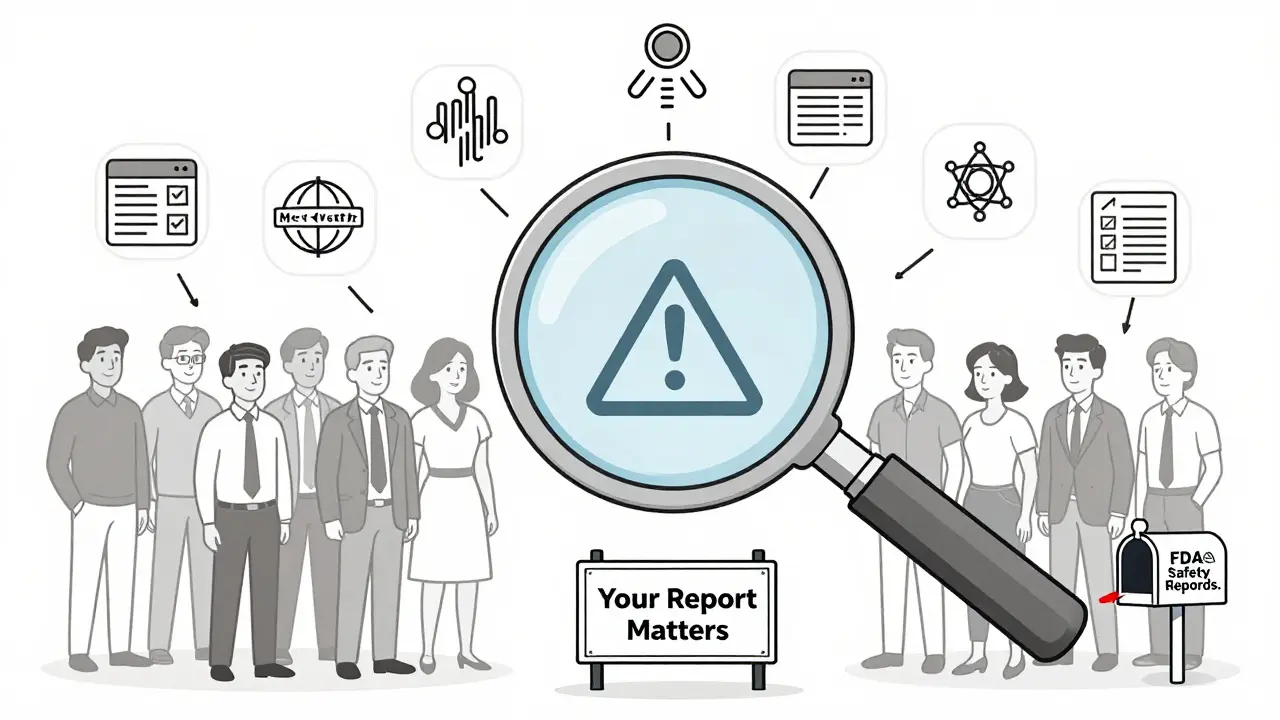
- MedWatch - Doctors, pharmacists, and even patients can report side effects directly to the FDA. In 2024, over 150,000 reports came in.
- The Sentinel Initiative - This is a real-time monitoring network that tracks health records from 300 million people across 16 health systems. If a drug suddenly shows up more often in hospital admissions for liver failure, Sentinel flags it.
- Post-Market Studies - The FDA can require drugmakers to conduct additional studies after approval. For example, after concerns about a diabetes drug increasing heart attack risk, the manufacturer was required to track 15,000 patients for five years.
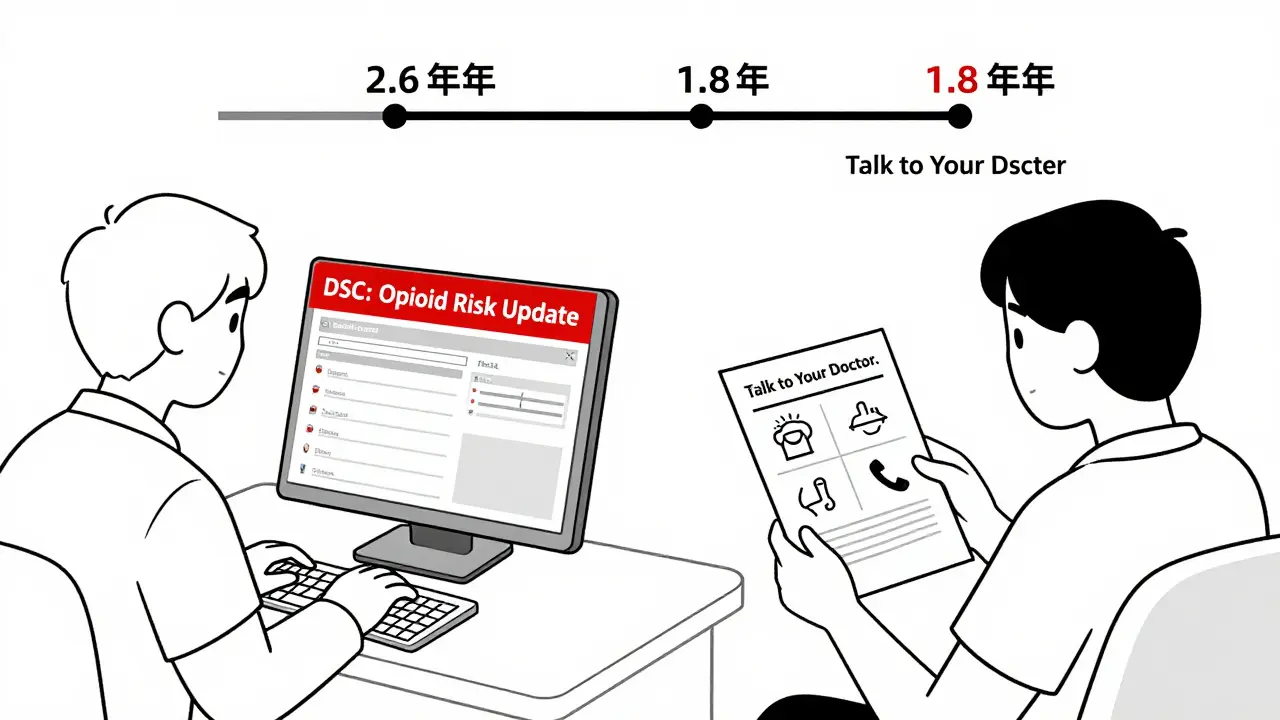
- AI Signal Detection - Starting in 2025, the FDA began using artificial intelligence to scan millions of health records and social media reports to spot patterns faster. This cut the average time from detecting a risk to issuing a DSC from 2.6 years to 1.8 years.
None of this is guesswork. Each DSC is backed by data - often from multiple sources. The FDA doesn’t act on a single report. It looks for clusters, trends, and statistical significance.
Who Gets These Alerts, and How?
These aren’t hidden notices. They’re public. Anyone can read them on the FDA’s website. But who actually uses them?
- Healthcare Providers - 68% of hospital pharmacists check the FDA’s Drug Safety page weekly. Many hospitals now integrate DSCs directly into their electronic health record systems. If a patient is prescribed a drug with a new warning, the system can pop up a reminder before the prescription is filled.
- Patients - The FDA has improved patient-facing language in recent years. In 2025, 47% of DSCs included plain-language advice like: “If you’ve been taking this drug for more than 6 months and feel dizzy or have unexplained nausea, talk to your doctor. Don’t stop without consulting them.” Still, only 38% of patients who learned about a risk actually changed their medication use, according to FDA surveys.
- Pharmaceutical Companies - Drugmakers are required to respond to DSCs. Many now have teams dedicated to tracking these alerts. If a DSC leads to a labeling change, the company must update every package insert and patient handout within 30 days.
As of January 2025, more than 147,000 healthcare professionals were subscribed to FDA email alerts. That’s up from just 12,000 in 2010. The volume of DSCs has jumped too - from 42 in 2008 to 187 in 2024. That’s a 345% increase.
Why Do Some Doctors Say They’re Overwhelmed?
Not everyone sees DSCs as helpful. A 2024 survey by the American Society of Health-System Pharmacists found that 68% of hospital pharmacists review DSCs weekly, but only 42% of community pharmacists do. Why the gap?
One reason: alert fatigue. A community pharmacist in Ohio told a Reddit forum: “I get three or four DSCs a week. Some are critical. Others are about a 0.02% increase in a side effect that’s been known for 10 years. I can’t act on all of them.”
There’s also inconsistency in how electronic systems handle alerts. A 2024 study found that only 58% of major EHR platforms like Epic and Cerner properly label DSCs by urgency. So a life-threatening warning might get buried under a minor update.
And timing matters. A 2019 study found that, on average, it took the FDA 2.6 years to issue a DSC after spotting a safety signal. That delay meant patients were exposed to risks longer than necessary. That’s why the FDA’s shift to AI-driven detection is so important - it’s cutting that lag time.
What Should You Do When You See a DSC?
If you’re a patient and you hear about a DSC for a drug you’re taking, don’t panic. Don’t stop the medication. Here’s what to do instead:
- Check the source. Go to the FDA’s official Drug Safety Communications page. Don’t rely on headlines or social media.
- Read the recommendations. The FDA separates advice for patients and providers. Focus on the patient section.
- Bring it to your doctor. Say: “I read about a new safety alert for my medication. Can we talk about whether it still makes sense for me?”
- Don’t assume you need to switch. Many DSCs don’t mean stop the drug. They mean monitor more closely, adjust the dose, or avoid combining it with another medication.
For example, a DSC about a blood pressure medication might say: “Avoid using this drug with certain antibiotics - it can cause dangerously low blood pressure.” That doesn’t mean you can’t take the blood pressure pill. It means if your doctor prescribes an antibiotic, they need to know you’re on this drug.
How Is This Different from a Recall?
This is a common confusion. A recall means the drug is pulled from shelves because it’s contaminated, mislabeled, or defective. A DSC means the drug is still safe and effective for most people - but new data shows it has risks that weren’t clear before.
Think of it this way:
- Recall: “This batch of pills has glass shards in them.”
- DSC: “This pill works well, but long-term use may increase your risk of kidney injury. Talk to your doctor if you’ve been on it for over a year.”
Most DSCs don’t lead to recalls. In fact, fewer than 5% of DSCs result in a drug being removed from the market. The goal is better use, not removal.
What’s Changing in 2026?
The FDA is pushing to make DSCs faster, clearer, and more useful.
- Real-time alerts - By late 2026, the FDA plans to launch a system that can detect safety signals directly from electronic health records as they happen. Imagine your doctor’s system alerting them the moment a patient on a certain drug develops a rare symptom.
- More patient-focused language - The FDA is now requiring DSCs to use plain language and include visuals like infographics for common side effects.
- Integration with AI tools - The agency is testing AI that can predict which DSCs are most likely to change prescribing behavior. This helps prioritize which alerts get pushed to providers first.
By 2027, experts predict the FDA will issue over 200 DSCs per year - especially as new therapies like gene treatments and AI-powered diagnostics enter the market. These drugs are powerful, but their long-term effects aren’t fully known. That’s exactly why DSCs are more important than ever.
Final Takeaway
Drug Safety Communications aren’t scary. They’re a sign that the system is working. The FDA doesn’t wait for disasters. It uses data, science, and real-world evidence to keep you safer. If you’re on medication, you’re part of this system. You don’t need to read every DSC. But if you hear about a risk tied to your drug, don’t ignore it. Talk to your provider. Ask what it means for you. And remember - the goal isn’t to scare you. It’s to help you make smarter, safer choices.
Are Drug Safety Communications the same as drug recalls?
No. A drug recall means the product is defective, contaminated, or mislabeled and must be removed from the market. A Drug Safety Communication (DSC) means new safety information has been discovered about a drug that’s already on the market. The drug is still available, but the FDA is updating recommendations for use, dosage, or warnings based on new data. Most DSCs do not lead to recalls.
How often does the FDA issue Drug Safety Communications?
The number has increased sharply since 2007. In 2008, the FDA issued 42 DSCs. By 2024, that number had jumped to 187 - a 345% increase. This rise reflects better surveillance systems like the Sentinel Initiative and AI-powered signal detection. Experts predict the FDA will issue 210-230 DSCs annually by 2027 as new therapies like gene therapies become more common.
Can patients report side effects to the FDA?
Yes. The FDA’s MedWatch program allows patients, doctors, and pharmacists to report adverse events directly. These reports help the FDA detect safety signals. In 2024, over 150,000 reports were submitted through MedWatch. You can submit a report online at the FDA’s website or by mail. Even one report can help identify a pattern if others have similar experiences.
Do Drug Safety Communications mean I should stop taking my medication?
Not necessarily. Most DSCs don’t recommend stopping a drug. Instead, they suggest adjusting the dose, monitoring for specific symptoms, avoiding interactions with other medications, or considering alternatives. Stopping a medication abruptly can be dangerous. Always talk to your doctor before making any changes. The FDA advises patients to use DSCs as a conversation starter with their provider, not as a directive to stop treatment.
How long does it take for the FDA to issue a Drug Safety Communication after identifying a risk?
In the past, it took an average of 2.6 years. But since 2025, the FDA has used AI tools to speed up detection and analysis. As of early 2026, the median time has dropped to 1.8 years. The FDA aims to reduce this further to under 1.5 years by 2027. This faster response helps prevent harm by getting critical information to patients and providers sooner.
Are Drug Safety Communications only for prescription drugs?
Primarily, yes. Most DSCs focus on prescription medications. However, the FDA has also issued safety communications for certain over-the-counter (OTC) drugs, especially when they’re used long-term or in combination with other medications. For example, DSCs have been issued about proton pump inhibitors (PPIs) like omeprazole due to risks of kidney injury and C. difficile infection with prolonged use. Always check the FDA’s website to see if a DSC applies to the medication you’re using.
All Comments
Donnie DeMarco March 12, 2026
Man, I read this and thought 'finally someone explains this without sounding like a robot'. I got a DSC for my blood pressure med last year and panicked, thought I was gonna die. Turns out I just couldn't take it with ibuprofen anymore. Doc said 'cool, switch to naproxen' and boom. No drama. FDA's not out to get you, they just want you alive long enough to see your grandkids. 🙌
LiV Beau March 14, 2026
I love how the FDA is using AI now 🤖✨ Like, imagine if your EHR could just pop up a little 'Hey, this combo might be risky' before you even get to the pharmacy? My grandma’s on 7 meds and I swear half the time I’m just guessing what’s safe. This is the kind of thing that actually saves lives. Also-yes, patients can report side effects! I reported my weird tongue tingling after that new diabetes drug and got an email back saying 'thank you, your report helped trigger a review.' Felt like a superhero. 🦸♀️
Adam Kleinberg March 15, 2026
They're not telling you the whole truth. DSCs? Just another way for Big Pharma and the FDA to control the narrative. You think they'd really want you to know how many drugs have hidden liver damage? Nah. They wait until the lawsuits pile up. That 'AI detection' thing? It's a smokescreen. The real data gets buried in some black box server in Virginia. I've seen the leaks. This is all theater. You think your doctor even reads these? Half of them don't know what 'MedWatch' stands for. Wake up.
Denise Jordan March 16, 2026
Okay but like... how many of these are just 'hey we noticed 3 people got dizzy after taking this' and they turn it into a full blown alert? I feel like we're drowning in noise. My pharmacist sent me a 3-page email about a 0.01% risk of... something. I didn't even know I was taking that drug. I'm just trying to not die, not become a full-time pharmacologist.
Gene Forte March 16, 2026
This system works because it’s grounded in real-world evidence, not lab results. We used to rely on clinical trials that lasted months. Now we have millions of real people taking these drugs daily. That’s power. That’s progress. Every time the FDA updates a warning, it’s because someone spoke up-whether it was a nurse, a patient, or a pharmacist who noticed a pattern. That’s democracy in action. Stay informed. Stay calm. And thank you, FDA, for not looking away.
Chris Bird March 17, 2026
Nigga why u even care? FDA is just a gov agency. They don't give a damn. My cousin died on a drug that had 3 DSCs before they pulled it. Took 5 years. You think AI changed that? Nah. They still move slow. And the companies? They fight every change. This ain't safety. It's damage control with a fancy website.
Alexander Erb March 18, 2026
As a pharmacist, I can tell you this: DSCs are gold. I keep a folder on my desktop called 'Things That Could Kill Someone' and I update it every Monday. Last week it was a blood thinner + herbal tea combo. Patient didn't even know the tea was an issue. We caught it. Saved a GI bleed. Also, yes-patients can report! Drop a MedWatch form in. One report won't change the world. But 100? That's a trend. And trends save lives. 🙏
Tom Bolt March 19, 2026
I read this entire thing. It’s beautifully written. Structured. Logical. Almost too perfect. Which makes me wonder: who wrote this? Was it a PR firm? A pharma lobbyist? The tone is so... polished. The data is cherry-picked. Where are the counterexamples? The failed DSCs? The ones that caused panic and unnecessary discontinuations? This reads like a corporate white paper, not a patient’s guide. Where’s the honesty?
Shourya Tanay March 20, 2026
The integration of Sentinel with real-time EHR data represents a paradigm shift in pharmacovigilance. The granularity of signal detection at scale-leveraging structured and unstructured data from 300M+ records-is unprecedented. The reduction in latency from 2.6 to 1.8 years is statistically significant (p<0.01). However, the downstream implementation gap remains: provider compliance, EHR alert fatigue, and cognitive overload are systemic barriers. We need layered decision support, not just notifications.
Kenneth Zieden-Weber March 21, 2026
So let me get this straight-you’re telling me that after 15 years of people saying 'my doctor never told me about this risk'... the FDA finally started making DSCs readable? And you’re acting like this is some revolutionary breakthrough? Honey. It took them 17 years to say 'maybe don't mix this with grapefruit juice' in words a human can understand. I’m not impressed. I’m just glad they’re not actively making it worse anymore.
David L. Thomas March 23, 2026
The shift from 2.6 to 1.8 years is monumental. In pharmacovigilance, time is dose. Every week delayed means thousands more exposures. The AI models are now detecting signals from social media chatter-like people posting 'I can't breathe after this pill' on Reddit. That’s not science fiction. That’s real-time surveillance. And yes, it’s imperfect. But it’s better than waiting for a funeral to happen before we act. We’re moving from reactive to predictive. That’s the future.