Most people who lose weight gain it back. Not because they lack willpower, but because their thoughts about food, body image, and failure keep pulling them off track. Behavioral weight loss therapy doesn’t just tell you what to eat-it rewires how you think about eating. And that’s where real, lasting change happens.
Why Thinking Matters More Than Diets
Diets fail because they treat symptoms, not causes. You cut carbs, you lose weight, then stress hits, you crave sugar, and suddenly you’re back where you started. That’s not weakness. That’s biology meeting belief.
Research shows that people who use cognitive strategies alongside eating changes lose more weight and keep it off longer. A 2023 analysis of 9 studies with over 900 participants found that those using cognitive behavioral therapy (CBT) lost an average of 1.6 BMI points more than those on standard diets. That’s not a miracle. But it’s meaningful. And it sticks.
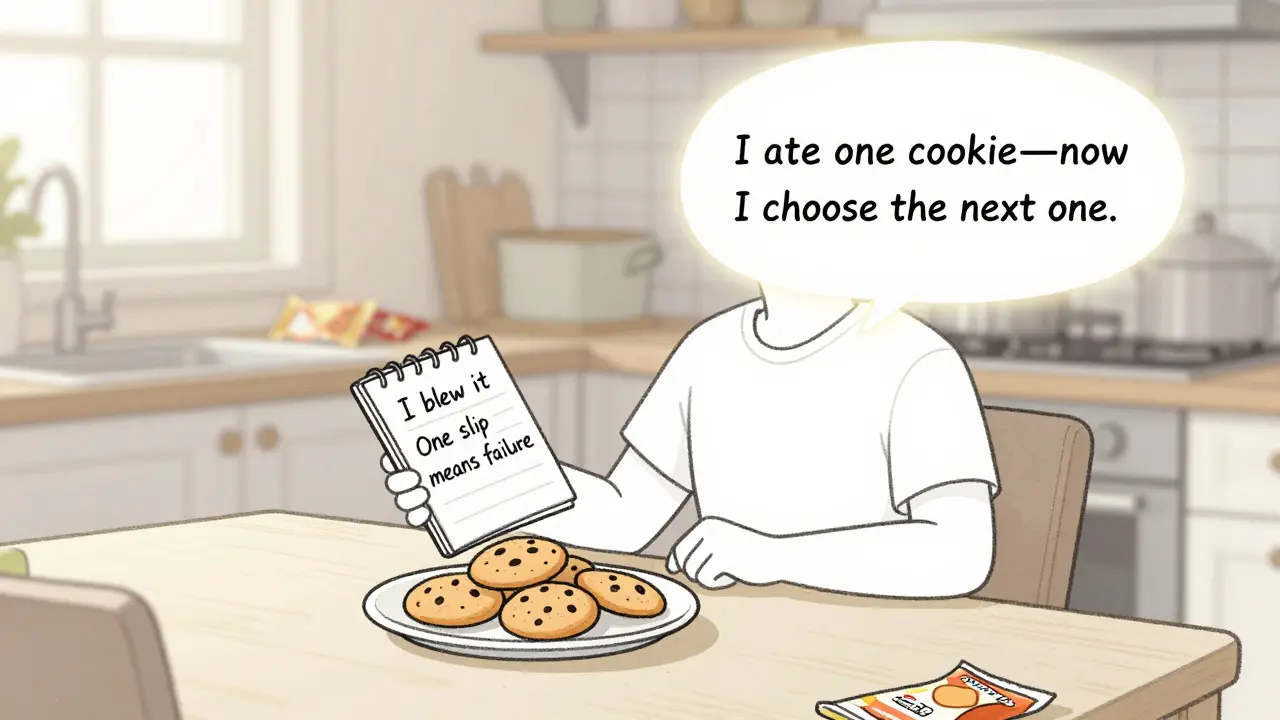
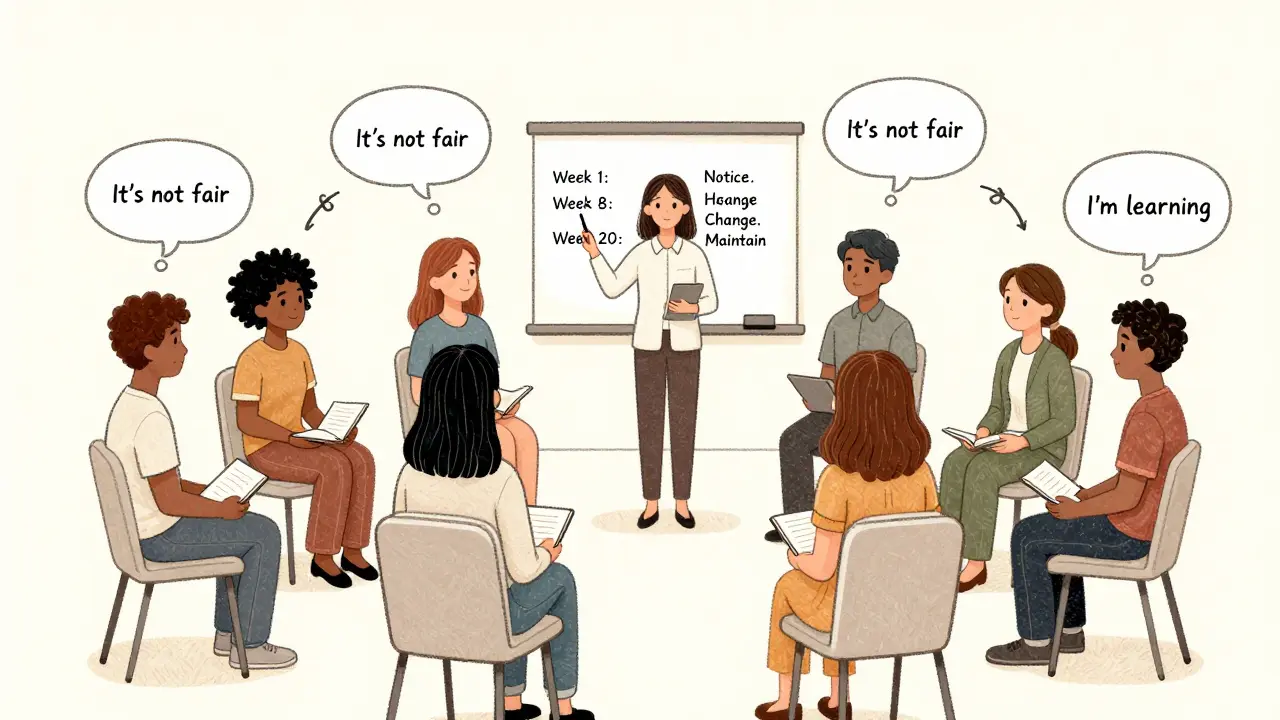
The key difference? CBT tackles the mental noise: "I can’t ever eat that again," "One slip means I’ve ruined everything," "It’s not fair I have to work so hard." These thoughts aren’t just in your head-they drive your actions. Change the thinking, and the behavior follows.
The 6 Cognitive Strategies That Actually Work
Not all therapy is the same. Effective CBT for weight loss uses a focused set of tools backed by years of clinical testing. Here’s what works:
- Cognitive restructuring - When you catch yourself thinking, "I blew it," you don’t just feel guilty-you give up. CBT teaches you to challenge that thought. Instead of "I failed," you ask: "What actually happened? Did I eat one cookie, or did I binge all night?" Most of the time, it’s the former. Rewriting these stories cuts emotional eating by 63%.
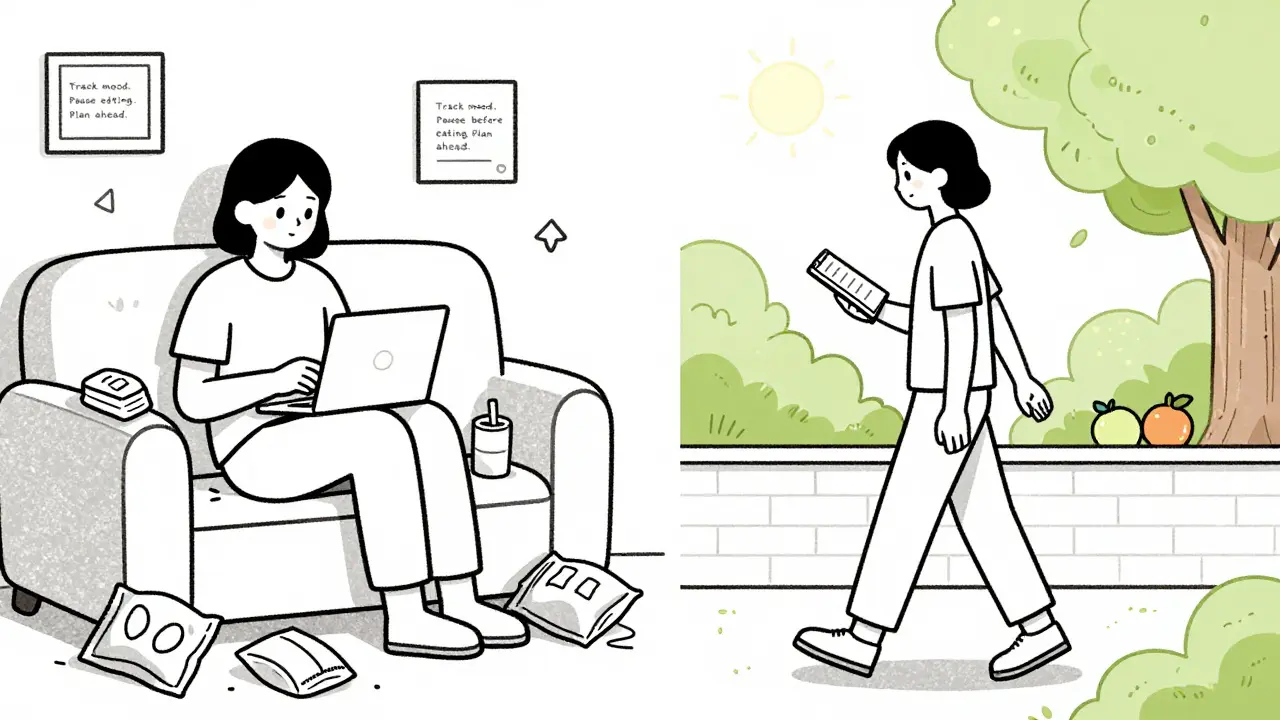
- Self-monitoring - Writing down what you eat isn’t about guilt. It’s about awareness. Studies show people who track meals and moods lose 5-10% more weight than those who don’t. You don’t need fancy apps. A notebook and a pen work fine. The goal isn’t perfection-it’s noticing patterns. Do you snack after work? Eat more when you’re tired? Track it, and you start to see the triggers.
- Stimulus control - Your environment is your biggest ally or enemy. If your kitchen is full of snacks, you’ll eat snacks. If your couch is where you scroll and snack, you’ll keep doing it. CBT helps you redesign your space: keep fruit on the counter, move the cookies to a high cabinet, leave your phone in another room during meals. Small changes. Big impact.
- SMART goal setting - "Lose weight" is too vague. "Eat three servings of vegetables every day" is specific. "Walk 20 minutes after dinner, four days a week" is measurable. CBT pushes for goals that are realistic, achievable, and tied to behavior-not the scale. Progress isn’t just pounds lost. It’s consistency.
- Problem-solving for high-risk situations - What do you do when your boss takes the team out for pizza? When your partner says, "Just one slice won’t hurt"? CBT doesn’t avoid these moments. It prepares you. You rehearse responses: "I’ll have a salad and one slice, and I’ll savor it." You plan ahead. You don’t wait for willpower to show up.
- Relapse prevention - Slip-ups aren’t the end. They’re data. CBT teaches you to see them as signals, not failures. If you overate, ask: "What was different today? Was I stressed? Sleep-deprived?" Then adjust. This is where most programs fail-they don’t teach you how to get back on track. CBT does.
Who Benefits Most From CBT for Weight Loss?
CBT isn’t for everyone-but it’s life-changing for some. The strongest evidence is for people with binge eating disorder (BED). One study found more than half of BED patients stopped meeting diagnostic criteria five years after CBT. That’s not just weight loss. That’s freedom from compulsive eating.
It also helps people with depression or anxiety. In clinical trials, participants saw a 40% drop in symptoms of both as they lost weight. That’s because emotional eating isn’t just about hunger-it’s about numbness, loneliness, or stress. CBT addresses the root.
It’s also effective for people who’ve had bariatric surgery. Many regain weight after surgery because their thoughts haven’t changed. CBT helps them adjust to new eating habits without falling back into old patterns. One study showed patients’ confidence in staying on track jumped from a 2 to a 7 on a 10-point scale after just a few sessions.
What Doesn’t Work (And Why)
Not every CBT program delivers results. What makes the difference?
First, duration matters. Programs under 12 weeks rarely stick. The most effective ones run 16 to 26 weeks. Why? It takes time to unlearn a lifetime of automatic thinking. Most people don’t master cognitive restructuring until after session six. Without enough time, you’re just scratching the surface.
Second, format matters. In-person CBT has the strongest results-37% more effective than phone or app-based versions. The human connection, the accountability, the ability to read tone and body language-it all adds up. That said, internet-based CBT (ICBT) is catching up. A 2024 study showed online modules still reduced BMI and stress significantly, especially when they included live check-ins.
Third, combining CBT with Motivational Interviewing (MI) boosts outcomes. MI doesn’t push you to change. It helps you find your own reasons to change. That reduces dropout rates by 22%. People stay because they feel heard, not because they’re being told what to do.
Why Most People Still Don’t Get It
CBT is recommended by the American Heart Association and used in 78% of accredited weight programs. But only 32% of U.S. insurance plans cover more than 12 sessions. That’s a huge barrier.
There’s also a shortage of trained specialists. In the U.S., there’s one certified CBT obesity therapist for every 125,000 people who could benefit. Rural areas are especially underserved. That’s why group CBT is growing fast. A 2022 study showed group sessions delivered the same results as one-on-one therapy-at one-third the cost.
And then there are the apps. Noom, WeightWatchers Beyond the Scale-they use CBT principles. But they’re not therapy. A 2023 review found app-based programs led to an average 3.2% weight loss. Therapist-led CBT? 6.8%. The difference isn’t the tools. It’s the relationship. You can’t replace a therapist with an algorithm.
What Comes After Weight Loss?
The biggest myth? That losing weight is the hard part. It’s not. Keeping it off is.
Studies show most people regain 30-35% of lost weight within a year. Why? Because they stop using the tools. They stop journaling. They stop checking their thoughts. They think, "I’ve done it, I can relax." But the brain doesn’t forget old patterns.
That’s why CBT includes long-term maintenance plans. It’s not a 12-week fix. It’s a lifelong skill set. The goal isn’t to be perfect. It’s to be aware. To notice when you’re slipping. To use your tools before you spiral.
Now, researchers are testing CBT alongside new weight-loss drugs like semaglutide. The NIH just funded $14.7 million in trials to see if combining medicine with cognitive strategies can stop weight regain. The early thinking? Medication handles the biology. CBT handles the mind. Together, they’re stronger.
How to Get Started
If you’re ready to try CBT for weight loss:
- Ask your doctor for a referral to a psychologist trained in CBT for obesity.
- Look for programs that last at least 16 weeks and include both cognitive and behavioral components.
- Ask if they offer group sessions-they’re cheaper and just as effective.
- If therapy isn’t accessible, try a structured online CBT program with live support (not just an app).
- Start small: buy a notebook. Write down your thoughts before meals for one week. Notice the patterns.
You don’t need to fix everything at once. Just notice one thought that’s holding you back. Challenge it. Then do it again tomorrow. That’s how change builds.
Is CBT for weight loss just another diet?
No. Diets focus on what to eat. CBT focuses on why you eat. It doesn’t give you a meal plan-it gives you tools to understand your cravings, manage stress without food, and stop self-sabotaging thoughts. You can still enjoy your favorite foods-you just won’t let them control you.
How long does it take to see results from CBT?
Most people start noticing changes in their eating habits within 4-6 weeks. Weight loss typically follows after 8-12 weeks. But the real benefit shows up later-after 6 months, when people who used CBT are still holding onto their weight loss while others have regained it.
Can I do CBT on my own without a therapist?
You can start with workbooks or online programs, but it’s harder. CBT works best with feedback. A therapist helps you spot blind spots-like when you think you’re being "fair" to yourself but you’re actually being harsh. If you can’t afford therapy, look for group programs or digital platforms that include live coaching.
Does CBT work for people who’ve had weight loss surgery?
Yes. Many people regain weight after surgery because their relationship with food hasn’t changed. CBT helps them adjust to new portion sizes, manage emotional triggers, and avoid falling back into old habits. Studies show it improves confidence and long-term success after surgery.
What if I can’t afford therapy?
Start with self-monitoring. Write down what you eat and how you felt before and after. Look for patterns. Use free CBT-based apps like Noom or the NHS’s online weight loss program. Join a support group-many are free and run by community health centers. Progress doesn’t require a pricey therapist-it requires consistency.
Final Thought: It’s Not About Perfection
You don’t need to be perfect to succeed. You just need to be aware. One thought, one meal, one day at a time. The goal isn’t to never want cake again. It’s to want it without feeling like you’ve failed if you eat it. That’s the quiet power of CBT. It doesn’t change your life overnight. But it changes how you live it-every day after that.
All Comments
Kiran Plaha January 6, 2026
I tried counting calories for months. Zero results. Then I started writing down why I ate-bored? tired? stressed?-and suddenly I saw the pattern. It wasn’t the food. It was the noise in my head. This post nailed it.
Matt Beck January 8, 2026
So… you’re saying the real diet is… your THOUGHTS??? 😵💫🤯 Like… is this enlightenment or just fancy psychology? I’m here for it. 🙌
Ryan Barr January 9, 2026
Cognitive restructuring is just self-talk with a PhD. The rest is common sense. But hey, if charging $200/hour for it helps people feel better, who am I to judge?
Cam Jane January 10, 2026
OMG YES. I used to think one cookie meant I was a failure. Then I started catching those thoughts like a bad habit-‘Wait, I just ate ONE. That’s not a binge. That’s a snack.’ And guess what? I stopped bingeing. It’s not magic. It’s just noticing. You don’t need to be perfect. You just need to be aware. And honestly? That’s enough. You’ve got this. 💪
Dana Termini January 12, 2026
I’ve been doing self-monitoring for six months now. Not with an app. Just a notebook. I write down what I ate and how I felt before and after. I didn’t realize I ate more when I was lonely. That was the real trigger. This isn’t about willpower. It’s about understanding yourself. Simple. But powerful.
Wesley Pereira January 13, 2026
CBT my ass. They just call it therapy so you’ll pay for it. I did this on my own with a notebook and zero therapist. And guess what? I lost 40 lbs. You don’t need a degree to notice that stress = snacks. But yeah, if you wanna pay someone to tell you to move your cookies… go for it. 🤷♂️
Isaac Jules January 14, 2026
So let me get this straight… people are too lazy to change their behavior, so we invented a $200/hr therapy to tell them to write stuff down? Brilliant. Just brilliant. The real problem? Society tells people they’re broken so they’ll buy solutions. CBT isn’t therapy. It’s capitalism with a clipboard.
Amy Le January 14, 2026
Why are we even talking about this? In America, we have the best food, the best healthcare, and the worst obesity rates. It’s not the brain. It’s the system. Stop blaming individuals. Fix the food industry. Stop subsidizing corn syrup. Then we’ll talk about CBT.
Pavan Vora January 16, 2026
Wow… this is so true… I am from India… we don’t have ‘diets’ like you… we have ‘sattvic’ eating… but still… the mind… the mind is the real enemy… I used to think… if I eat one samosa… I am a bad person… now I say… one samosa… is just one samosa… 😊
Stuart Shield January 17, 2026
It’s like learning to drive. You don’t just memorize the rules-you learn to read the road. CBT’s the same. It’s not about the food. It’s about reading the traffic in your head. When you’re tired, the road gets foggy. When you’re lonely, the signs get blurry. You don’t need a map. You need awareness. And that? That’s free.
Indra Triawan January 19, 2026
I read this and I just felt… sad. Like… I’ve been fighting this war alone for years. And now you’re telling me I just needed to write stuff down? Like… what’s the point? I’m already tired. I don’t even have the energy to think about thinking.
Susan Arlene January 21, 2026
the thing no one says is… after you lose the weight… you still have to live with yourself. and that’s the real work. not the scale. not the meals. just… being quiet with your own mind.