Pill Burden Reduction Calculator
Current Medication
Results
Enter your current pill count and combination pill count to see your potential reduction.
Your calculation will appear here.
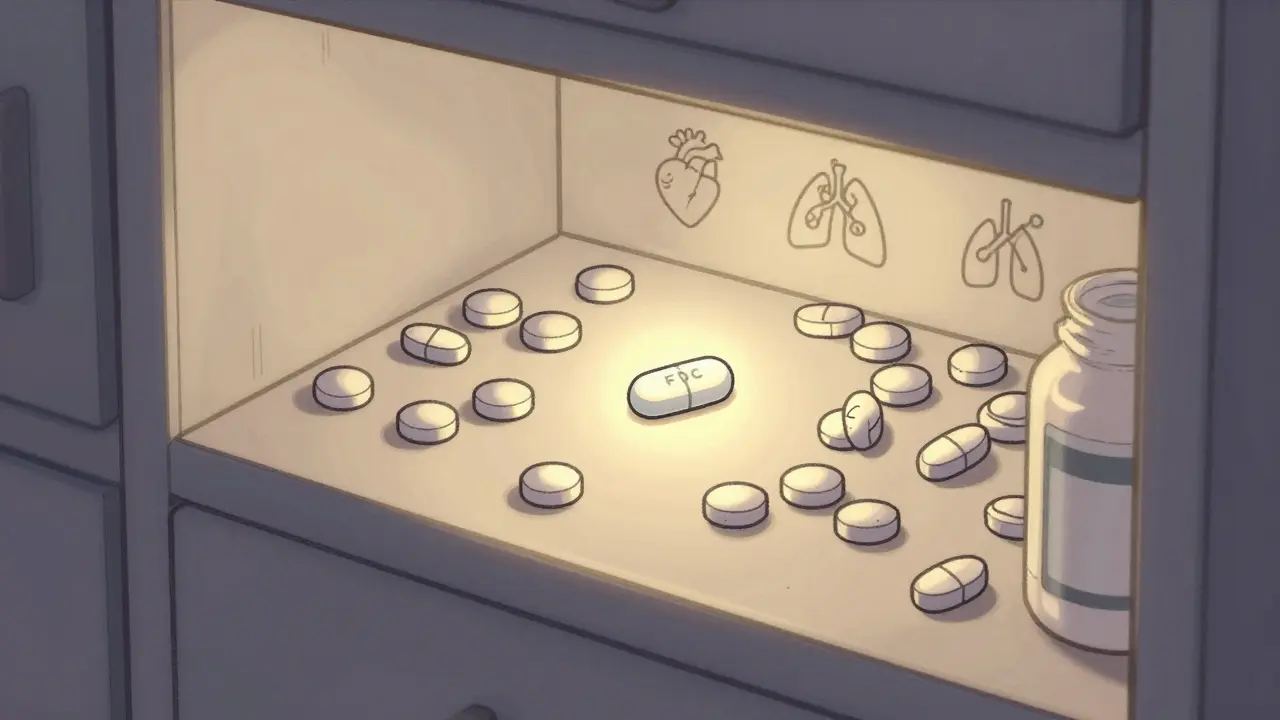
Think about your medicine cabinet. How many pills do you swallow each day? If you’re managing high blood pressure, diabetes, or even tuberculosis, chances are you’re juggling several different tablets. Now imagine if you could take just one pill instead of four. That’s the promise of combination drugs - also called fixed-dose combinations (FDCs). They bundle two or more active ingredients into a single tablet or capsule. For many patients, it’s a game-changer. But behind the convenience lies a hidden cost: increased risk of side effects, inflexible dosing, and even dangerous drug interactions.
Why Combination Drugs Exist
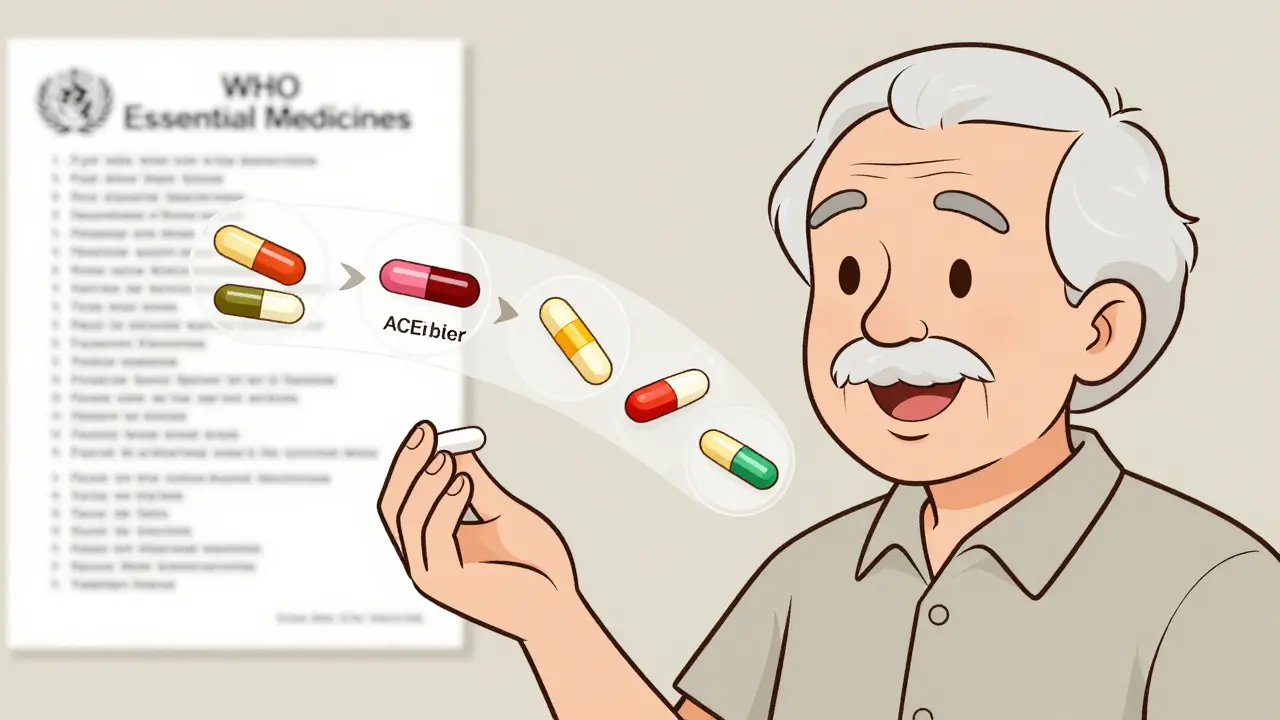
Combination drugs aren’t new. Traditional medicine systems like Chinese herbal formulas have used multi-ingredient remedies for centuries. But modern FDCs started gaining traction in the 1970s with combinations like sulfamethoxazole and trimethoprim for urinary tract infections. These weren’t random mixes - they were carefully designed. The goal? To attack a disease from multiple angles at once.Take tuberculosis. Treating it used to mean swallowing six or seven pills a day. That’s hard to stick with, especially in places with limited healthcare access. The WHO added fixed-dose combinations like rifampicin + isoniazid to its Essential Medicines List because they made treatment simpler. Studies show patients on FDCs are more likely to finish their full course. That’s huge. Incomplete TB treatment leads to drug-resistant strains - a global health crisis.
Same goes for hypertension. High blood pressure rarely has one cause. It’s often tied to fluid retention, narrowed arteries, and overactive nerves. A single pill combining a diuretic, a beta-blocker, and an ACE inhibitor can hit all three targets. Clinical trials confirm these combos lower blood pressure more effectively than single drugs alone. The WHO now lists over a dozen such combinations as essential for basic care.
The Convenience Factor
The biggest win with combination drugs is reducing pill burden. A 2019 study found that patients taking just one pill a day were 30% more likely to stick to their regimen than those taking multiple pills. Less clutter in the medicine cabinet. Fewer missed doses. Better sleep because you’re not worrying about when to take your next tablet.For older adults or those with chronic conditions, this matters. Imagine someone with heart failure, diabetes, and arthritis. They might be on eight different medications. If four of them can be combined into two pills, it cuts their daily routine in half. That’s not just convenience - it’s life-changing. It reduces confusion, lowers the chance of dangerous mistakes, and improves quality of life.
Even in cancer treatment, combination therapies are standard. Chemotherapy regimens often use three or four drugs together because cancer cells adapt quickly. Hitting them with multiple mechanisms at once slows resistance. That’s why FDCs are now being explored for rare diseases too. Companies are using AI to find new rational pairings - drugs that work well together but weren’t obvious before.
The Hidden Risks
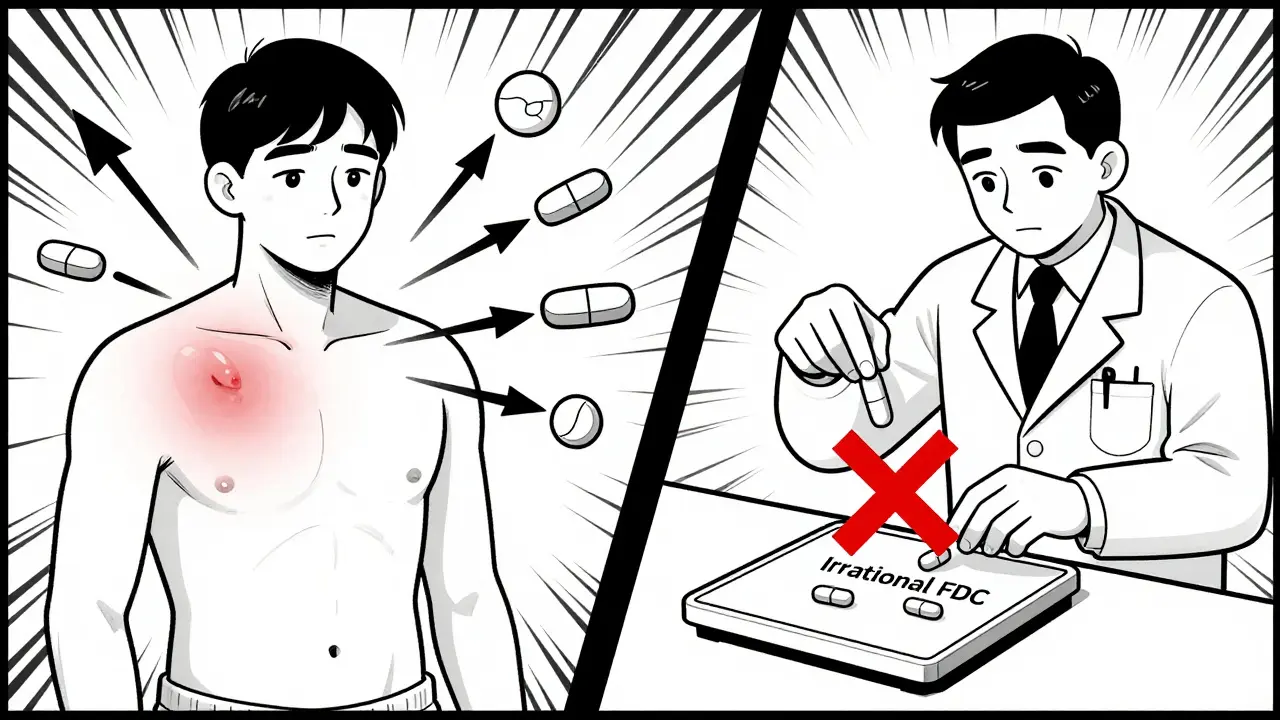
But here’s the catch: when you combine drugs, you lose control. If one ingredient causes an allergic reaction - say, a rash from the diuretic in your blood pressure pill - you can’t just stop that one part. You have to stop the whole pill. That means abandoning the benefits of the other components too. No middle ground.What if your kidney function drops? Your doctor needs to lower the dose of one drug in the combo. But since the doses are fixed, you can’t adjust them separately. You might have to switch entirely to individual pills, which defeats the whole purpose.
Then there’s the risk of drug interactions. Two drugs that are safe alone might become dangerous together. For example, combining certain blood pressure meds with NSAIDs like ibuprofen can spike potassium levels or damage kidneys. In FDCs, these risks aren’t always obvious to patients. They don’t realize they’re now taking two drugs at once - and that one might be interacting with something else they’re on.
And not all combinations are created equal. In countries like India, regulators have banned hundreds of FDCs because they were irrational - meaning there was no proven benefit, or the doses didn’t match clinical guidelines. Some contained outdated antibiotics or useless additives. These weren’t helping. They were fueling antimicrobial resistance - a silent pandemic the WHO calls one of the top global health threats.
Regulation: A Patchwork System
In the U.S., the FDA treats combination drugs as unique products. Even if each ingredient was approved separately, the combo must prove its own safety and effectiveness. That’s good. It means the agency looks at how the drugs interact, not just that they’re both legal on their own.But in other places, oversight is weaker. Some manufacturers exploit loose rules to push out combinations that offer no real advantage - just a new patent or higher profit margin. The FDA has cracked down on these, especially in recent years. Guidance documents from 2015 and later require stronger data before approving any new FDC. Still, enforcement varies globally.
Compare that to compounded medications - custom mixes made by pharmacists for individual patients. These aren’t FDA-approved. They’re used when someone can’t swallow pills, needs a dye-free version, or requires a specific dose not available commercially. But unlike FDCs, they’re not mass-produced. They’re made one at a time, with strict quality controls in place. That’s a big difference.
When Combination Drugs Work - And When They Don’t
Not all FDCs are smart. The key is whether the combination is rational. The WHO and FDA agree on three rules:- The drugs should work through different biological pathways.
- They should have similar half-lives - meaning they stay active in the body for about the same amount of time.
- There should be no added risk of toxicity when taken together.
Good examples: levodopa + carbidopa for Parkinson’s. Carbidopa stops levodopa from breaking down too fast in the gut, so more reaches the brain. That’s a smart pair. Or the HIV combo tenofovir + emtricitabine - both attack the virus at different points, reducing resistance.
Bad examples? Antibiotic combos without clear evidence. Or pills mixing a statin with a vitamin D supplement - no proven synergy, just marketing. These don’t improve outcomes. They just make it harder to spot side effects later.
What Patients Should Ask
If your doctor prescribes a combination drug, don’t just accept it. Ask:- Why this combo? Is there evidence it works better than taking the drugs separately?
- Can I still adjust doses if my condition changes?
- What happens if I develop a reaction to one ingredient?
- Is this on the WHO Essential Medicines List? That’s a good sign.
Also, keep a list of all your medications - including over-the-counter ones - and bring it to every appointment. Many dangerous interactions happen because doctors don’t know what else you’re taking.
The Future of Combination Drugs
The trend is clear: more complex diseases need multi-targeted treatments. FDCs will keep growing - but only the smart ones. Researchers are using AI to predict which drug pairs will work best together, based on genetic profiles and disease pathways. Clinical trials are now designed to test combinations from the start, not as an afterthought.Regulators are tightening rules. The WHO’s next Essential Medicines List, due in 2025, will likely include more evidence-based FDCs and remove outdated ones. The goal isn’t to ban combination drugs - it’s to ban the bad ones.
For patients, the message is simple: convenience shouldn’t come at the cost of safety. A well-designed FDC can save your life. A poorly designed one can put it at risk. Know the difference. Ask questions. And don’t let marketing convince you that more ingredients equals better care.
All Comments
Ron Williams December 15, 2025
Been on a combo pill for hypertension for years. Honestly? Life’s easier. No more pill organizer chaos. But I did have to switch when my kidneys started acting up - couldn’t tweak the dose. That’s the real trade-off.
Still, if your doc knows what they’re doing, it’s a win.
Kitty Price December 17, 2025
One pill = one less thing to stress about 😌
Randolph Rickman December 17, 2025
Let’s be real - combination drugs saved my dad’s life after his heart attack. He was taking 11 pills a day. Now it’s three combos and one aspirin. His adherence jumped from 40% to 95%.
Yeah, you can’t adjust doses easily - but that’s why your doctor monitors you. If you’re getting regular labs and check-ins, the benefits massively outweigh the risks. The real danger is people skipping meds because it’s too much to manage.
And don’t get me started on the Indian pharma乱象. Yeah, some combos there are junk - but that’s a regulatory failure, not a flaw in the concept. The FDA’s standards? Spot on. We need more of that globally.
Also, AI-designed combos? That’s the future. Imagine a pill tailored to your genetics, not just your diagnosis. That’s not sci-fi - it’s already in phase 2 trials.
Don’t fear the combo. Fear the lack of oversight. And if your doc can’t explain why they’re prescribing it? Get a second opinion.
Kim Hines December 19, 2025
I stopped taking my combo because I got a rash. Had to go back to three separate pills. Took weeks to figure out which one was the culprit. Not fun.
Mike Smith December 20, 2025
It is imperative that patients approach fixed-dose combinations with a discerning and informed mindset. The pharmaceutical industry, while often well-intentioned, is not immune to profit-driven motivations. One must rigorously evaluate whether the combination adheres to the tripartite criteria established by the World Health Organization: distinct pharmacological pathways, congruent pharmacokinetics, and absence of synergistic toxicity. The efficacy of such formulations is not guaranteed merely by their commercial availability. Therefore, it is incumbent upon the patient to seek clarification from their physician regarding the clinical evidence supporting the specific combination prescribed. Furthermore, the maintenance of a comprehensive, up-to-date medication log - inclusive of over-the-counter agents and dietary supplements - is not merely advisable, but essential for the prevention of iatrogenic harm. The convenience of a single tablet must never supersede the imperative of safety and individualized care.
Aditya Kumar December 21, 2025
Why even bother? Just take the pills. Too much writing for nothing.
Colleen Bigelow December 22, 2025
Big Pharma’s got us all hooked on these ‘magic pills’ - they don’t want you to know you’re basically a lab rat for their patent extensions. One pill? Sure. But what’s really in it? And why does your insurance cover it but not the individual generics? Coincidence? I think not.
They’re hiding side effects, pushing combos that don’t work, and bribing doctors with free vacations to Belize. Read the fine print - the FDA’s been pressured to approve junk. And don’t get me started on how they’re pushing these into developing countries like India - dumping toxic combos under the guise of ‘helping.’
Wake up. It’s not medicine. It’s control.
Billy Poling December 23, 2025
While the article presents a comprehensive overview of the advantages and disadvantages associated with fixed-dose combinations, it is noteworthy that the regulatory disparities between jurisdictions are not adequately contextualized within the broader framework of global public health equity. In low- and middle-income countries, where access to individualized pharmaceuticals is often constrained by economic and infrastructural limitations, the implementation of FDCs represents not merely a therapeutic convenience, but a critical public health intervention. The WHO’s endorsement of such formulations for tuberculosis and hypertension is grounded in epidemiological data demonstrating improved adherence and reduced mortality. To frame these combinations as inherently risky without acknowledging the systemic failures that necessitate their use is to privilege the regulatory luxury of high-income nations over the survival imperatives of populations with limited healthcare infrastructure. Furthermore, the suggestion that patients should routinely question the rationality of their prescriptions, while theoretically sound, assumes a level of medical literacy and access to specialist care that is not universally available. A more balanced discourse would recognize that FDCs are not merely pharmaceutical products - they are sociopolitical tools of health justice.
SHAMSHEER SHAIKH December 24, 2025
As a pharmacist in Mumbai, I’ve seen both sides: the miracle of FDCs for TB patients who used to forget 5 pills a day - and the horror of unregulated combos sold in roadside stalls with expired antibiotics. The WHO guidelines are clear. But enforcement? Weak. Patients don’t know the difference between a rational combo and a marketing gimmick.
And here’s the truth: if a combo has no clinical trial data backing it, it shouldn’t be sold. Period.
AI-driven drug pairing? Yes. But only if it’s peer-reviewed, not just coded by a startup with $20k in funding.
Patients need education, not just pills. Doctors need training. Regulators need teeth. And manufacturers? They need to stop treating medicine like a soda brand.
James Rayner December 25, 2025
I think about how medicine used to be… you’d go to the healer, they’d mix herbs by hand, watch how you responded, adjust. Now we get a factory-made pill with three drugs in it - and we’re supposed to trust it because it’s ‘evidence-based’?
It’s not that I distrust science - I just wonder if we’ve lost the art of listening to the body.
Maybe the combo works… but what if the body’s trying to tell us something by reacting to one ingredient? We just cut it out and call it ‘non-compliance.’
Convenience is a beautiful lie.
…I still take mine, though. I’m not brave enough to go back to six pills.
Souhardya Paul December 26, 2025
My mom’s on a combo for diabetes and high blood pressure. She loves it - says she forgets less. But last month she had a weird tingling in her feet. Turns out it was the combo interacting with her new fish oil. Took two weeks to untangle.
So yeah, combos are great - but they need better labeling. Like, a little icon on the bottle: ‘This pill contains two drugs. If you feel weird, don’t assume it’s just aging.’
Also, why can’t we have combo pills with a ‘split option’? Like, if you need to drop one ingredient, you can just pop it open and take half? Maybe that’s too sci-fi.
Josias Ariel Mahlangu December 28, 2025
Combination drugs are a Western luxury. In South Africa, we’re lucky to get one pill, let alone three. Don’t lecture us about risks when your biggest problem is forgetting to take your pill.
anthony epps December 29, 2025
so like… if i take a combo pill and feel weird, do i just stop the whole thing? even if only one part is bad?