Imagine a world where every time you needed a new medication, you had to pay the full price because no cheaper alternative existed. That was the reality in the United States before a specific legal framework changed everything. Today, when you pick up a prescription at your local pharmacy, there is a high chance it is a generic version of a brand-name drug. This shift didn't happen by accident. It was built on a solid legal foundation rooted in the Federal Food, Drug, and Cosmetic Act, commonly known as the FD&C Act.
The FD&C Act is the primary law that empowers the Food and Drug Administration (FDA) to protect public health. While most people know this act for ensuring food safety or approving new vaccines, its role in creating the modern generic drug market is just as critical. Without these laws, the pharmaceutical industry would look very different-likely more expensive and less accessible for millions of patients.
From Tragedy to Regulation: The Birth of the FD&C Act
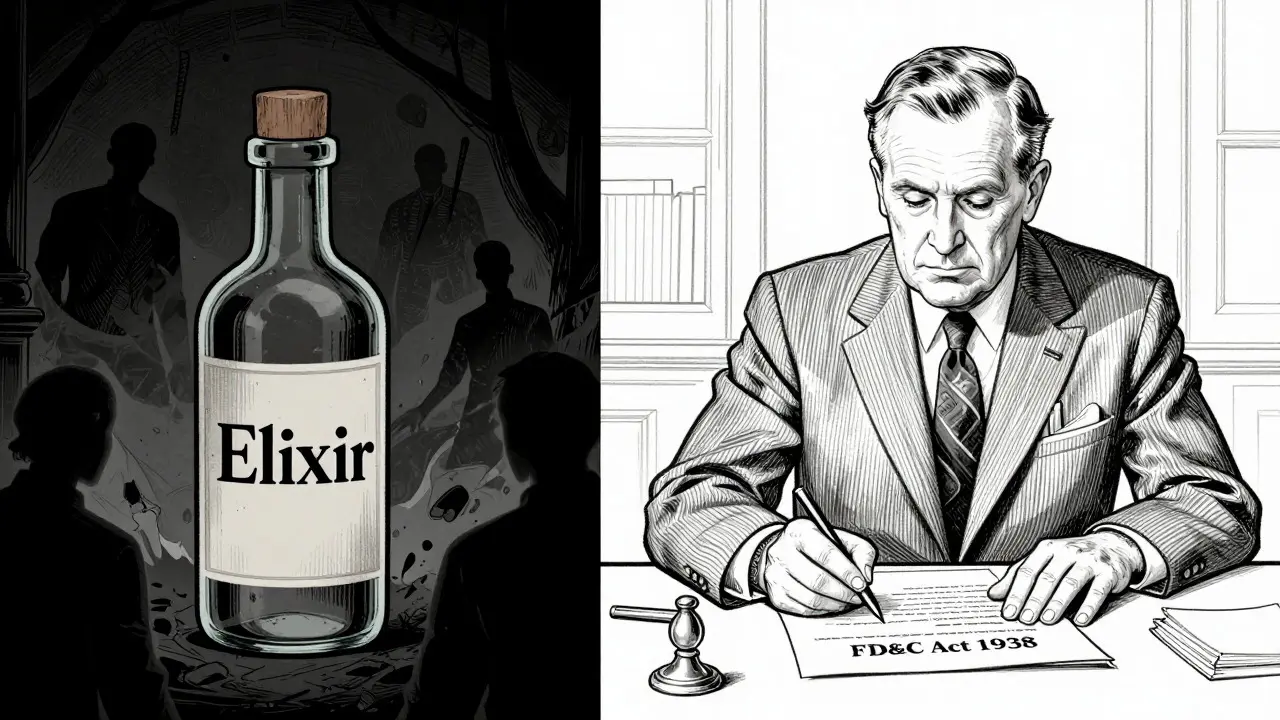
To understand why generics exist today, we have to go back to 1938. Before this year, drug manufacturers in the U.S. did not need to prove their products were safe. They could sell almost anything they wanted. This changed dramatically after the Elixir Sulfanilamide tragedy. A company marketed an antibiotic dissolved in diethylene glycol, which is essentially antifreeze. Over 100 people died across 15 states.
This disaster shocked the nation and led President Franklin D. Roosevelt to sign the Federal Food, Drug, and Cosmetic Act into law on June 25, 1938. For the first time, manufacturers had to prove a new drug was safe before selling it. However, this original act did not mention generic drugs. In fact, the concept of "generic" medications as we know them today did not exist yet. The law focused solely on preventing unsafe products from reaching consumers.
For decades, the system worked for safety, but it created a bottleneck for competition. Brand-name companies held patents that gave them exclusive rights to sell their drugs. When those patents expired, other companies wanted to make cheaper versions. But here was the problem: under the old rules, a generic manufacturer had to repeat all the expensive clinical trials to prove safety again. This made developing a generic drug prohibitively costly, so few companies tried it.
The Game Changer: Hatch-Waxman Amendments
If the 1938 FD&C Act built the house, the Hatch-Waxman Amendments added the rooms where generics live. Officially called the Drug Price Competition and Patent Term Restoration Act of 1984, this legislation completely transformed the legal landscape. Named after Senator Orrin Hatch and Representative Henry Waxman, these amendments added Section 505(j) to the FD&C Act.
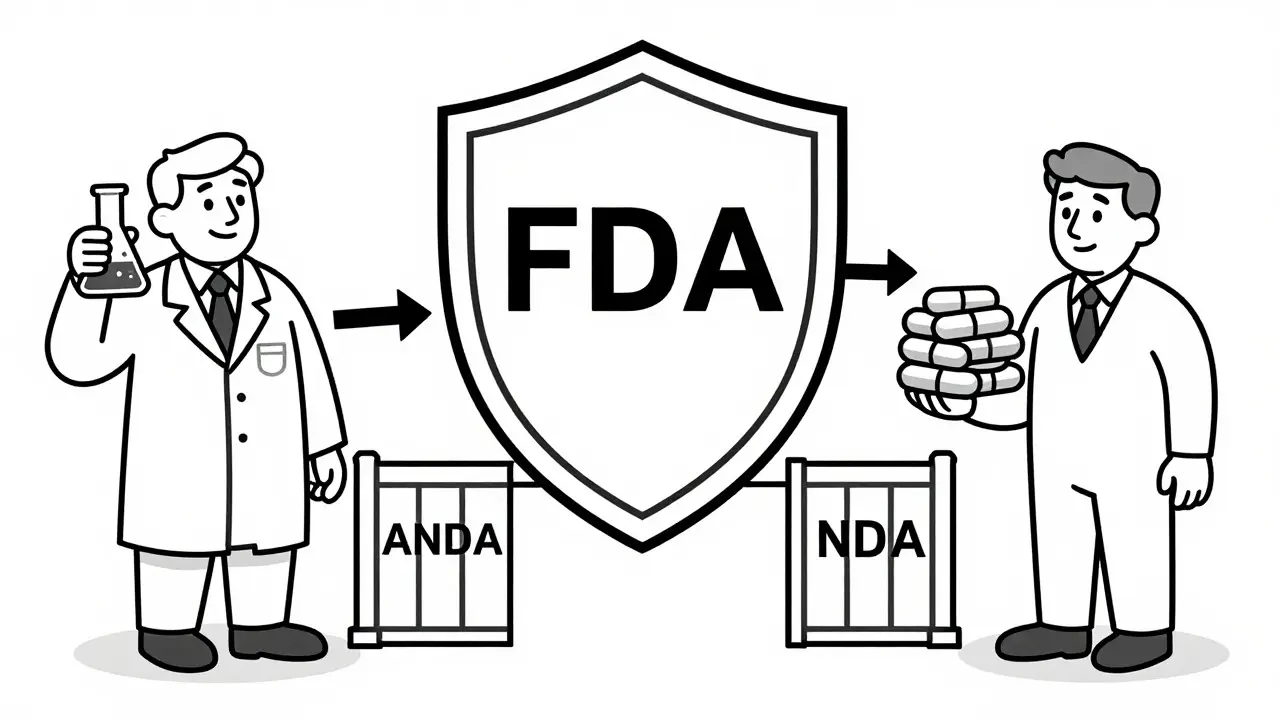
Before 1984, if you wanted to sell a generic version of a popular heart medication, you had to run your own large-scale human trials. You needed to prove the drug was safe and effective from scratch. This cost hundreds of millions of dollars and took years. The Hatch-Waxman Amendments solved this by creating the Abbreviated New Drug Application (ANDA) pathway.
Under the ANDA process, a generic manufacturer does not need to repeat clinical trials. Instead, they must prove two things: pharmaceutical equivalence and bioequivalence. Pharmaceutical equivalence means the generic has the same active ingredient, strength, dosage form, and route of administration as the brand-name drug. Bioequivalence means the generic works in the body at the same rate and extent as the brand name. Scientists measure this using pharmacokinetic studies, looking at metrics like Cmax (peak concentration) and AUC (area under the curve). If the 90% confidence intervals fall within 80-125% of the reference product, the generic is considered equivalent.
| Feature | New Drug Application (NDA) | Abbreviated New Drug Application (ANDA) |
|---|---|---|
| Purpose | Approve a new brand-name drug | Approve a generic copy of an existing drug |
| Clinical Trials | Required (Phase I-III) | Not required (relies on prior data) |
| Key Requirement | Safety and Efficacy | Bioequivalence and Pharmaceutical Equivalence |
| Cost | $500 million - $2 billion+ | $1 million - $5 million |
| Legal Basis | Section 505(b) of FD&C Act | Section 505(j) of FD&C Act |
How Patents and Exclusivity Work Together
The Hatch-Waxman Amendments didn't just help generic makers; they also protected innovators. It was a delicate balance. Brand-name companies argued that without patent protection, they wouldn't invest billions in research. Generic companies argued that without a clear path to market, prices would stay too high. The solution was a complex web of patents and exclusivity periods.
Brand-name manufacturers must list their relevant patents in the FDA's Orange Book, officially titled Approved Drug Products with Therapeutic Equivalence Evaluations. This book serves as the central database for drug approval status. When a generic company files an ANDA, they must certify against these patents. There are four types of certifications, known as Paragraph I through IV certifications.
A Paragraph IV certification is the most aggressive. It claims the brand-name patent is invalid, unenforceable, or will not be infringed by the generic. If a brand-name company sues the generic maker over this claim, a 30-month stay begins. During this time, the FDA cannot approve the generic while the courts decide the patent dispute. This period allows both sides to litigate without rushing the approval process.
To encourage generic companies to take this risk, the law offers a massive reward: 180 days of marketing exclusivity. The first generic applicant to successfully challenge a patent gets sole access to the generic market for six months. During this time, no other generic can enter. This exclusivity period is worth billions of dollars, incentivizing companies to tackle tough patent cases. It creates a race to the courthouse, which ultimately benefits consumers by bringing lower-priced options to market sooner.
The Impact on Healthcare Costs
Has this legal framework actually worked? The numbers say yes. According to FDA data cited in their 40th Anniversary report, before the Hatch-Waxman Amendments, generic drugs accounted for only about 19% of prescriptions filled. Today, that number is around 90%. More importantly, generics represent only about 17% of total pharmaceutical spending. This means the vast majority of medications Americans take are significantly cheaper than their brand-name counterparts.
The Federal Trade Commission estimated that the generic drug system saved consumers approximately $2.2 trillion over a recent decade. These savings ripple through the entire healthcare system, reducing costs for insurance companies, Medicare, and individual patients. Without the FD&C Act's amendment structure, many chronic conditions would be much harder to manage financially.
However, the system isn't perfect. Experts like Dr. Aaron Kesselheim from Harvard Medical School point out that some brand-name companies use tactics to delay generic entry. Strategies like "evergreening" involve filing new patents for minor changes to a drug, such as a new coating or delivery method, to extend market exclusivity. Others use "citizen petitions" to ask the FDA to pause approvals based on safety concerns, sometimes stalling competition for years. These loopholes highlight the ongoing tension between innovation incentives and public access.
Modern Challenges and Future Directions
The legal foundation laid by the FD&C Act continues to evolve. One major issue today is complex generics. Simple pills are easy to replicate. But what about inhalers, injectables, or nasal sprays? These products require special devices or formulations that are harder to match exactly. The original Hatch-Waxman framework was designed for small-molecule oral tablets. Adapting it for complex products has been slow.
In response, Congress passed the CREATES Act in 2019. This law addresses "product hopping," where brand manufacturers switch patients to a new formulation before generics can launch, effectively locking out competition. The CREATES Act requires brand companies to provide samples of their drugs to generic applicants unless they can prove significant safety risks. This helps ensure generic developers have the materials they need to conduct bioequivalence studies.
The FDA has also updated its review processes through the Generic Drug User Fee Amendments (GDUFA). First enacted in 2012 and reauthorized recently, GDUFA sets strict timelines for reviewing ANDAs. Currently, the FDA aims to approve 95% of standard ANDAs within 10 months. In fiscal year 2022, they achieved a 98% success rate for priority reviews. This speed is crucial for keeping the supply chain healthy and ensuring timely access to affordable medications.
Looking ahead, the FDA's strategic plan focuses on modernizing pathways for complex generics. Draft guidance documents are being developed for ophthalmic suspensions and nasal sprays. As science advances, the legal framework must adapt to keep pace. The core principle remains the same: ensure safety while promoting competition.
Compliance and Enforcement
For companies operating in this space, compliance with the FD&C Act is non-negotiable. The FDA enforces strict Current Good Manufacturing Practices (cGMP). Violations can lead to severe penalties. In recent years, the agency has issued dozens of warning letters to generic manufacturers for issues like inadequate quality control and data integrity problems. Penalties can exceed $1 million per violation, and intentional violations can result in criminal prosecution.
This enforcement ensures that "generic" doesn't mean "lower quality." Every pill leaving a factory must meet the same rigorous standards as the brand-name original. The FDA inspects facilities, reviews data, and monitors adverse events. This oversight maintains public trust in the generic drug system, which relies on the assumption that a $5 generic is just as safe and effective as a $500 brand-name drug.
What is the main difference between the FD&C Act and the Hatch-Waxman Amendments?
The Federal Food, Drug, and Cosmetic Act (FD&C Act) of 1938 established the basic requirement that drugs must be safe before sale. The Hatch-Waxman Amendments of 1984 specifically created the legal pathway for generic drugs by allowing manufacturers to prove bioequivalence instead of repeating full clinical trials. Essentially, the FD&C Act set the stage, and Hatch-Waxman wrote the script for generic competition.
Do generic drugs have to be exactly the same as brand-name drugs?
Yes, in terms of performance. Generic drugs must have the same active ingredient, strength, dosage form, and route of administration. They must also demonstrate bioequivalence, meaning they work in the body at the same rate and extent as the brand-name drug. However, inactive ingredients like dyes or binders may differ, which is why some people notice slight differences in appearance or taste.
What is the Orange Book and why is it important?
The Orange Book is the FDA's official list of approved drug products with therapeutic equivalence evaluations. It includes patent information and exclusivity data for brand-name drugs. Generic manufacturers use it to determine which patents they need to address when filing an Abbreviated New Drug Application (ANDA). It is the central reference point for navigating the legal landscape of drug competition.
Why do some generic drugs take longer to get approved?
Complex generics, such as inhalers, injectables, or extended-release formulations, are harder to replicate than simple tablets. Proving bioequivalence for these products requires more sophisticated testing and analysis. Additionally, if a brand-name company challenges a generic application via a Paragraph IV patent suit, a 30-month stay can delay approval while the legal dispute is resolved.
What happens if a generic drug fails to meet safety standards?
If a generic drug is found to be adulterated or misbranded under the FD&C Act, the FDA can issue warning letters, seize products, or ban manufacturers. Companies face civil penalties of over $1 million per violation. In cases of intentional fraud or endangerment, criminal prosecution is possible. This strict enforcement ensures that all generics meet the same high safety standards as brand-name drugs.