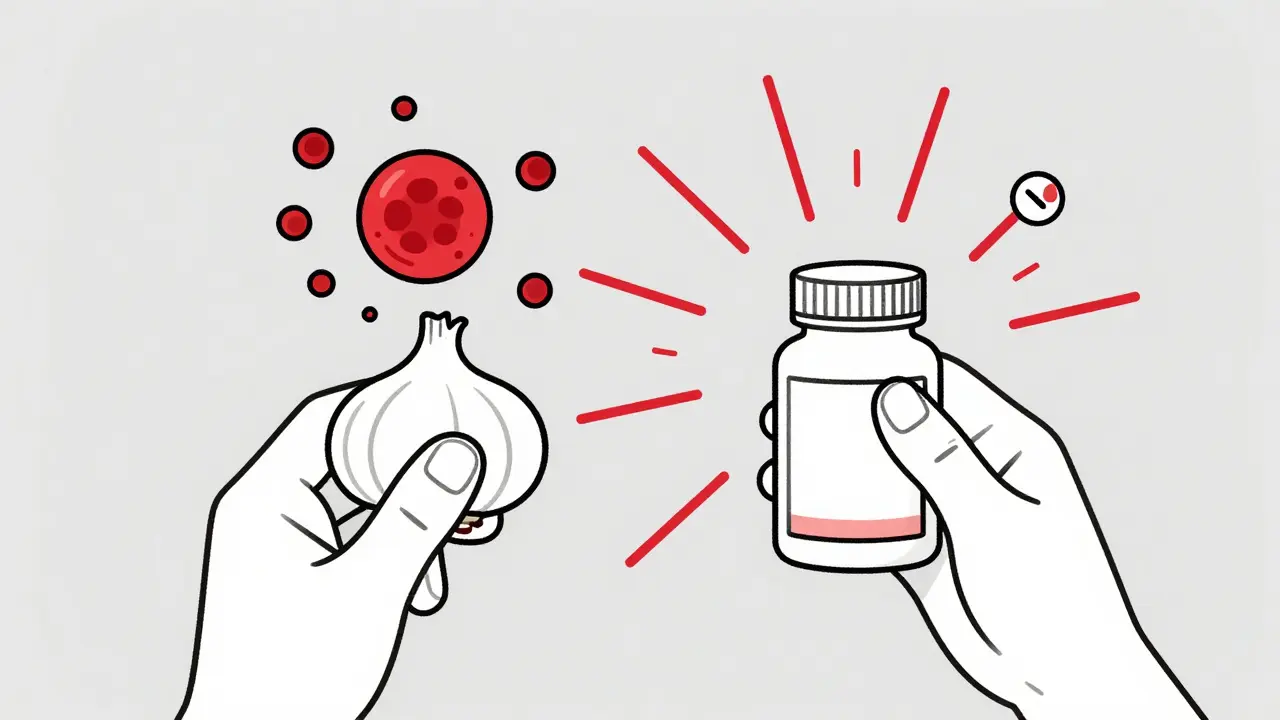
Many people take garlic supplements thinking they’re just boosting heart health or fighting colds. But if you’re on a blood thinner like warfarin, apixaban, or rivaroxaban, that daily pill could be putting you at serious risk. Garlic doesn’t just add flavor to food-it has real, measurable effects on your blood’s ability to clot. And when it meets anticoagulants, the result can be dangerous, even life-threatening bleeding.
How Garlic Affects Your Blood
Garlic contains a compound called ajoene, which is powerful enough to stop platelets from sticking together. Platelets are the tiny cells in your blood that form clots to stop bleeding. When they’re blocked, your blood thins. This is why garlic has been studied for lowering blood pressure and improving circulation. But the same mechanism that helps healthy people can be dangerous for those already on blood thinners.Studies show that standard garlic supplements-usually 600-1,200 mg of dried powder daily-can reduce platelet activity by 20-40%. That’s similar to low-dose aspirin. But unlike aspirin, which is prescribed and monitored, garlic supplements are sold over the counter with no regulation on potency. One brand might have 0.1 mg of ajoene per capsule; another might have 1.0 mg. That’s a tenfold difference. And most people have no idea which one they’re taking.
The effects last a long time, too. Once platelets are inhibited, they stay that way until your body makes new ones-about 7 to 10 days. So even if you stop taking garlic a few days before surgery, the risk doesn’t disappear overnight.
Why This Is a Big Deal With Blood Thinners
Anticoagulants work differently than garlic. Warfarin slows down clotting factors in your liver. DOACs like apixaban block specific proteins in the clotting cascade. Garlic doesn’t directly interfere with those pathways. Instead, it adds another layer of thinning by stopping platelets. When you combine them, you’re hitting the same goal-preventing clots-from two different angles.The outcome? Your INR (a test that measures how long it takes your blood to clot) can jump by 1.0 to 2.5 points. For someone on warfarin, that could push them from a safe range (INR 2.0-3.0) into the danger zone (INR >4.0). At that level, even a minor bump can cause internal bleeding. There are documented cases of people needing emergency surgery because of brain bleeds, spinal hematomas, or uncontrolled bleeding during routine procedures.
One case from 2019 involved an elderly man who developed a spinal epidural hematoma after taking 2,400 mg of garlic daily. He didn’t have any other risk factors. Just garlic and time. He needed emergency spine surgery. Another patient had a nosebleed that lasted over 30 minutes after combining garlic with apixaban. He ended up in the ER.
Who’s at Risk? The Hidden Population
It’s not just older adults on warfarin. About 18% of people over 65 in the U.S. take garlic supplements. And 23% of them are also on anticoagulants. That’s over 3 million Americans at risk-many of whom don’t even realize they’re combining the two.Why? Because most people don’t think of garlic as a supplement. They say, “I just eat garlic,” or “I take a pill for my heart.” They don’t connect it to blood thinners. A 2022 survey found that 83% of garlic supplement users didn’t know it could interact with blood thinners. And 67% never told their doctor about it.
This isn’t just about pills. Garlic oil, garlic extract, aged garlic products-all of them vary in potency. Aged garlic extract has almost no ajoene, so it’s lower risk. But raw garlic powder or oil macerates? Those are the ones with the strongest effects. And labels rarely tell you which kind you’re getting.
What Happens During Surgery?
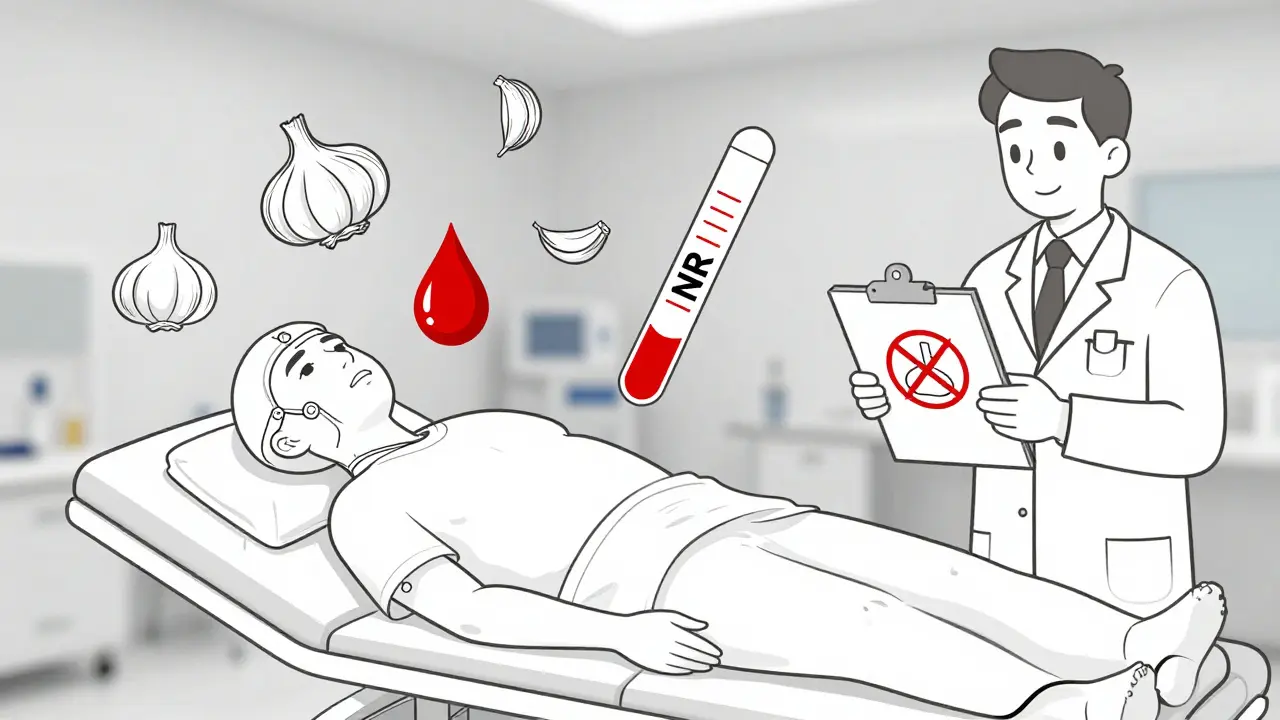
Surgeons and anesthesiologists know this risk well. The American Society of Anesthesiologists lists garlic as a high-risk herbal product that must be stopped at least 14 days before surgery. The European Society of Anaesthesiology says 7 days is enough. But here’s the problem: patients rarely volunteer this information.A 2017 study found that 68% of patients continued taking garlic supplements within 7 days of their scheduled surgery-even after being asked about herbal supplements. Why? Because they didn’t think garlic counted. Or they thought it was “natural,” so it must be safe.
The consequences are real. In colorectal surgery, uncontrolled bleeding can lead to leaks at the surgical site, requiring a colostomy. In prostate or dental surgery, bleeding can be so severe it requires blood transfusions. One case report described a patient who bled for four hours after a routine prostate procedure. He had been taking garlic daily for “cholesterol control.”
How Garlic Compares to Other Supplements
Garlic isn’t the only supplement that thins blood. Ginkgo biloba is stronger, but less commonly used. Fish oil (omega-3s) has mild effects-around 10-20% platelet inhibition. Ginseng and St. John’s wort have some risk, but not as consistent.Garlic’s danger lies in its combination of widespread use, unpredictable potency, and irreversible effect on platelets. Unlike aspirin, which is dosed carefully and monitored, garlic supplements are a wild card. You can’t trust the label. You can’t predict the dose. And you can’t assume it’s safe just because it’s “natural.”
What Should You Do?
If you’re on a blood thinner:- Stop all garlic supplements at least 7-14 days before any surgery, dental work, or invasive procedure. Ask your doctor which timeline to follow.
- Don’t assume aged garlic is safe. Even if it’s labeled “ajoene-free,” there’s no guarantee. Stick to whole food garlic in cooking if you want flavor.
- Tell your doctor-every time. Say “I take garlic pills” or “I use garlic oil.” Don’t say “I eat garlic.” Be specific.
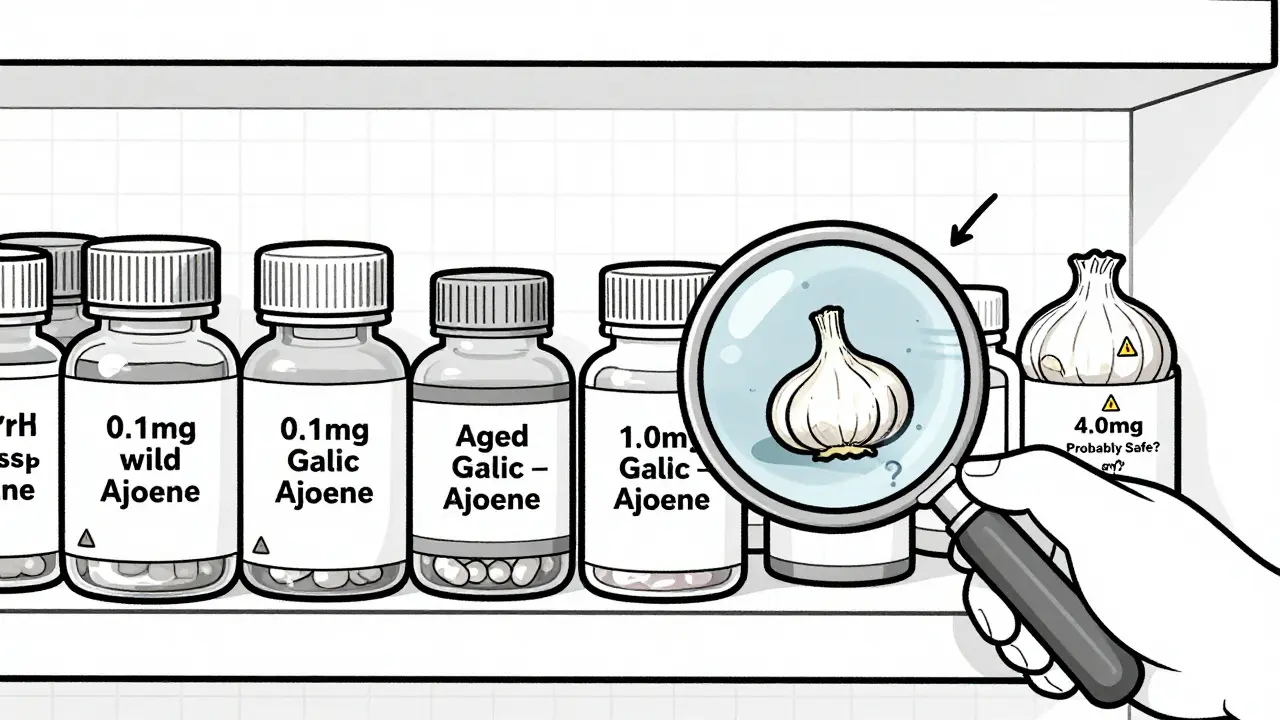
- Check your supplement labels. Look for “ajoene,” “allicin,” or “standardized extract.” If it doesn’t say, assume it’s high risk.
- Monitor your INR weekly if you’re on warfarin and accidentally continue garlic. A sudden spike means trouble.
If you’re not on anticoagulants but take garlic for heart health, talk to your doctor before starting. The blood pressure benefit is modest-about 7-8 mmHg systolic-and not enough to justify the risk if you’re ever prescribed a blood thinner later.
The Bigger Problem: Lack of Regulation
The FDA doesn’t require garlic supplements to list ajoene content. A 2019 FDA warning pointed out that potency varies by up to 15 times between brands. Only 42% of manufacturers follow labeling standards. And only 37% even reference the NIH’s LiverTox database, which tracks these interactions.There’s progress. The FDA is drafting new rules for standardized labeling, expected in 2024. Some companies are now making “ajoene-free” garlic products. But until those rules are enforced, you can’t rely on the label. You have to assume every garlic supplement has the potential to thin your blood.
Final Reality Check
Yes, some people take garlic supplements for years with no issues. A 2021 survey of 412 users found 78% reported no bleeding problems. But here’s the catch: only 12% of them were on blood thinners. The people who had problems? They weren’t surveyed. They were in the ER.The risk isn’t theoretical. It’s documented in peer-reviewed journals, operating rooms, and emergency departments. And it’s growing. With garlic supplement sales hitting $1.27 billion in 2022-and anticoagulant use rising fast-this interaction is becoming a public health issue.
There’s no magic number that says “safe.” There’s no dose that’s guaranteed harmless. The only safe approach is to avoid garlic supplements entirely if you’re on anticoagulants. Not because garlic is evil. But because your blood needs predictable control. And garlic, in supplement form, is anything but predictable.
All Comments
Ellie Norris February 1, 2026
just had my mom tell me she’s been taking garlic pills for her ‘cholesterol’ for 3 years while on warfarin… i freaked out and made her stop. she said ‘but it’s natural!’ like that means it’s not going to turn her into a human pincushion. yikes.
Vatsal Srivastava February 2, 2026
the real issue isn’t garlic it’s that people think ‘natural’ = safe. if it was a pharmaceutical company selling this shit with 15x potency variance they’d be sued into oblivion. but nope, it’s just ‘herbal wellness’ and we all just shrug
clarissa sulio February 2, 2026
so let me get this straight-some guy in india takes garlic pills and now the whole american medical system has to change its protocols? we got real problems like opioid overdoses and gun violence and this is what we’re panicking about? grow up
Hannah Gliane February 3, 2026
oh wow you mean that ‘miracle cure’ you bought at the gas station next to the energy drinks and fake gold necklaces can actually KILL YOU?? shocking. 🤦♀️
Murarikar Satishwar February 4, 2026
the science here is solid and the real tragedy is that this isn’t a rare case-it’s systemic. patients aren’t being asked about supplements during intake. doctors assume they’re ‘just eating garlic.’ but supplements aren’t food. they’re unregulated drugs with invisible dosing. we need mandatory labeling and patient education. this isn’t alarmism-it’s basic safety.
Bob Hynes February 5, 2026
my grandpa in toronto took garlic for 15 years, never had a problem. then he had a knee replacement and nearly bled out because he didn’t tell the surgeon. he said ‘i thought they knew.’ they didn’t. now he’s fine but he doesn’t touch the stuff anymore. just… tell your doc. it’s that simple.
Marc Durocher February 5, 2026
so… if i eat 3 cloves of roasted garlic with my pasta, am i gonna die? because that’s what i do every sunday. or is this only about the ‘supplements’? because i’m confused now
Akhona Myeki February 7, 2026
the FDA’s incompetence is why this is even a problem. in south africa, herbal products must be registered, labeled with active compounds, and include interaction warnings. here? you buy garlic pills and pray. this is not healthcare. this is carnival medicine.
Gary Mitts February 8, 2026
stop taking pills. eat garlic. problem solved.
Brittany Marioni February 8, 2026
PLEASE-everyone reading this-tell your doctor, your pharmacist, your dentist, your yoga instructor, your cousin who ‘knows a guy’ who sells ‘premium garlic extract’-tell them. write it down. put it in your medical app. don’t assume they’ll ask. don’t assume it’s ‘no big deal.’ your life isn’t a gamble. this isn’t ‘alternative medicine’-it’s preventable harm.
Monica Slypig February 9, 2026
obviously the solution is to ban garlic supplements. like we did with ephedra. if it can kill you and it’s sold without a prescription-it’s not a supplement. it’s a weapon. and the fact that we still allow this is a national disgrace.