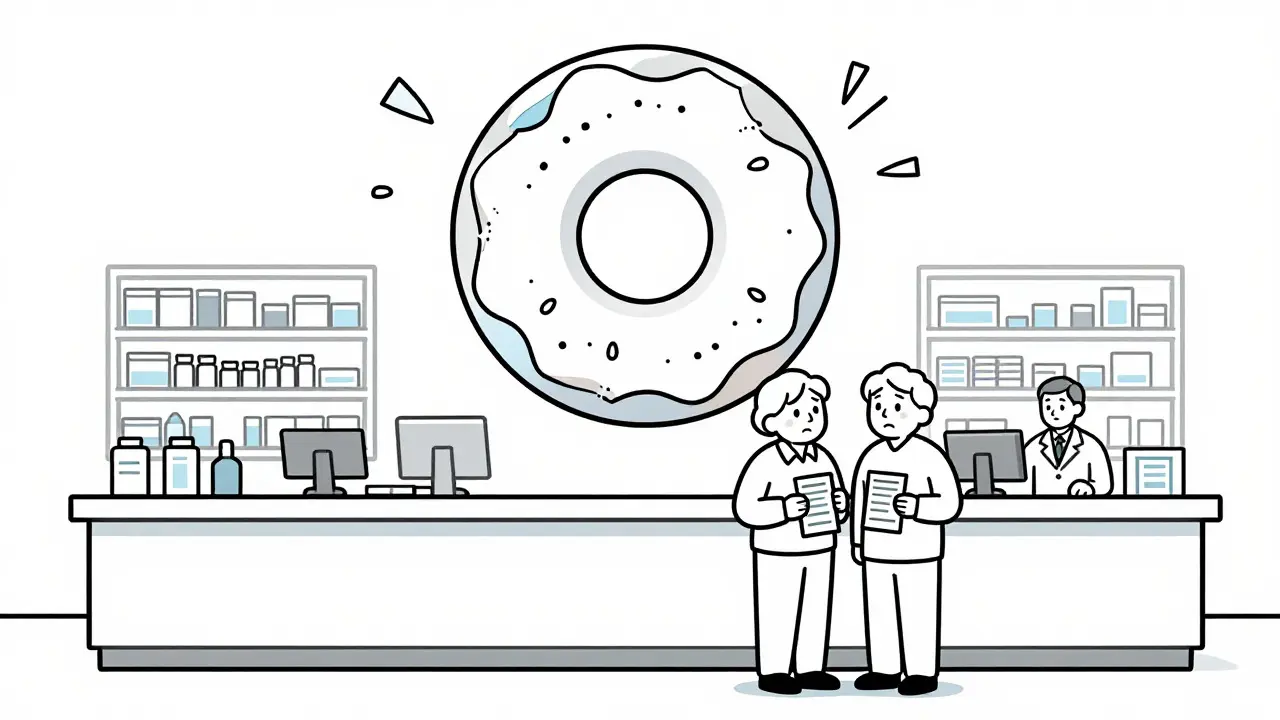
Walking into a pharmacy and seeing your copay jump from $15 to over $100 is a shock many seniors dread. For years, this spike was tied to the Medicare Part D coverage gap, commonly known as the the 'donut hole,' a phase where beneficiaries paid higher out-of-pocket costs for prescriptions after reaching initial coverage limits but before catastrophic coverage kicked in. If you are managing prescriptions in 2026, the landscape has changed significantly. The Inflation Reduction Act eliminated the traditional high-cost burden of the donut hole starting in January 2025, capping your annual out-of-pocket spending at $2,000. However, understanding how this new structure works-and knowing which strategies still apply-is crucial to avoiding unexpected bills.
The New Reality: What Changed in 2025?
Before diving into tactics, it helps to understand what actually happened to the "hole." Under the old rules, once you hit a certain spending threshold (around $4,660 in 2023), you entered a phase where you paid a larger share of drug costs. Now, that distinct penalty phase is gone. Instead, the system operates on a simpler three-phase model:
- Deductible Phase: You pay the full cost of covered drugs up to your plan’s deductible (capped at $590 in 2025).
- Initial Coverage Phase: Your plan pays most of the cost, and you pay a smaller share until your total out-of-pocket spending hits $2,000.
- Catastrophic Coverage Phase: Once you spend $2,000 out of pocket, you pay little to nothing for the rest of the year.
This shift means the "donut hole" no longer acts as a financial cliff. Yet, confusion remains. Many people still refer to the period between the deductible and the $2,000 cap as the "gap," even though the harsh cost-sharing rules have been removed. The key takeaway? Your maximum yearly bill for covered prescriptions is now hard-capped at $2,000, regardless of how much your medications cost in the hospital or at the pharmacy.
Strategies to Keep Costs Below the Cap
Even with a $2,000 ceiling, hitting that number early in the year can strain a budget. Here are practical ways to stretch your coverage further.
1. Verify Your Formulary Tier
Not all drugs cost the same under your plan. Each Part D plan has a formulary-a list of covered drugs divided into tiers. Generic drugs usually sit in Tier 1 or 2, costing you the least. Brand-name drugs often land in Tier 3 or 4, where your share of the cost is higher. Check your plan’s specific formulary online or call their member services line. If your doctor prescribes a brand-name drug that has a generic equivalent, ask about switching. A 2023 analysis by GoodRx found that switching to generics for common conditions could save patients between $1,200 and $2,500 annually.
2. Leverage Manufacturer Assistance Programs
If you must stay on a brand-name medication, look into patient assistance programs (PAPs) offered by pharmaceutical companies. These programs can reduce your out-of-pocket costs by 63% to 92%. For example, a beneficiary taking Repatha for cholesterol reported dropping their monthly cost from $560 to just $5 during a previous coverage gap by using Amgen’s assistance program. Most major manufacturers, including those for Humira and Eliquis, offer these programs. They typically require proof of income and insurance status, so keep your recent bank statements handy.
3. Use Mail-Order Pharmacies for 90-Day Supplies
Many plans offer lower copays if you fill prescriptions through a mail-order service rather than a local pharmacy. By ordering a 90-day supply instead of a 30-day one, you not only reduce the number of trips to the pharmacy but also often lower the per-month cost. Medicare data suggests this strategy can reduce copays by 15% to 25%. Just be careful not to buy extra months’ worth of medication in advance, as unused pills can expire or create confusion when your plan resets.
Who Qualifies for Extra Help?
If your income is low, you might qualify for Extra Help, also known as the Low-Income Subsidy (LIS). This federal program helps pay for premiums, deductibles, and copays. In 2023, over 12 million beneficiaries qualified. If you receive Extra Help, your out-of-pocket costs are capped at a much lower amount-often less than $1,000 per year depending on your income level. To apply, you can contact Social Security directly or use the Medicare Plan Finder tool. It’s a free application, and approval can take a few weeks, so do it early in the year if you think you might qualify.
| Phase | Old Structure (Pre-2025) | New Structure (2025+) |
|---|---|---|
| Deductible | Up to $505 (2024) | Up to $590 (2025) |
| Initial Coverage | Plan pays ~75%, you pay ~25% | Plan pays majority, you pay minority until $2,000 OOP |
| Coverage Gap | You pay 25% of brand/generic costs | Eliminated; continuous coverage toward $2,000 cap |
| Catastrophic Coverage | Triggered at ~$8,000 total spending | Triggered at $2,000 out-of-pocket spending |
| Max Annual Out-of-Pocket | ~$7,050 (varies by plan/drugs) | $2,000 (hard cap) |
Navigating the Transition: Common Pitfalls
While the new rules are better, they aren’t perfect. One major issue is premium inflation. Because the government now guarantees the $2,000 cap, some analysts predict that average Part D premiums may rise slightly to cover the risk. The Congressional Budget Office modeled a potential 4.2% increase in average premiums by 2026. To mitigate this, review your plan every year during Open Enrollment (October 15 - December 7). Use the Medicare Plan Finder to compare plans based on your *specific* medications, not just the lowest sticker price. A plan with a higher premium might have a much lower copay for your specific blood pressure medication, saving you money in the long run.
Another pitfall is ignoring state-specific assistance. Thirty-seven states operate Medicare Savings Programs that help with premiums and other costs. If you live in a state like California or New York, check with your local Area Agency on Aging. These programs are separate from federal Extra Help and can stack benefits to further reduce your bill.

When to Call Your Doctor
Sometimes the best way to manage costs is to change the treatment plan. If your current medication is expensive and has a cheaper alternative, talk to your doctor. Ask questions like:
- "Is there a generic version of this drug?"
- "Can we try a different drug in the same class that my plan covers more cheaply?"
- "Does this medication need to be taken daily, or can we adjust the frequency?"
Doctors are used to discussing cost barriers. They can often prescribe a therapeutic equivalent that fits your budget without compromising your health. In cases where no alternative exists, ask for a letter of medical necessity to appeal a prior authorization denial if your plan tries to restrict coverage.
Frequently Asked Questions
Does the donut hole still exist in 2026?
Technically, the "coverage gap" phase as a distinct period of high cost-sharing was eliminated on January 1, 2025. While people still use the term "donut hole" colloquially, the legal structure now provides continuous coverage up to a $2,000 out-of-pocket limit. There is no longer a phase where you pay 25% of the drug cost while the manufacturer pays a discount.
What happens if I spend more than $2,000 on prescriptions?
Once your out-of-pocket spending reaches $2,000, you enter catastrophic coverage. At this point, you pay a small fixed amount (usually around $10-$20) for each prescription for the rest of the calendar year. The plan and/or manufacturer cover the rest. You will never pay more than $2,000 out of pocket for covered Part D drugs in a single year.
Do premiums count toward the $2,000 cap?
No. The $2,000 cap applies only to out-of-pocket costs like deductibles, copays, and coinsurance. Monthly premiums you pay to keep your Part D plan active do not count toward this limit. Similarly, drugs bought outside of your Part D network (like at a non-participating pharmacy) may not count toward the cap unless billed correctly.
How do I find out if I’m close to hitting the $2,000 limit?
Your Part D plan sends an Explanation of Benefits (EOB) statement with every claim. Look for a line item labeled "Out-of-Pocket Spending" or "Accumulated OOP." Many plans also have online portals or apps that show a progress bar toward the $2,000 cap. Some pharmacies also provide real-time estimates at the counter.
Can I switch plans mid-year if my meds get more expensive?
Generally, no. You can only switch Part D plans during the Annual Open Enrollment Period (Oct 15 - Dec 7) or if you move to a new area. However, if your plan changes its formulary or stops covering your essential medication, you may have a Special Enrollment Period (SEP) to switch plans within a short window. Check with your plan or Medicare.gov if this happens.