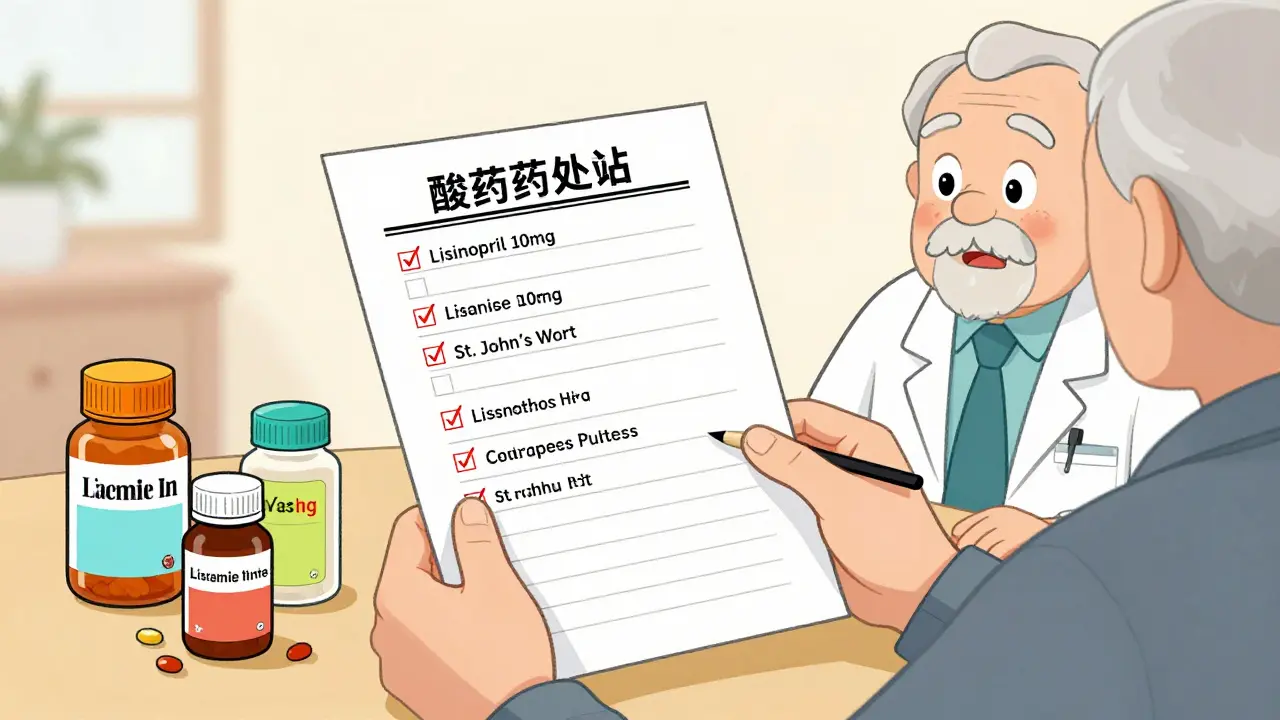
Every year, tens of thousands of people end up in hospitals because of drug interactions they never saw coming. It’s not always the new prescription that causes trouble-it’s the extra vitamin you started taking, the painkiller you grabbed at the store, or the herbal tea your cousin swore by. And here’s the hard truth: most doctors don’t ask about these things unless you bring them up. If you’re taking five or more medications-including over-the-counter pills, vitamins, or supplements-you’re at serious risk. But you can stop this before it starts. Sharing a complete, accurate medication list isn’t optional. It’s your best defense.
What Goes on a Complete Medication List?
A simple list of names won’t cut it. You need details. Each medication should include:- Exact name-both brand and generic (e.g., "Lisinopril 10 mg" not just "blood pressure pill")
- Dosage-how much you take each time
- Frequency-once daily? Twice a day? Every 8 hours?
- Route-oral, topical, injected?
- Purpose-what condition it treats (e.g., "for atrial fibrillation")
- Start date-when you began taking it
- Prescribing provider-who wrote the prescription
- Special instructions-"take on empty stomach," "avoid grapefruit," "take with food"
And don’t forget the non-prescription stuff. That’s where most mistakes happen. Include:
- Over-the-counter pain relievers (Tylenol, Advil, Aleve)
- Vitamins and minerals (Vitamin D3 2000 IU, Calcium 600 mg)
- Herbal supplements (St. John’s Wort, Ginkgo Biloba, Turmeric)
- Home remedies (fish oil, probiotics, melatonin)
- Allergies and reactions (e.g., "Penicillin-hives, swelling, trouble breathing")
According to the FDA, over-the-counter meds and supplements cause nearly one-third of serious drug interactions. If you don’t list them, your doctor won’t know to check. And that’s dangerous.
Why Paper Lists Fail (and What Works Better)
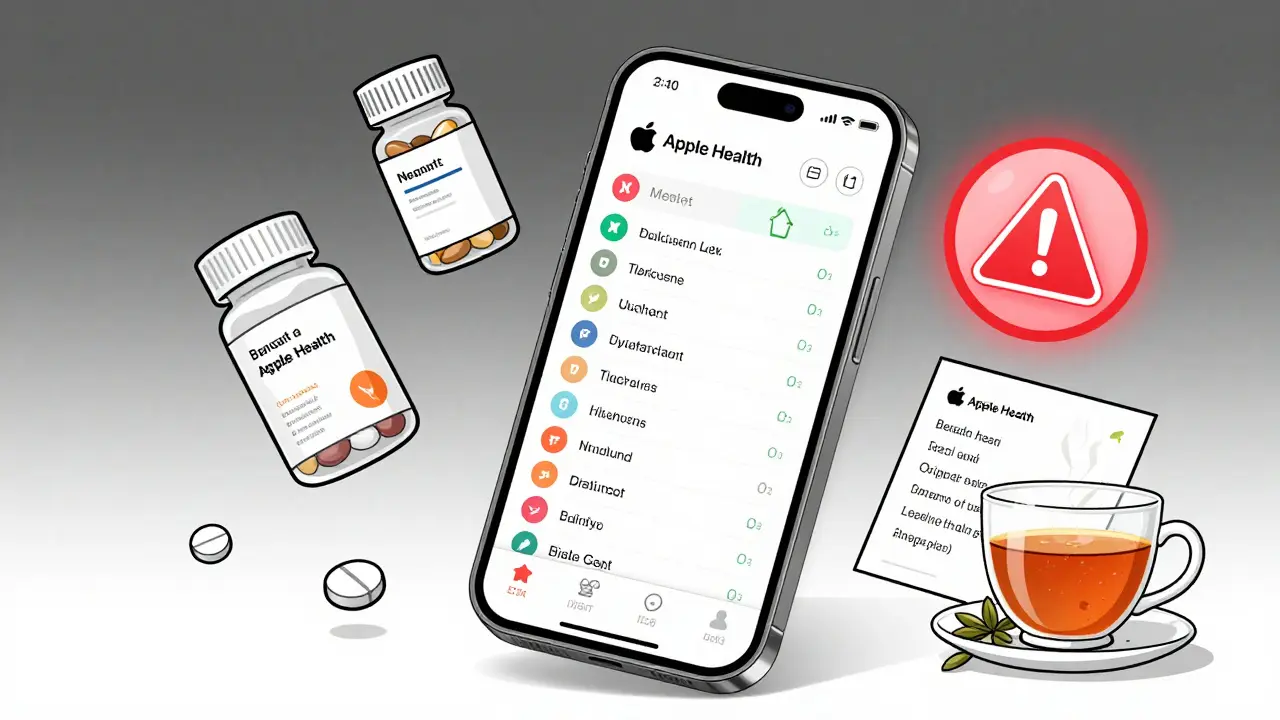
You’ve probably seen people carry a folded piece of paper in their wallet. It’s a start-but it’s not enough. A 2022 study in the Journal of Patient Safety found that paper lists are only 62% accurate in emergencies. Why? They’re outdated. People forget to update them. They lose them. Or they write "aspirin" without the dose.Digital lists are better. Smartphones with health apps like Apple Health or Google Health can store medication details, send reminders, and even sync with pharmacies. A 2023 Pew Research study showed that digital lists have 78% accuracy. But here’s the catch: 23% of adults over 65 don’t own smartphones. That’s not a small gap-it’s a safety gap.
The real winner? A hybrid approach.
- Use one pharmacy for all your prescriptions. Pharmacies have automated systems that flag interactions with 92% accuracy. If you get your blood pressure pill, your statin, and your sleep aid from the same place, they’ll catch clashes before you even leave the counter.
- Take photos of every bottle. Snap a picture of the label on each pill, supplement, and OTC box. Store them in a folder on your phone. This way, if you forget a name or dose, you’ve got the exact label right there.
- Carry a printed card. Print your list, fold it, and keep it in your wallet or purse. Update it every time you change something. Don’t wait for your next appointment.
One patient in Exeter told me last year that she caught a deadly interaction between warfarin and St. John’s Wort because she had a photo of her supplement bottle. Her pharmacist noticed the conflict before she even walked into her cardiologist’s office.
When and How to Share Your List
Don’t wait to be asked. By the time a doctor says, "Do you take anything else?" it’s often too late. You need to take control.- Bring your list to every appointment-even for a sore throat or a rash. That new medication might interact with your heart pills.
- Hand it to the provider before they sit down. Studies show 63% of providers never request a full list. Don’t make them guess.
- Update it within 24 hours of any change. Added a new pill? Removed one? Changed the dose? Update the list immediately. Paper lists go stale fast.
- Review it monthly. Set a reminder on your phone. Go through every item. Are you still taking it? Did your doctor change the dose? Did you stop one but forget to remove it from the list?
Also, ask two key questions at every visit:
- "Could any of these medications interact with each other?"
- "Should I avoid any foods or supplements while taking these?"
These questions force providers to think beyond the immediate issue. A 2023 study in JAMA Internal Medicine found that patients who asked these questions had 22% fewer adverse events.
Who Should Be Your Medication Coordinator?
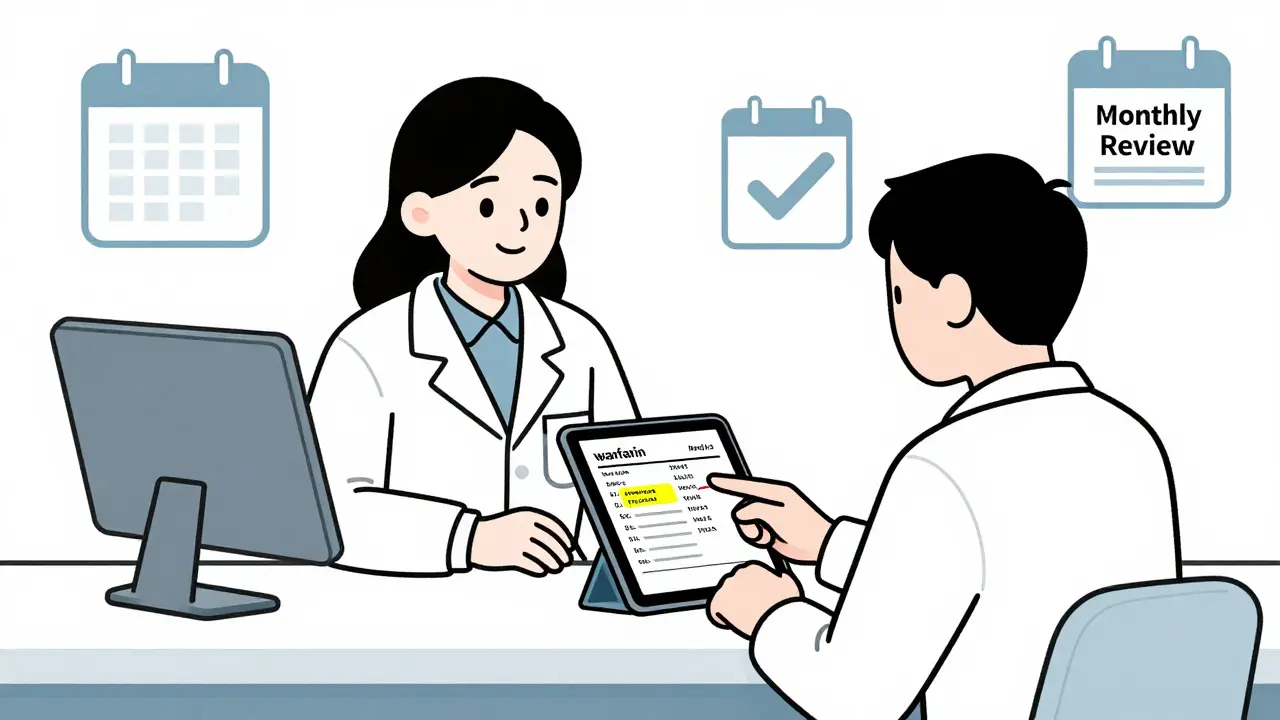
If you see three or more specialists-a cardiologist, a rheumatologist, a neurologist-you’re in high-risk territory. Each one may prescribe something without knowing what the others ordered.Designate one provider as your medication coordinator. Usually, that’s your primary care doctor or your pharmacist. Tell them: "I want you to oversee all my meds." Give them your full list. Ask them to review it every 3 months.
At Johns Hopkins Hospital, clinics that assigned a pharmacist to review all patient lists cut adverse drug events by 41%. Pharmacists don’t just fill prescriptions-they spot conflicts, catch duplicates, and know how supplements interact with prescriptions. And they’re often more accessible than your doctor.
Common Mistakes That Put You at Risk
The Institute for Safe Medication Practices tracked the top six errors in medication lists. Here’s what you need to avoid:- Missing OTC meds and supplements-37% of all errors. This is the #1 mistake.
- Forgetting discontinued meds-28%. If you stopped a pill but didn’t remove it, a new doctor might re-prescribe it.
- Wrong dosage-22%. Writing "5 mg" instead of "50 mg" is deadly.
- Missing allergy details-19%. Saying "allergic to penicillin" isn’t enough. Say "hives, swelling, anaphylaxis."
- No timing instructions-15%. Levothyroxine must be taken alone, 30-60 minutes before food. If you don’t say that, someone might tell you to take it with breakfast.
- Outdated lists-52% of lists are more than 30 days old. That’s not just outdated-it’s dangerous.
One woman in Devon took a blood thinner and started taking a new multivitamin with vitamin K. She didn’t tell her doctor. Within weeks, her INR dropped dangerously low. She nearly had a stroke. Her list had no supplements. Her doctor didn’t ask.
Tools That Actually Help
You don’t need to build your list from scratch. Use these:- My Medicine Record (FDA free form)-downloadable PDF, fillable, printable.
- Medisafe or MyMeds apps-send reminders, sync with pharmacies, share with caregivers.
- Your pharmacy’s app-most major chains (Boots, Lloyds, Superdrug) let you view and manage your prescriptions online.
- Apple Health or Google Health-you can manually add medications and set alerts.
And if you’re helping an older parent or relative? Take photos of their bottles together. Sit down once a week and go through the list. Make it a routine, like checking the mail.
The Bigger Picture
This isn’t just about avoiding a bad reaction. It’s about keeping you out of the hospital, avoiding emergency trips, and staying independent longer. The CDC says adults over 65 now take an average of 4.8 prescription drugs. That number keeps rising. By 2030, the National Academy of Medicine says medication safety will be one of the top three priorities in healthcare.And it’s not just about you. If you’re a caregiver, a family member, or someone helping a loved one manage meds-you’re the frontline defense. A 2023 survey found that patients who had someone help them update their list were 58% more likely to catch a dangerous interaction.
Start today. Open your medicine cabinet. Take photos. Write down everything. Update your list. Bring it to your next appointment. Ask the questions. You don’t need to be a medical expert. You just need to be prepared.
What if I forget to bring my medication list to my appointment?
If you forget, ask the provider if you can send it later-via email, a photo, or even a printed copy left at the front desk. But don’t assume they’ll remember to check. Many clinics don’t have time to follow up. The safest approach is to always bring it. Keep a copy in your bag, your car, and your wallet. If you’re going to an emergency, that list could save your life.
Can my pharmacist really help me find dangerous interactions?
Yes-and they’re often better at it than your doctor. Pharmacists are trained to spot drug interactions, especially with supplements and over-the-counter meds. In fact, a 2023 study in the Journal of the American Pharmacists Association found that pharmacist-led reviews reduced inappropriate prescribing by 32% in older adults. If you get all your prescriptions from one pharmacy, they’ll flag clashes before you even leave. Don’t hesitate to ask: "Can you check if these all work together?"
Do I need to list vitamins and supplements even if they’re "natural"?
Absolutely. "Natural" doesn’t mean safe. St. John’s Wort can make blood thinners useless. Calcium can block thyroid meds. Fish oil can increase bleeding risk when taken with aspirin. The FDA reports that 30% of serious drug interactions involve supplements. If you’re taking it, it goes on the list-no exceptions.
How often should I update my medication list?
Update it within 24 hours of any change-whether you started, stopped, or changed the dose of a medication. Then, review the entire list every month. Set a calendar reminder. Make it part of your routine, like checking your bank balance. Outdated lists are the leading cause of preventable medication errors. A 2022 Agency for Healthcare Research and Quality report found that 52% of medication lists were more than 30 days out of date. Don’t be part of that statistic.
What if my doctor doesn’t seem to care about my list?
It’s not you-it’s the system. Many doctors are rushed and don’t have time to review long lists. But that doesn’t mean you should stop. If your doctor ignores your list, ask: "Could you refer me to a pharmacist for a medication review?" Many clinics now offer free pharmacist consultations. If they still dismiss it, consider switching providers. Your safety matters more than convenience. A 2023 Medscape survey found that 47% of patients felt their providers didn’t take their lists seriously. You’re not overreacting-you’re being smart.
All Comments
Mike Dubes March 2, 2026
I started using Medisafe after my mom had a bad reaction to mixing turmeric and blood thinners. Best thing I ever did. Now I get alerts when something might clash, and I can share the list with my pharmacist. Seriously, if you take more than 3 meds, get an app. It's not optional anymore.
John Cyrus March 2, 2026
People still use paper lists in 2024 really wow the system is broken and you're all just waiting to die one pill at a time
John Smith March 3, 2026
Man I used to think vitamins were harmless until I saw a guy in the ER with a heart attack because he took ginkgo with his aspirin. Natural doesn't mean safe. It means your grandma's kitchen cabinet is weaponized. Take pictures of every bottle. Every. Single. One.
Matt Alexander March 5, 2026
Just take a photo of each pill bottle and save it in a folder called Meds. Done. No apps needed. No paper. Just phone. If you're in the hospital they can pull up your pics. Simple. Works.
Gretchen Rivas March 6, 2026
I keep my list on my phone and update it every Sunday night. It takes 5 minutes. My doctor said she’s never had a patient do that before. I think she’s impressed.
Siri Elena March 7, 2026
Oh wow a medication list. How novel. I guess most people just wing it until they end up in a coma. How quaint. I mean I suppose you need a spreadsheet for your aspirin now. How very 2024.
Divya Mallick March 9, 2026
In India we don't have access to these apps or pharmacies that do reviews. We rely on our local pharmacist who knows our family history. Your Western obsession with digital tools ignores real-world realities. We manage with trust and tradition not QR codes.
Pankaj Gupta March 10, 2026
The data is clear: pharmacist-led reviews reduce adverse events by 32%. This is not anecdotal. This is evidence-based. If your provider dismisses this, they are not practicing evidence-based medicine. You have the right to request a formal medication reconciliation.
Alex Brad March 11, 2026
If you're helping an older relative, do this with them. Sit down. Take the photos. Talk through each pill. It's not about control. It's about care. And yes it's awkward at first. But you'll thank yourself later.
Renee Jackson March 12, 2026
I cannot emphasize enough the importance of updating your medication list within 24 hours of any change. This is not a suggestion. This is a critical safety protocol. Your life depends on the accuracy of this documentation. Please treat it with the gravity it deserves.
RacRac Rachel March 13, 2026
I started using Apple Health and now I have a little heart icon next to my meds 🫀✨ My pharmacist even texted me to say she caught a conflict I didn't even know about. So happy I did this. You guys are all so brave for sharing your stories 💛
Stephen Vassilev March 14, 2026
The notion that a digital list is 78% accurate is statistically misleading. The study's sample size was skewed toward urban populations with broadband access. Rural communities with limited tech literacy are systematically excluded. The FDA's own 2022 report indicates that 61% of seniors over 70 in non-metropolitan areas do not use smartphones. To recommend digital solutions as a universal standard is not merely impractical-it is ethically negligent. Paper, when properly maintained, remains the only equitable solution.
Jane Ryan Ryder March 16, 2026
My doctor laughed when I brought my list. Said I was "overthinking." So I brought the bottle photos. Then he called a pharmacist. Turned out I was on two drugs that cancel each other out. Guess who was right?