Missing a dose. Forgetting a pill. Skipping a week because you felt better. These aren’t just small mistakes-they’re serious risks. About half of people with long-term conditions like high blood pressure, diabetes, or heart failure don’t take their meds as prescribed. And it’s not because they’re lazy. It’s because remembering six different pills at different times, every day, for years, is exhausting. The good news? You don’t have to guess or hope you’re doing it right. There are real, simple ways to track medication adherence-and they actually work.
Why Tracking Matters More Than You Think
When people skip doses, it doesn’t just mean their condition gets worse. It means more hospital visits, more emergency trips, and higher costs. In the U.S. alone, non-adherence costs the system over $300 billion a year. That’s not a statistic-it’s your neighbor, your parent, your friend. A 2021 study from Kaiser Permanente found that heart failure patients using electronic tracking had 23% fewer hospital readmissions. That’s not magic. It’s data.
But here’s the catch: most people think they’re doing fine. Surveys say 80% of patients take their meds correctly. But when researchers use actual monitoring devices, only 27% of those self-reports are accurate. That’s not a mistake-it’s a blind spot. You can’t fix what you can’t see.
Paper Logs: The Old Way That Still Works (If Done Right)
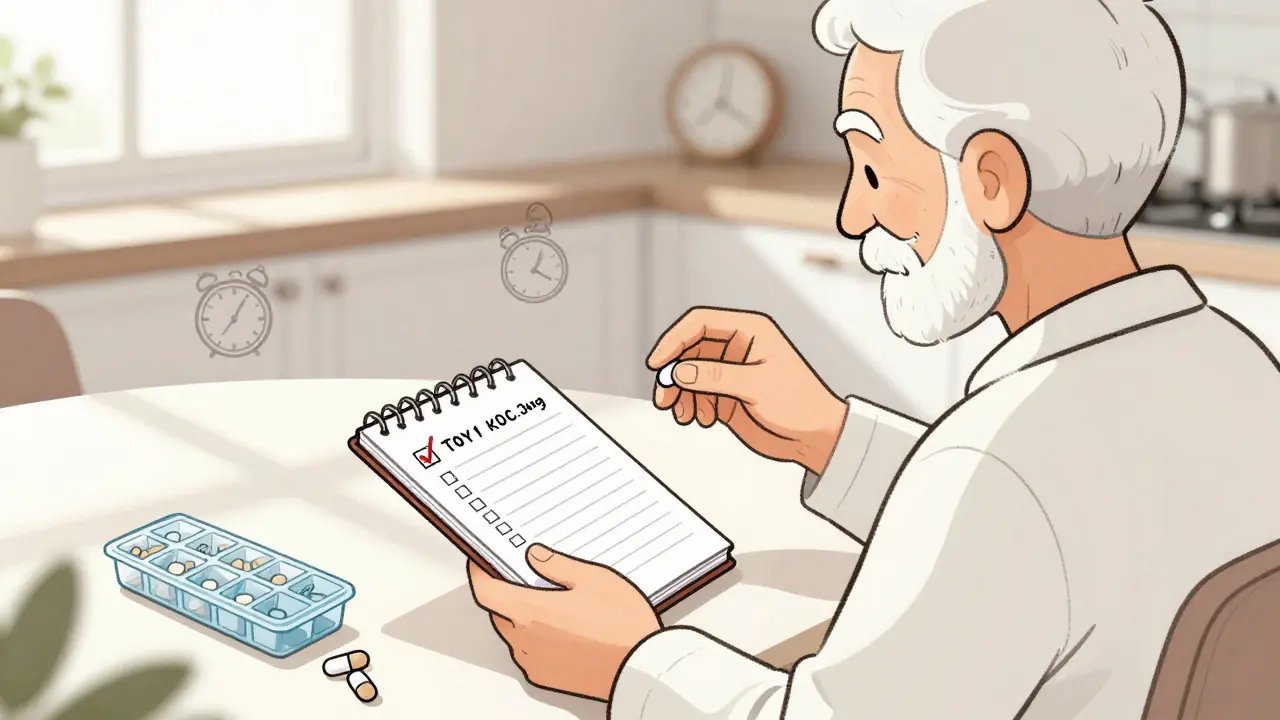
Before smartphones, people used notebooks. And guess what? Some still do. A simple paper log-just a table with dates, times, and checkboxes-is better than nothing. But only if it’s used honestly and consistently.
Here’s how to make it work:
- Use a printed template or a small notebook you keep with your pills.
- Write down every dose you take-right after you take it. Not later. Not the next day.
- Include notes: “Felt dizzy after taking,” “Missed due to travel,” “Took with food.”
- Bring it to every doctor visit. Don’t just say, “I think I took them.” Show them.
But paper has limits. A 2020 University of Michigan study found that 42% of patients intentionally falsified their paper logs-either to please their doctor or because they felt guilty. That’s not adherence. That’s avoidance.
Digital Tools: The Real Game-Changer
Today, the best tools don’t just remind you-they report back. These aren’t fancy apps for tech lovers. They’re medical-grade systems built for real people with real lives.
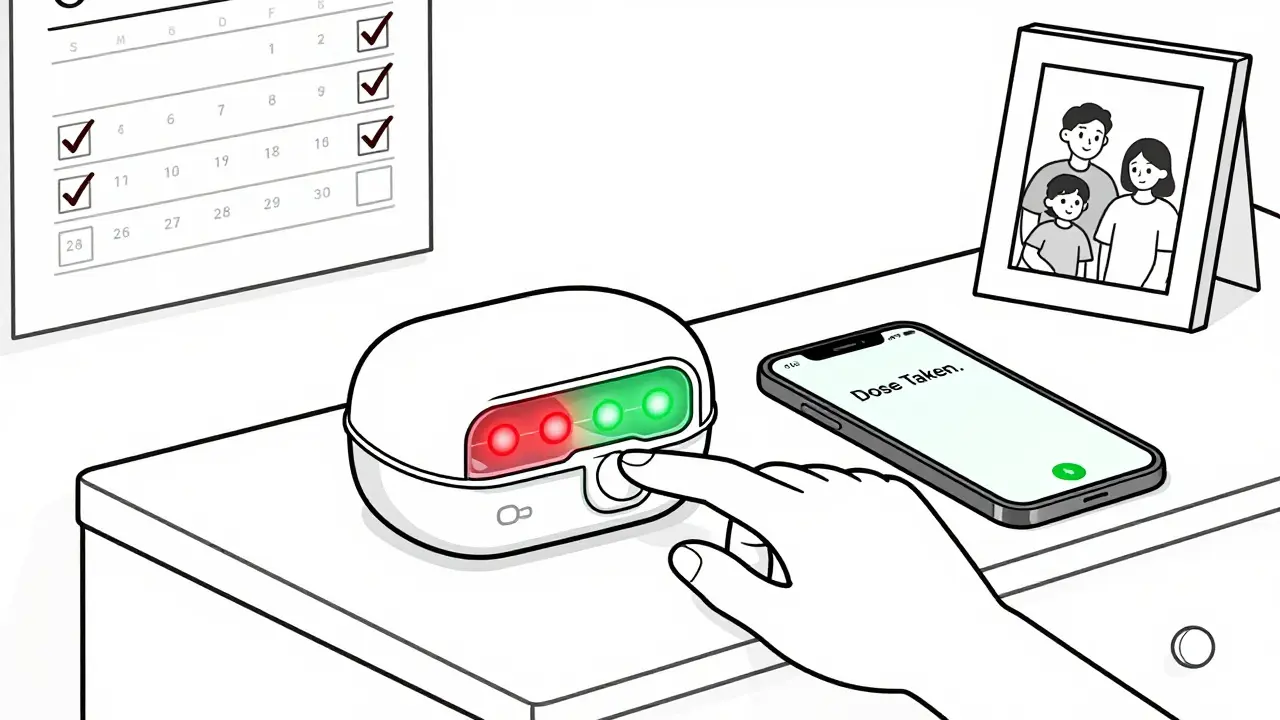
One of the most widely used is the Tenovi Pillbox. It’s a smart container with LED lights. Red light? Dose is due. Green light? You took it. It connects to your phone and sends alerts to your care team if you miss a dose. No typing. No app opening. Just take the pill, press the button. Done.
Another option is the MEMS cap-a tiny electronic cap that screws onto your pill bottle. Every time you open it, it records the date and time. It doesn’t know if you took the pill, but it knows if you opened the bottle. That’s still 97% accurate for tracking patterns. Used in clinical trials since 1991, it’s the gold standard for research.
Then there are advanced systems like ReX and Medication Behavior Monitoring Systems (MBMS). ReX physically dispenses pills into a tray. If you don’t take it, the system knows. MBMS uses scales inside the pill container to detect when a pill is removed. These aren’t just trackers-they’re guardians.
What Works Best for Different People?
Not everyone needs the same tool. Your age, tech comfort, and condition matter.
- Under 55, tech-savvy, on multiple meds: Try Tenovi or a smartphone app like Medisafe. These sync with your calendar, send alarms, and let you share data with your pharmacist.
- Over 75, limited tech experience: Stick with simple pill organizers with alarms, or even a basic paper log with a family member helping check it weekly. Don’t force a smartphone if it causes stress.
- Chronic mental health condition (e.g., schizophrenia, bipolar): Video Directly Observed Therapy (VDOT) works best. You take your pill in front of a video call with your nurse. It’s 98.5% accurate. Yes, it takes time. But for some, it’s life-saving.
- Living alone, no family nearby: IoT devices with cellular backup (like Tenovi) are ideal. They send alerts to your care team if you miss a dose for two days straight.
A 2023 Kaiser Permanente study showed 92% of patients under 55 adopted digital tools. But only 47% of Medicare patients over 75 did. Why? Not because they didn’t care. Because the tools weren’t designed for them.
The Hidden Problem: Just Opening the Bottle Isn’t Enough
Here’s something most people don’t realize: almost all trackers only know if you opened the bottle or removed the pill. They don’t know if you swallowed it.
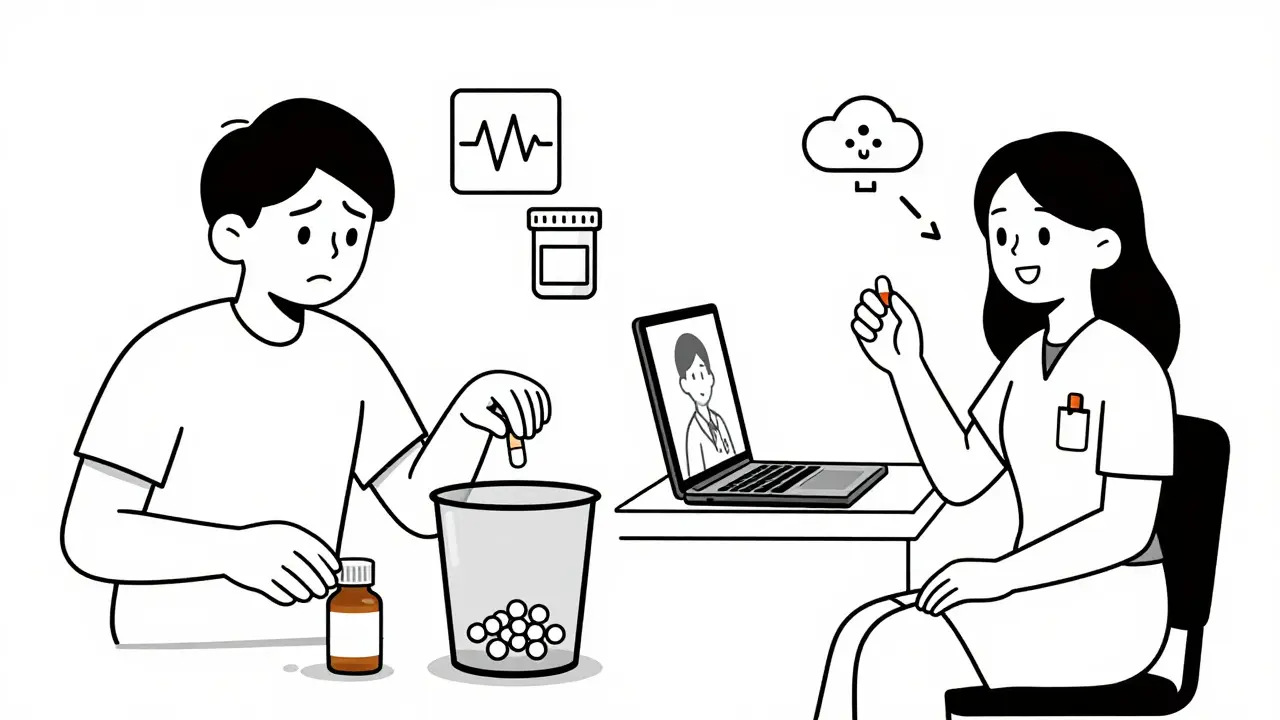
That’s a big deal. Someone with depression might open the bottle and toss the pill in the trash. Someone with dementia might take the pill but spit it out later. These systems can’t catch that. That’s why 92% of current tech has a 12.3% false adherence rate-meaning it says you took your meds when you didn’t.
This is especially dangerous for psychiatric drugs, blood thinners, and insulin. That’s why doctors still ask, “Did you take it?” even when you’re using a tracker. The device tells you what happened. You tell them what really happened.
How to Get Started: A Simple 3-Step Plan
You don’t need to overhaul your life. Start small.
- Make a list. Write down every medication: name, dose, time, reason. Use a free template from your pharmacy or print one from the CDC website.
- Choose one tracker. If you’re comfortable with tech, try a free app like Medisafe. If not, get a pill organizer with a loud alarm. If you’re on Medicare, ask your care coordinator about Tenovi or similar devices-they’re often covered.
- Share it. Email your list to your pharmacist. Bring your tracker data to your next visit. Say: “I want to make sure I’m taking these right. Can we look at this together?”
Yale New Haven Health found that patients who did this had adherence rates jump from 61% to 84% in just 12 weeks. No magic. Just clarity.
What to Avoid
Don’t fall for the hype. Not every app is trustworthy. Look for ones that:
- Are FDA-cleared or CE-marked (not just “health apps”)
- Connect to your EHR (like Epic or Cerner)
- Don’t require you to manually log every time
- Have customer support you can actually reach
Avoid anything that asks for payment unless your insurance covers it. Many Medicare Advantage plans now pay for adherence devices under new CMS rules. Ask your provider.
The Future: Smarter, Not Just More Tech
The next big step isn’t another app. It’s integration. Cleveland Clinic’s system, launched in 2022, combines Tenovi pillbox data with Apple Watch heart rate readings, EHR records, and pharmacist check-ins. When your heart rate spikes and you missed your beta-blocker, the system alerts your nurse before you even feel sick.
By 2026, wearables may detect drug levels in your sweat or blood. That’s not sci-fi-it’s in testing right now. But for now, the best tool is still the one you’ll actually use.
Final Thought: It’s Not About Being Perfect
You don’t need to take every pill at exactly 8:03 a.m. every day. Life happens. Travel. Illness. Stress. The goal isn’t perfection. It’s awareness. If you miss a dose, you should know. And you should be able to tell your doctor without shame.
Tracking isn’t about being watched. It’s about being supported. The right system turns guilt into guidance. Confusion into clarity. And missed doses into meaningful conversations with your care team.
Start today. Write down your meds. Pick one tool. Share it. That’s all it takes to take control.
All Comments
Abby Polhill December 25, 2025
Let’s be real - paper logs are a relic, but they’re still the most honest tool out there. Digital trackers? Great until your phone dies or the app glitches. I’ve seen patients lie to their doctors with digital logs because they think the system’s infallible. But a pen and paper? You can’t fake the ink. And if you’re skipping doses, you’re not fooling yourself - you’re just delaying the inevitable crash.
The real issue isn’t adherence tech - it’s the systemic failure to design for cognitive load. Elderly patients aren’t ‘tech-illiterate’ - they’re being asked to navigate interfaces designed by 25-year-olds who’ve never had to manage five meds at once. Tenovi’s brilliant because it removes the interface entirely. No taps. No menus. Just light and pill.
And let’s not pretend MBMS is flawless. I work in a geriatric clinic. I’ve had patients take the pill, then spit it into their cheek and flush it later. The scale doesn’t know. The cap doesn’t know. Only the patient knows - and they won’t tell you unless you ask without judgment.
VDOT for psychiatric meds? Absolute game-changer. I had a patient with bipolar disorder who’d hoard lithium until she felt ‘stable.’ Video observation didn’t just improve adherence - it rebuilt trust. She started showing up for therapy because she knew someone was watching, not judging.
But here’s the kicker: no tool works if the patient feels surveilled. The goal isn’t compliance. It’s collaboration. That’s why Kaiser’s integration with Apple Watch is the future - it doesn’t ask you to log anything. It just notices when your heart rate spikes after missing your beta-blocker. That’s care, not control.
Bret Freeman December 26, 2025
People think they’re being responsible by using apps or pillboxes, but let’s cut the crap - most of these systems are just glorified reminders. You still have to swallow the damn pill. And if you’re the type who opens the bottle and tosses it in the trash because you’re depressed or scared of side effects, no sensor in the world is going to catch that. This whole industry is built on the delusion that technology can fix human behavior.
And don’t get me started on ‘FDA-cleared’ apps. Half of them are just rebranded fitness trackers with a pill icon slapped on. I’ve seen patients pay $50 a month for an app that sends them a text saying ‘Take your meds!’ - like they’ve never heard of an alarm clock. This isn’t innovation. It’s exploitation.
Meanwhile, real solutions like MEMS caps have been around since 1991. Why aren’t they standard? Because insurance won’t cover them unless someone dies first. And by then, it’s too late. We’re not fixing adherence. We’re just billing for it.
Austin LeBlanc December 28, 2025
Okay, but why are we even pretending this is a patient problem? It’s a systemic failure. You want people to take their meds? Stop making them pay $400 a month for insulin. Stop forcing them to see five different specialists who all prescribe different things without talking to each other. Stop giving them 12 pills with 7 different schedules and then acting shocked they forget one.
Adherence isn’t about discipline. It’s about accessibility. If your medication costs more than your rent, you’re not ‘non-compliant’ - you’re surviving. And if your doctor won’t help you navigate the system, then your ‘tracker’ is just a guilt machine.
I’ve had patients cry because they skipped their blood pressure meds to afford groceries. And now you want them to buy a Tenovi? For $200? With a monthly subscription? This isn’t healthcare. It’s a scam dressed in tech.
Fix the pricing. Fix the fragmentation. Fix the stigma. Then we can talk about trackers.
niharika hardikar December 29, 2025
While the technological advancements in medication adherence monitoring are commendable, the underlying socio-economic determinants remain critically under-addressed. The emphasis on digital tools such as Tenovi or MEMS caps, though statistically validated, inadvertently marginalizes populations with limited digital literacy, particularly in low-resource settings. In India, for instance, where over 60% of the elderly population lacks smartphone access, the proliferation of such devices constitutes a form of epistemic exclusion.
Furthermore, the assumption that adherence can be quantified through mechanical means - such as bottle-opening frequency or scale displacement - neglects the phenomenological dimension of illness. Patients with chronic conditions often experience complex psychosocial barriers: stigma, fear of dependency, or internalized shame. These cannot be captured by sensors.
It is imperative that healthcare systems adopt a biopsychosocial model wherein adherence interventions are co-designed with patients, not imposed upon them. Paper logs, when supported by community health workers, remain a viable, dignified, and culturally resonant alternative in contexts where technology is neither accessible nor appropriate.
Until systemic inequities in pharmaceutical pricing and healthcare infrastructure are resolved, adherence technologies risk becoming instruments of surveillance rather than empowerment.
EMMANUEL EMEKAOGBOR December 30, 2025
I appreciate the thoughtful breakdown here, especially the emphasis on dignity over surveillance. In Nigeria, many elderly patients rely on family members to help manage medications - and that’s not a flaw, that’s community care. We don’t need fancy gadgets to track pills; we need systems that support the people already doing the work.
My aunt takes six meds daily. She doesn’t have a phone. But her grandson checks in every morning with a notebook and a cup of tea. He writes down what she took, what she felt, and what she didn’t. No app. No alert. Just presence. That’s the real tracker.
Technology should serve that, not replace it. If a pillbox costs more than a month’s rent, it’s not a solution - it’s a privilege.
Let’s invest in human connections before we invest in sensors.
Jillian Angus December 30, 2025
paper logs are underrated honestly
my grandma used one and it worked better than any app
she’d scribble in pencil and cross out the days she missed
no notifications no passwords just a notebook and a pen
and she brought it to every appointment like it was a sacred thing
doctors loved it
she didn’t care about tech she cared about not dying
simple works
Spencer Garcia December 31, 2025
Agreed. The best tool is the one you’ll use. No app is worth it if it adds stress. For my dad with Parkinson’s, a simple alarm clock with labeled pill cups was 100% more effective than a $100 smart box. He didn’t trust tech. He trusted routine. And that’s what matters.
Also - if your doctor doesn’t ask you about your tracker data, they’re not doing their job. Adherence isn’t your burden to carry alone.
Blow Job January 1, 2026
Man. I had my mom on ten different meds after her stroke. We tried every app. She hated them. Then we got one of those weekly pill organizers with the big loud alarm. Set it for 7am, 1pm, 7pm. That’s it. She’d hit snooze, but she’d take it eventually. And I’d check the box every Sunday. No guilt. No tech. Just us.
That’s what works. Not sensors. Not alerts. Just someone who shows up.
Christine Détraz January 2, 2026
I think the real win here is the 3-step plan. Start small. Don’t try to fix everything at once. My sister tried to use five apps at once and just gave up. Then she picked one pill organizer with a timer. Now she’s been consistent for eight months. Progress over perfection.
Also - sharing the list with your pharmacist? Genius. They’re the ones who catch interactions you don’t even know about. They’re not just dispensing pills. They’re your safety net.
John Pearce CP January 2, 2026
These so-called ‘solutions’ are a distraction from the real problem: American healthcare is broken. We don’t need more gadgets. We need single-payer. We need price controls. We need to stop treating chronic illness like a moral failure. If your insulin costs $300, you’re not ‘non-adherent’ - you’re a victim of corporate greed. And no app can fix that.
Stop blaming patients. Start holding pharma accountable.
Gray Dedoiko January 3, 2026
Just wanted to say - I’ve been using a MEMS cap for my anticoagulant. It’s not perfect. I’ve opened the bottle and not taken it. But the data helped my doctor realize I was skipping doses on weekends. We adjusted the schedule. Now I take it after breakfast. No more anxiety. No more guilt. Just a better rhythm.
It’s not about being perfect. It’s about being seen.
Joe Jeter January 5, 2026
Wait - so the solution to forgetting pills is… more tech? That’s the big reveal? I’ve got news for you - the reason people miss doses is because they don’t trust the system. They’ve been lied to by doctors, overcharged by pharmacies, and gaslit by insurance companies. Now you want them to trust a blinking LED?
Here’s a radical idea: what if we stopped treating patients like children who need reminders? What if we treated them like adults who deserve honesty, affordability, and respect?
Adherence isn’t a behavioral problem. It’s a moral one.
Sidra Khan January 7, 2026
ok but like… why is everyone so obsessed with tracking pills? 🤔
what if we just… didn’t need so many meds? 🤷♀️
like… what if the real solution was… less pharmaceuticalization of life? 🌱
why is the default always ‘take more pills’ instead of ‘eat better, move more, sleep more’? 🤔
also why is no one talking about how the system profits from non-adherence? 💸
just saying… maybe we’re asking the wrong questions 😅
Abby Polhill January 9, 2026
That’s why I brought up VDOT for psychiatric meds - it’s not about surveillance. It’s about connection. When my patient takes her pill in front of the camera, she’s not just ‘adhering.’ She’s saying, ‘I’m still here. I’m still trying.’ That’s the moment the system finally sees her as a person, not a data point.
And that’s what the best trackers do - they turn silence into conversation.