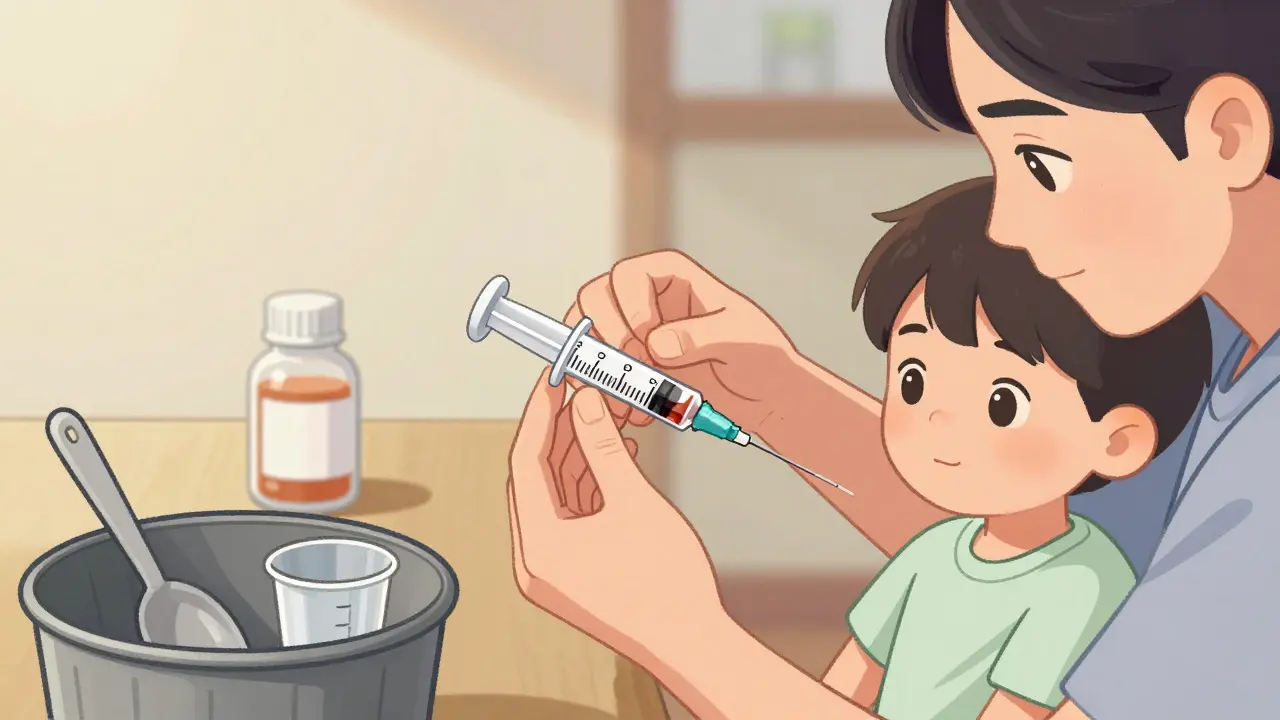
Giving liquid medicine to a child isn’t as simple as pouring it into a spoon. One wrong milliliter can mean the difference between relief and danger. In the UK, over 1 in 5 parents admit they’ve been unsure how much to give - and it’s not their fault. Many medicine bottles still show "teaspoon" on the label, even though no two teaspoons are the same. That’s why dosing syringes are the gold standard for kids’ medications - and if you’re not using one, you’re risking your child’s safety.
Why Dosing Syringes Are the Only Safe Choice
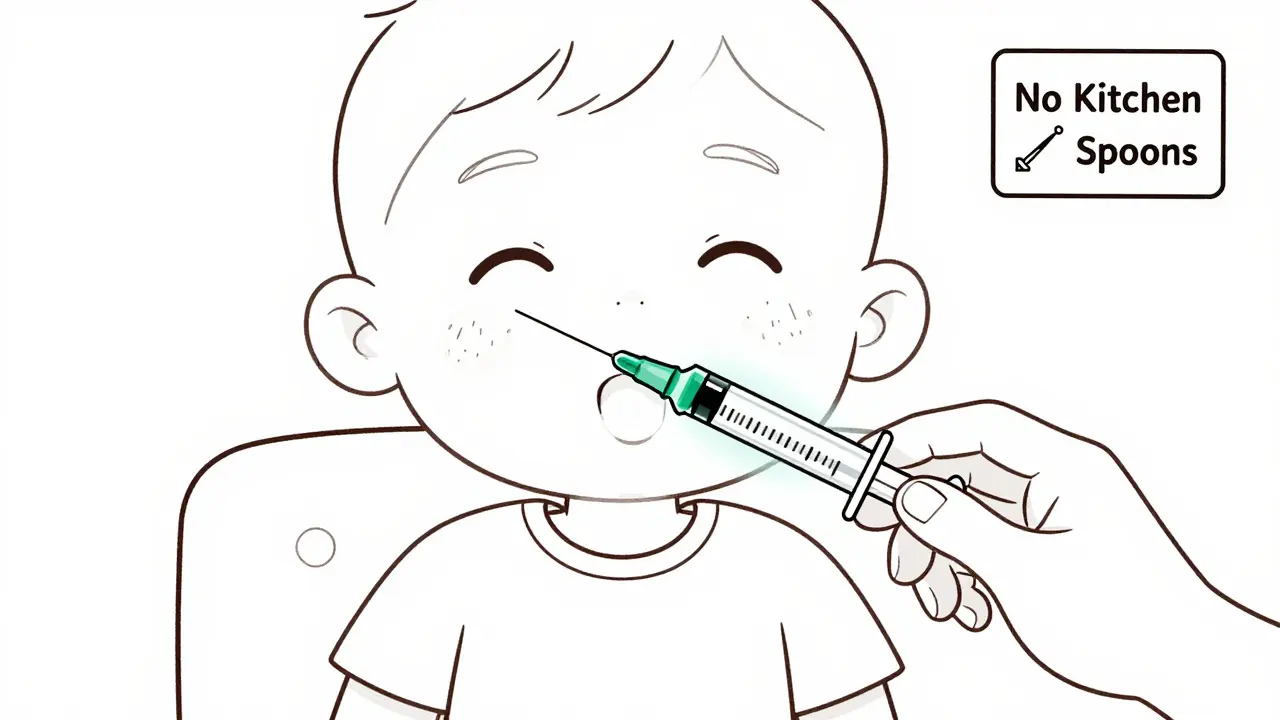
Kitchen spoons, medicine cups, and even the little plastic spoons that come with the bottle? They’re unreliable. A 2016 study from Yale found that parents using household spoons made errors in 68% of doses. Even the dosing spoons provided by pharmacies had a 22% error rate. Why? Because a "teaspoon" can hold anywhere from 2.5 to 10 millilitres - that’s a 400% variation. For a child weighing 10kg, a 2mL dose of acetaminophen could easily become 6mL if you use a big spoon. That’s a dangerous overdose. Oral syringes, on the other hand, are designed for precision. They’re marked in 0.1mL or 0.01mL increments, depending on size. The Institute for Safe Medication Practices says 67% of pediatric dosing errors come from using the wrong tool. Switching to a syringe cuts those errors by more than half. The FDA has been clear since 2010: all oral syringes must be labeled "for oral use only." This isn’t just a suggestion - it’s a safety rule. Before 2010, there were 137 cases where kids got liquid medicine through an IV line because someone accidentally used a syringe meant for the mouth. That’s how serious this is.Choosing the Right Syringe Size
Not all syringes are made the same. You need the right size for the dose:- 1 mL syringe: For doses under 1mL. Marked in 0.01mL increments. Best for infants on antibiotics or heart medications.
- 3 mL syringe: For doses between 1-3mL. Marked in 0.1mL. This is the most common size for fever reducers like paracetamol or ibuprofen.
- 5 mL syringe: For 3-5mL doses. Marked in 0.2mL. Good for older toddlers on higher doses.
- 10 mL syringe: For doses over 5mL. Marked in 0.5mL. Only use for larger volumes - it’s too coarse for small doses.
Always pick the smallest syringe that can hold your child’s dose. A 10mL syringe for a 2mL dose is like using a garden hose to fill a thimble - you’ll miss the mark. The American Academy of Pediatrics says syringes with 0.1mL increments are required for doses under 3mL - a rule that took effect in January 2024.
How to Measure Accurately
Measuring isn’t just about pulling the plunger. Here’s how to do it right:- Shake the bottle for 10-15 seconds. Many liquid meds are suspensions - the medicine settles at the bottom. If you don’t shake it, you’re giving mostly water.
- Remove the cap and insert the syringe tip into the bottle. Don’t use the cap as a funnel - it’s a choking hazard.
- Turn the bottle upside down and slowly pull the plunger until the top of the black ring lines up with your dose mark. Never guess. Never fill to the top. Always read the line, not the level.
- Check the mark at eye level. Hold the syringe up to a light. If you’re looking from above, the line will look higher than it is.
- Wipe the tip with a clean tissue. Don’t rinse it - you’ll lose medicine.
Some parents think they need to fill the syringe to the very top. That’s wrong. The mark is the dose. The space above it is empty. If you see 2.5mL on the syringe, that’s your dose - even if the plunger goes further down.
How to Give the Medicine Without a Fight
You’ve got the right dose. Now how do you get it in? The way you administer matters just as much as the measurement.- Keep your child upright. Never lie them flat. That’s when choking happens.
- Place the syringe tip between the cheek and gum. Not at the back of the throat. Not on the tongue. Between the cheek and gum. This avoids the gag reflex.
- Push slowly. Give 0.5mL at a time. Pause for 5-10 seconds between each push. Let them swallow. Rushing causes spitting, gagging, or choking.
- Don’t force it. If they clamp their mouth shut, wait. Try again in a minute. Stress makes kids more likely to reject the medicine.
Parents often say their child "spits out half the dose." That’s usually because they’re squirting too fast or in the wrong spot. One study found 63% of parents initially aimed at the back of the throat - and 15% of those kids choked. After proper instruction, choking dropped to under 2%.
What About Thick Medicines Like Amoxicillin?
Antibiotics like amoxicillin can be sticky. They don’t draw into the syringe easily. Here’s how to handle it:- Use a 3mL or 5mL syringe - larger barrels give you more suction.
- Draw the medicine slowly. Don’t yank the plunger.
- Tap the syringe gently to release air bubbles.
- If it’s still hard, ask your pharmacist for a special tip. Some syringes have wider openings for thick liquids.
- Don’t dilute it with water. That changes the dose.
One parent on Reddit shared that she kept her amoxicillin in the fridge - the cold made it thicker. She switched to room temperature, and it flowed much easier.
What About Color-Coded Syringes?
Many syringes now come with color-coded plungers: green for paracetamol, purple for ibuprofen, blue for antibiotics. These aren’t just for looks - they’re safety tools. A 2023 study showed parents who used color-coded syringes made 31% fewer mix-ups.Even better - in 2023, the FDA approved the first syringe that changes color when you pull the right dose. It starts blue and turns green at 2mL. Clinical trials showed it cut measurement errors by 37%. These are still new, but if you see one, grab it.
Common Mistakes (And How to Avoid Them)
Here’s what most parents get wrong - and how to fix it:- Mistake: Using a kitchen spoon. Solution: Throw it away. Use the syringe.
- Mistake: Measuring while the child is crying. Solution: Wait until they’re calm. Stress affects accuracy.
- Mistake: Not checking the concentration. Solution: Always read the label. Paracetamol is 120mg/5mL or 160mg/5mL - they’re not the same.
- Mistake: Forgetting to shake the bottle. Solution: Shake every time. Even if it looks mixed.
- Mistake: Using the same syringe for different meds. Solution: Clean it thoroughly or use separate ones. Cross-contamination can change how the medicine works.
When Can You Use a Cup Instead?
For kids over 4 or 5 who can drink from a cup without spilling, a dosing cup might be okay - but only for doses over 5mL. Studies show cup errors drop to 8% at 10mL. But for any dose under 5mL? Stick with the syringe. Even a 4-year-old can’t measure 2.3mL accurately with a cup.And never use a cup if your child is sick, vomiting, or sleepy. They need precision - not guesswork.
What to Do If You Make a Mistake
If you accidentally give too much:- Don’t panic. Most accidental overdoses are minor.
- Call NHS 111 or your GP immediately.
- Have the medicine bottle ready - they’ll ask for the concentration and how much was given.
- Don’t try to make your child vomit. That can cause more harm.
If you gave too little, wait until the next scheduled dose. Don’t double up. It’s safer to wait than to risk an overdose.
Where to Get the Right Syringes
Your pharmacist should give you one for free with every prescription. If they don’t, ask. You can also buy them online or at pharmacies - look for "oral syringe, no needle, metric-only." Avoid cheap ones from supermarkets - they often have poor markings.Look for these features:
- Clear, bold markings
- Rubber plunger that slides smoothly
- Color-coded plunger
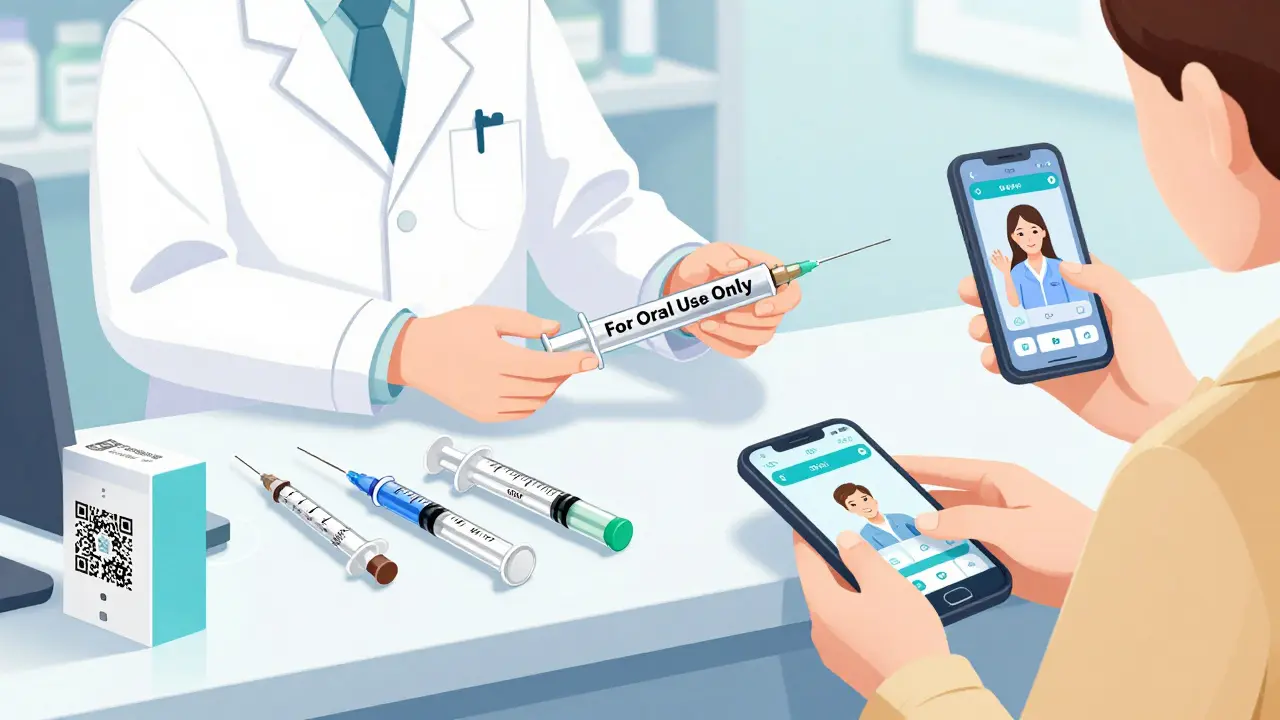
- "For oral use only" printed on the barrel
Some brands now come with QR codes that link to video instructions. Scan them. Watch them. It takes two minutes - and it could save your child’s life.
Final Thought: This Isn’t Just About Medicine - It’s About Safety
Dosing errors are one of the top 10 patient safety risks in children’s care. Most of them are preventable. You don’t need to be a nurse to give medicine safely. You just need the right tool - and the right technique.Every time you use a dosing syringe correctly, you’re doing something powerful: you’re protecting your child from harm. And that’s more important than any convenience.
Can I use a kitchen teaspoon if I don’t have a syringe?
No. A kitchen teaspoon varies from 2.5 to 10 millilitres - that’s a 400% difference. Even if you think you’re giving "one teaspoon," you might be giving too little or too much. Always use a dosing syringe for children’s liquid medicine.
Why do some syringes have different markings?
Syringes are sized for different dose ranges. A 1mL syringe has 0.01mL marks for tiny doses. A 10mL syringe has 0.5mL marks because large doses don’t need that precision. Always match the syringe size to your child’s dose. Never use a 10mL syringe for a 2mL dose.
How do I know if the medicine is mixed properly?
Shake the bottle for 10-15 seconds before each dose. If the liquid looks cloudy or has chunks, it’s not mixed. Some medicines settle quickly - even if they look fine, shake them anyway. Never give medicine without shaking.
Can I reuse a syringe for different medicines?
You can, but only if you clean it thoroughly between uses. Rinse with warm water, then let it air dry. Better yet, use separate syringes for each medicine - especially if they’re different types (like antibiotics and fever reducers). Cross-contamination can affect how the medicine works.
What should I do if my child chokes on the medicine?
If your child is coughing or gagging but breathing, stay calm and sit them upright. Don’t pat their back. If they can’t breathe, cry, or make noise, call 999 immediately and start infant or child first aid for choking. To prevent this, always place the syringe tip between the cheek and gum, not at the back of the throat, and give the medicine slowly in small amounts.
Are digital or smart syringes worth it?
They’re not necessary for most families, but they can help. Some new syringes change color when you get the right dose. Others connect to apps that remind you when to give the next dose. If you struggle with timing or measurement, they’re a good investment. But a regular, properly used syringe is still the safest option.
How often should I replace my dosing syringe?
Replace it if the plunger sticks, the markings fade, or the tip cracks. Otherwise, clean it after each use and it can last for months. Some parents keep one syringe per medicine to avoid mixing. If you’re unsure, ask your pharmacist - they’ll often give you a new one for free.
All Comments
Kelly McRainey Moore January 22, 2026
So glad I found this. I used a kitchen spoon for my daughter’s antibiotics last winter and didn’t even realize how risky it was. Bought a 3mL syringe after reading this and now it’s so much easier - no more guessing, no more crying. Seriously, everyone should have one.
Also, the color-coded ones? Total game changer. I can tell at a glance which is which now. No more mixing up ibuprofen and Tylenol.
PS: Shaking the bottle? I thought I was doing it right before. Turns out I was just shaking like I was trying to start a car. Now I do it for 15 seconds like it says. Magic.
Thanks for writing this - I’m sharing it with every mom I know.
Amber Lane January 23, 2026
My cousin in India told me her pharmacy gave her a syringe with no markings. She had to Google how to measure it. This post should be mandatory reading for every new parent.
Ashok Sakra January 24, 2026
OMG I JUST GAVE MY SON 6ML OF TYLENOL WITH A TEASPOON AND NOW I’M SCARED TO DEATH. IS HE GONNA DIE??
Andrew Rinaldi January 25, 2026
It’s fascinating how something so simple - a syringe - becomes this profound act of care. We treat medicine like it’s just a tool, but it’s really a bridge between our fear and our love. The fact that we’ve normalized spoon-measuring for decades says more about our systems than our intentions.
Maybe the real problem isn’t the spoons… it’s that we don’t make safe tools easy to access. Pharmacies should hand these out like tissues.
Gerard Jordan January 26, 2026
THIS. IS. EVERYTHING. 🙌
Just got my 2-year-old’s amoxicillin today - asked for the syringe and the pharmacist gave me one with a QR code! Scanned it and watched a 90-second video on how to hold it right. I cried. Not because I was sad… because I finally felt like I knew what I was doing.
Also - cold medicine = thick = nightmare. Room temp trick? WORKED. 🤯
Shoutout to the FDA for finally getting it right. 🇺🇸❤️
Roisin Kelly January 27, 2026
Yeah, but what if the syringe itself is contaminated? I read this one guy on a forum who said his kid got sick after using a syringe that was ‘cleaned’ with tap water. Who even checks these things? And what if the pharmacy gives you the wrong one? I’m not trusting anyone anymore. I’m just gonna give her chicken soup and hope for the best.
lokesh prasanth January 29, 2026
use 5ml syringe for 2ml? bad idea. too big. you lose precision. same as using truck to carry apple. also, dont trust color coding. they change colors sometimes. better to read numbers. always.