Every year, millions of people around the world take medications that aren’t what they claim to be. These aren’t just ineffective - they can be deadly. Counterfeit drugs might contain the wrong active ingredient, too little medicine, or even toxic substances like rat poison or paint thinner. The World Health Organization estimates that 1 in 10 medical products in low- and middle-income countries is fake or substandard. Even in high-income nations, the risk is real. So how do you know if the pill in your hand is real?
Why Drug Authenticity Matters
A fake antibiotic won’t cure your infection. A counterfeit blood pressure pill might send you into a stroke. Fake cancer drugs can give false hope while the disease spreads unchecked. The FDA warns that counterfeit medicines may contain no active ingredient, the wrong dose, or harmful contaminants. These aren’t theoretical risks - they’re documented deaths. In 2022, the U.S. Food and Drug Administration reported over 1,200 cases of counterfeit drugs intercepted at U.S. borders. Many more slip through. The global market for fake pharmaceuticals is estimated at $200 billion annually. That’s not just a business problem - it’s a public health emergency.The EU Falsified Medicines Directive (FMD)
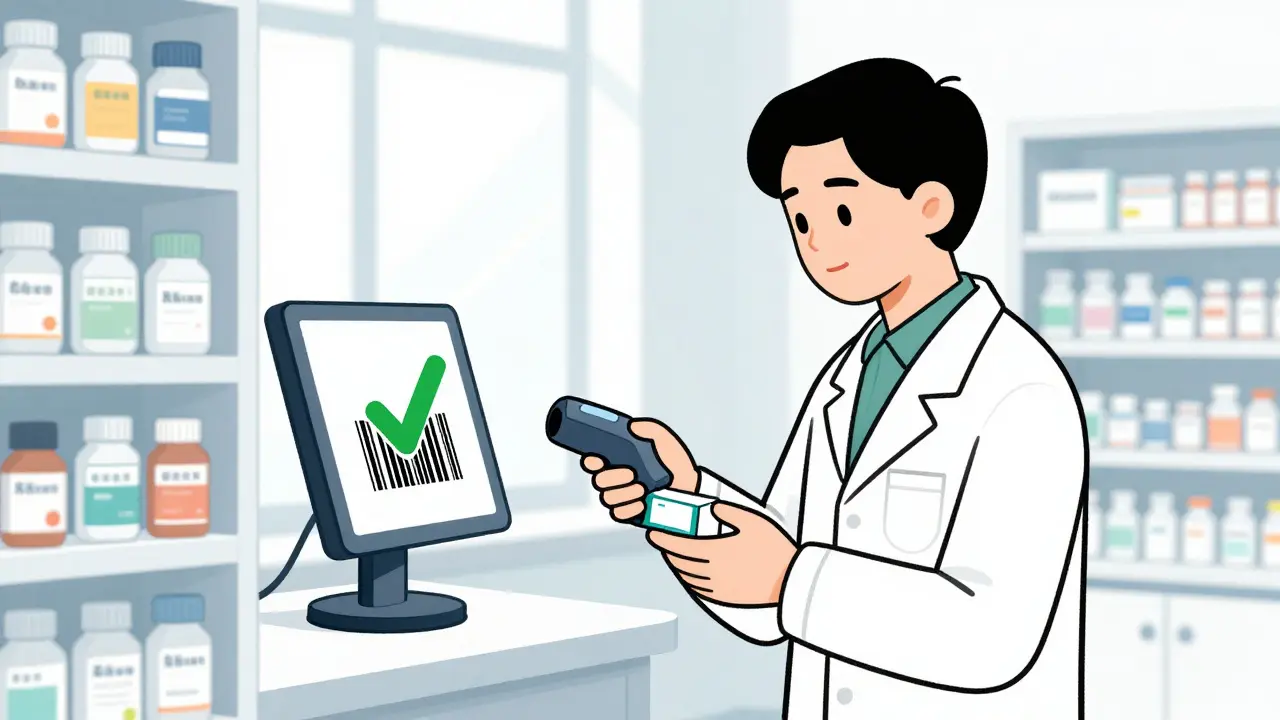
If you live in Europe, you’ve probably seen the small 2D barcode on your medicine box. That’s part of the Falsified Medicines Directive (FMD), which became mandatory on February 9, 2019. Every prescription medicine sold in the EU now has a unique 12-digit serial number, a batch number, and an expiry date encoded in a Data Matrix code. When you pick up your prescription at the pharmacy, the pharmacist scans that code. The system checks it against the EU Hub - a centralized database that tracks every medicine from factory to pharmacy. If the code doesn’t match, or if the product has already been sold, the system flags it instantly. The EU requires 100% verification at the point of dispensing. That means every single pack is checked before it reaches you. A 2018 study of NHS pharmacists found that 70% found the system quick and easy to use. But early on, many pharmacies struggled with confusing pop-up alerts. Some staff mistook a counterfeit warning for a message saying the drug had already been dispensed. That led to missed alerts. Today, most UK pharmacies use custom colors and audio alerts to reduce errors. As of August 2023, 14 NHS trusts are testing voice alerts to notify staff when a fake is detected - a change that could save lives.The U.S. Drug Supply Chain Security Act (DSCSA)
In the United States, the system works differently. The Drug Supply Chain Security Act (DSCSA) doesn’t require pharmacies to verify drugs at the point of sale. Instead, it focuses on tracking medicines as they move from manufacturer to wholesaler to distributor. By November 27, 2023, every entity in the supply chain had to be able to exchange electronic, interoperable transaction data. This means if a counterfeit drug enters the system, regulators can trace it back - but only after it’s already been distributed. There’s no final check at the pharmacy counter. That’s a major gap. The FDA admitted in its 2022 Supply Chain Security Report that this leaves patients unprotected. A 2023 proposed rule from the FDA now aims to fix that: by 2027, U.S. pharmacies will be required to verify prescriptions at the point of dispensing - finally aligning with the EU model. Until then, U.S. consumers have no direct way to check their own pills. That’s why many rely on third-party apps or physical inspection - both of which have limits.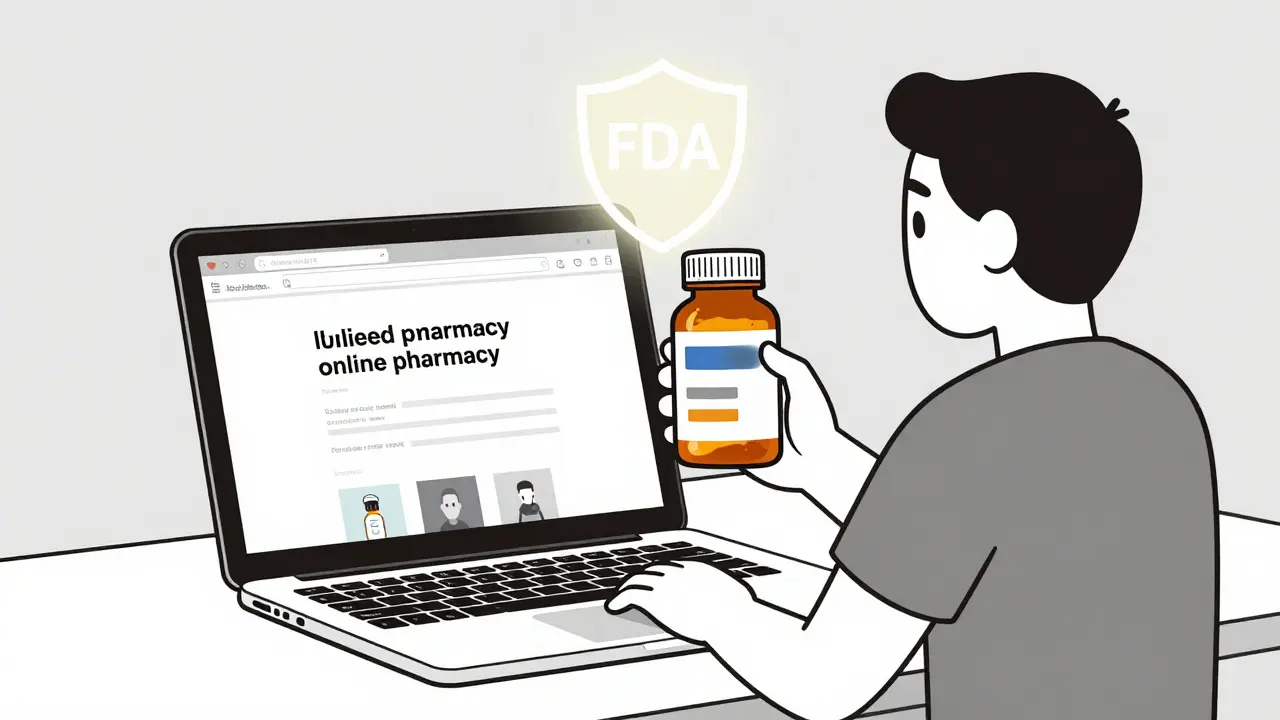
How to Spot a Fake: Tools You Can Use
You don’t need a lab to help protect yourself. Here are the official tools and methods available right now:- Serialization Scanners - Used by pharmacies in the EU. These handheld devices read the 2D barcode on medicine packs. They connect to national verification systems and return an instant ‘valid’ or ‘invalid’ result. Accuracy: 99.2%.
- Spectroscopic Devices - Handheld tools like NIR (near-infrared) or Raman spectrometers analyze the chemical signature of a pill. They don’t need to open the package. Accuracy in labs: 98.7%. In the field: 85-92%. The FDA and USP are building public spectral libraries for 1,200 essential medicines by 2025 - making these tools more accessible to frontline workers.
- QR Code Apps - Some manufacturers include QR codes on packaging that link to official verification pages. For example, Pfizer and Novartis let you scan a code to confirm batch details. But this only works if the code hasn’t been copied onto a fake package.
- Blockchain Systems - Used by companies like Pfizer and IBM. These create tamper-proof digital records of every step in the supply chain. Verification accuracy: 99.8%. But these systems are expensive - $2.7 million on average to implement - so they’re mostly used by large pharma, not small pharmacies.
- Molecular Taggants - Tiny, invisible markers added to the pill itself. These can be DNA-based or chemical. They’re nearly impossible to copy. Accuracy: 99.9%. But they add $0.03-$0.15 per pill to manufacturing costs, so adoption is slow.
What You Can Do as a Patient
Even without access to high-tech tools, you can take steps to protect yourself:- Check the packaging - Look for spelling errors, poor print quality, mismatched colors, or missing serial numbers. Fake medicines often have blurry text or inconsistent fonts.
- Compare with previous batches - If your pill looks different in size, color, or shape, ask your pharmacist. Don’t assume it’s just a generic switch.
- Buy only from licensed pharmacies - Avoid online sellers that don’t require a prescription or don’t list a physical address. The National Association of Boards of Pharmacy (NABP) offers a list of verified online pharmacies at www.pharmacychecker.com.
- Use official verification portals - If your drug brand offers a website or app to verify the batch, use it. Some companies like Sanofi and Roche provide this service.
- Report suspicious drugs - If something feels off, tell your pharmacist. They’re trained to report fake drugs to national authorities. In the UK, report to the MHRA; in the U.S., use the FDA’s MedWatch program.
Challenges and Limitations
No system is perfect. Even the best tech can fail if used wrong.- Human error - WHO says 72% of counterfeit detection failures are due to staff missing alerts or misreading screens. Training matters.
- System downtime - Pharmacies report an average of 2.3 hours of system outages per month. During those times, verification stops.
- Cost - Installing FMD systems costs an average of €285,000 per hospital pharmacy. Smaller clinics struggle to afford it.
- Speed - Each scan takes about 3.2 seconds. During busy hours, that adds up. Many U.S. pharmacists report delays that slow down patient care.
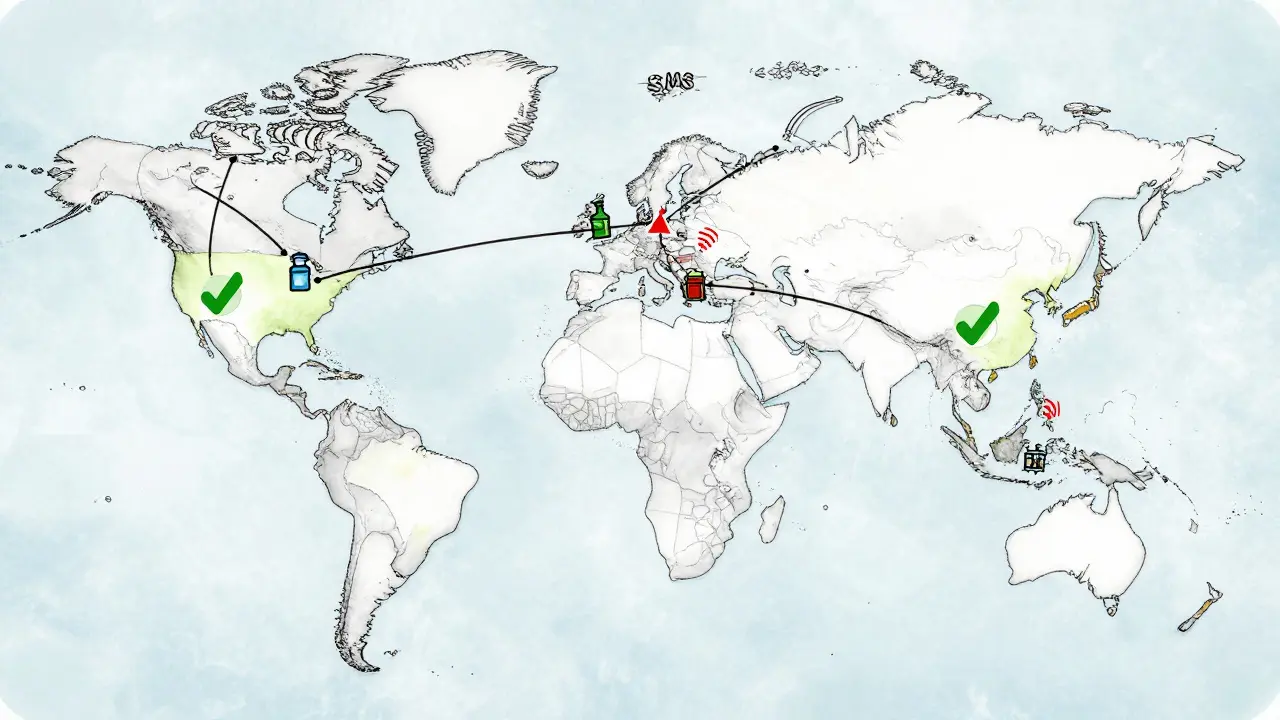
- Global inequality - In Africa and parts of Asia, SMS-based verification systems are common. But if your phone has no signal, the system fails. One study in Ghana showed only 68% effectiveness.
The Future of Drug Verification
The industry is moving fast. Here’s what’s coming:- AI-powered anomaly detection - The European Medicines Agency is testing AI that learns normal patterns in drug verification data. If a batch behaves oddly - say, 500 identical serial numbers appear in one day - the system flags it automatically. Pilot programs in 23 NHS hospitals improved detection rates by 40%.
- Public spectral libraries - The FDA and USP are building free databases of real drug signatures. In 2025, healthcare workers worldwide will be able to compare a pill’s spectral fingerprint against verified data - even with low-cost handheld devices.
- DNA barcodes - Alveron Pharma is testing molecular tags made of synthetic DNA. These can be read with a simple scanner and are impossible to replicate. Phase 3 trials are underway.
- Global harmonization - The Pharmaceutical Inspection Co-operation Scheme (PIC/S) is pushing for one global standard. By 2030, McKinsey predicts 95% of countries will use comprehensive verification systems.
But progress won’t reach everyone unless we invest in low-resource settings. As Professor David Bartram of Oxford University says: “SMS verification fails where connectivity is weak. We need portable, affordable tools for frontline workers - not just fancy tech for wealthy hospitals.”
Final Thoughts
Verifying drug authenticity isn’t just the job of regulators or pharmacists. It’s a shared responsibility. The tools exist - from high-tech scanners to simple visual checks. But they only work if people know how to use them. If you’re in the EU, trust the system. Scan your pills. Ask questions. If you’re in the U.S., be more cautious. Buy only from licensed pharmacies. Report anything suspicious. And stay informed - because in the fight against fake medicines, knowledge is your best defense.How can I tell if my medicine is fake?
Look for signs like poor packaging quality, misspellings, mismatched colors, or pills that look different from previous batches. In the EU, scan the 2D barcode at the pharmacy - it will tell you instantly if the drug is legitimate. In the U.S., buy only from licensed pharmacies and check the manufacturer’s website for batch verification tools if available.
Is it safe to buy medicine online?
Only buy from online pharmacies that require a prescription and show a physical address and license number. Use trusted lists like the NABP’s Verified Internet Pharmacy Practice Sites (VIPPS) or PharmacyChecker.com. Avoid sites that sell pills without a prescription - over 96% of these are illegal and often sell counterfeit drugs.
Do all countries have the same drug verification system?
No. The EU requires every prescription drug to be scanned at the pharmacy. The U.S. only requires tracking between distributors and manufacturers - not at the patient level. Low-income countries often rely on SMS or paper-based systems, which are less reliable. There’s no global standard yet, but efforts are underway to create one.
Can I verify my medicine with my smartphone?
You can scan QR codes or 2D barcodes if they’re on the packaging, but only if the manufacturer provides a verification link. Most smartphones can’t detect counterfeit drugs by camera alone. Spectral analysis or serialization checks require specialized hardware. Don’t rely on apps that claim to detect fakes with your phone’s camera - they’re not reliable.
What should I do if I think my medicine is fake?
Don’t take it. Contact your pharmacist or doctor immediately. In the UK, report it to the Medicines and Healthcare products Regulatory Agency (MHRA). In the U.S., file a report through the FDA’s MedWatch program. Keep the packaging and medicine - they may be needed for investigation.
Why don’t all pharmacies have verification systems?
Cost and infrastructure. Installing an FMD-compliant system costs over €285,000 per pharmacy. Many small clinics and independent pharmacies can’t afford it. In the U.S., there’s no legal requirement to verify at the point of sale yet. Even in the EU, some rural or low-budget pharmacies still struggle with internet connectivity or staff training.
Are generic drugs more likely to be fake?
No. Generic drugs are just as regulated as brand-name ones in countries with strong systems like the EU and U.S. But because they’re cheaper, counterfeiters often target them - especially in countries with weak oversight. Always buy generics from licensed pharmacies and check packaging carefully.
How accurate are handheld drug scanners?
Serialization scanners (reading 2D codes) are 99.2% accurate. Spectral scanners (NIR, Raman) are 98.7% accurate in labs, but drop to 85-92% in real-world use due to lighting, packaging, or operator error. Accuracy improves with training - field tests show that with 28 hours of training, health workers in Ghana reached 87% accuracy.
All Comments
Paul Ong January 2, 2026
This is huge. I never thought about how easy it is for fake meds to slip through. I just buy what my doc prescribes and assume it's safe. Scary stuff.
Richard Thomas January 4, 2026
The real tragedy here isn't just the counterfeit drugs themselves, but the systemic failure to treat pharmaceutical integrity as a human right. We've built entire economies around trust in medicine, yet we've outsourced verification to corporate logistics and left patients vulnerable. The EU model isn't just better-it's morally necessary. The U.S. system reads like a bureaucratic afterthought, prioritizing cost efficiency over life. And until we acknowledge that access to verified medicine is as fundamental as clean water or safe housing, we're just rearranging deck chairs on the Titanic. The FDA's 2027 deadline is a start, but it's a bandage on a hemorrhage.
Andy Heinlein January 5, 2026
I love that they're testing voice alerts in UK pharmacies. Imagine hearing a beep and a voice saying 'FAKE DRUG DETECTED' instead of staring at a tiny screen. That's the kind of simple fix that saves lives. Also, QR codes on packaging? Genius if you can trust them. I scanned my blood pressure pills last month and it actually worked. Felt like a spy or something 😎
Layla Anna January 5, 2026
I just checked my insulin box and noticed the font looked off... I called my pharmacy and they said it was a new batch but I'm still nervous. I'm so glad someone wrote this. I didn't know I could report it to MedWatch. I just did. Thank you for the info 🙏
Donna Peplinskie January 6, 2026
I'm from Canada, and we're somewhere in between the EU and the U.S. systems-partial scanning, but no real-time verification at the counter. It's frustrating. I've had to explain to my elderly mom why she can't just order pills from that 'amazing deal' website she found. She doesn't understand why we can't trust the internet. It's heartbreaking. We need public education campaigns-not just tech fixes.
Olukayode Oguntulu January 7, 2026
Ah yes, the Western obsession with technocratic solutions. While you all debate barcode scanners and AI anomaly detection, the Global South is drowning in counterfeit antimalarials because the WHO's 'SMS verification' systems collapse under 3G networks. Your €285,000 pharmacy scanners are a luxury. The real innovation? Community health workers with printed reference cards and basic training. You're optimizing the wrong problem. The issue isn't verification-it's equity. And equity doesn't come with a USB port.
jaspreet sandhu January 8, 2026
Everyone's talking about scanners and tech but no one's asking why the system lets this happen at all. In India, we've seen fake cancer drugs for years. The government does nothing. The FDA only acts after people die. The EU? They're just better at paperwork. The truth? Pharma companies don't want full transparency-it cuts profits. They'd rather pay fines than fix the supply chain. This whole article is a distraction. The real villain is profit motive, not bad packaging.
Alex Warden January 10, 2026
The U.S. is weak. Europe has the right idea. We need to mandate scanning like the EU. Why are we still letting criminals sell poison to Americans? It's pathetic. Our leaders are asleep at the wheel. This isn't a debate-it's a crisis. We need to get tough. Lock up the fakers. Ban the websites. End the nonsense.
Heather Josey January 10, 2026
Thank you for compiling such a comprehensive and vital resource. The distinction between the EU’s point-of-sale verification and the U.S.’s supply-chain-only approach is not just procedural-it’s ethical. The FDA’s upcoming 2027 mandate is a necessary step, but we must ensure funding and training accompany implementation. Pharmacists are on the front lines, and they deserve the tools to protect their patients-not just compliance checklists. I urge all healthcare institutions to begin pilot programs now.
LIZETH DE PACHECO January 11, 2026
I work in a small clinic and we can't afford the EU system. But we do check packaging, ask patients if their pills look different, and always recommend verified pharmacies. Small things matter. You don't need a scanner to care.
Kristen Russell January 12, 2026
I've been scanning my meds since 2021. It's a habit now. And honestly? It's the only thing keeping me sane.
Lee M January 13, 2026
The real problem isn't fake drugs. It's that we've outsourced responsibility to corporations and regulators. You think a barcode makes you safe? You're delusional. The system is designed to make you feel secure while the real players profit from the chaos. Trust no one. Question everything.
gerard najera January 14, 2026
Scan it. Report it. Don't wait.
Ann Romine January 15, 2026
I grew up in a country where medicine came from a neighbor’s cousin’s cousin. I never knew what was real or fake. Now I live in the U.S. and I still don’t trust the system. But this article helped me understand what’s possible. I’m sharing it with my mom. She’s 78. She needs to know.