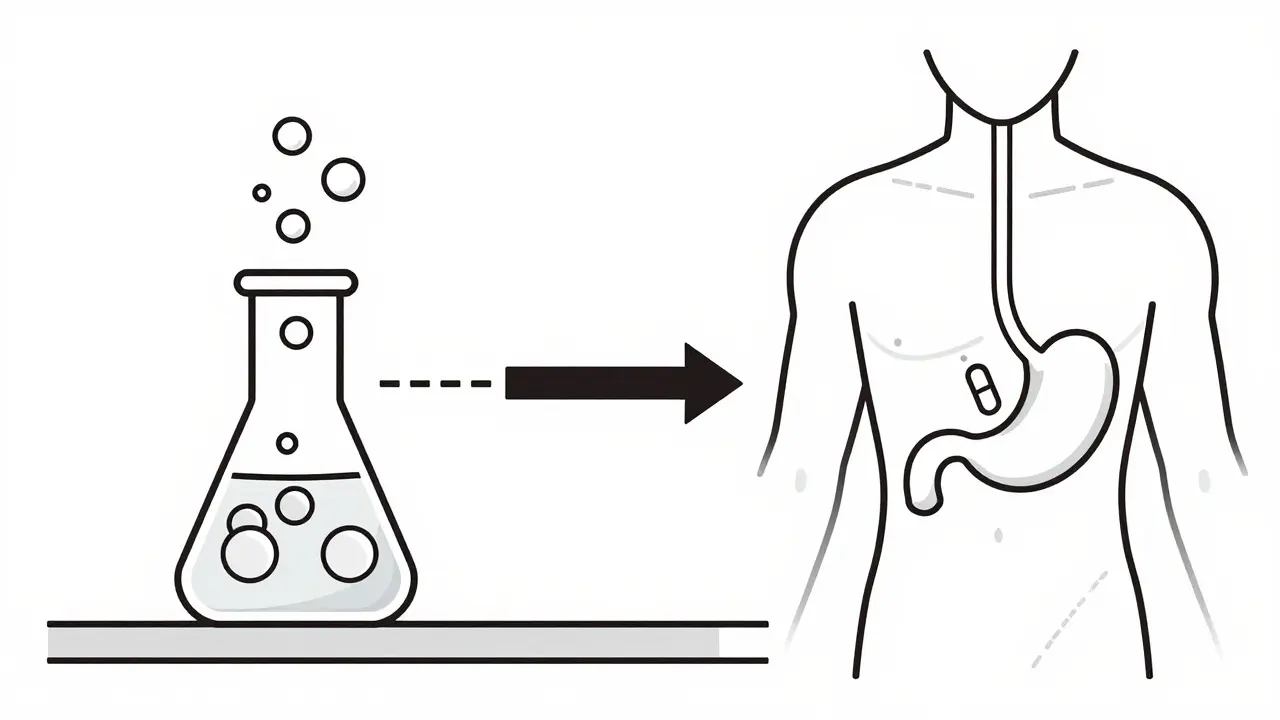
Imagine skipping a six-month clinical trial with 30 volunteers because your lab data proves the drug works. That is exactly what In Vitro-In Vivo Correlation (IVIVC) allows pharmaceutical companies to do. By mathematically linking how fast a tablet dissolves in a beaker to how much drug hits the bloodstream in a human body, IVIVC serves as a bridge between laboratory science and patient safety. This technique is critical for creating generic versions of complex extended-release medications without repeating expensive and time-consuming bioequivalence (BE) studies.
The core promise here is efficiency. Traditional BE testing requires recruiting healthy volunteers, administering multiple doses, and collecting blood samples over several days. With a validated IVIVC model, regulators like the FDA and EMA accept dissolution data as a surrogate marker for human performance. If you can prove that your new formulation dissolves at the same rate as the reference product, you might get a waiver from further clinical trials. But getting there is not easy; it requires precise modeling, robust data, and a deep understanding of pharmacokinetics.
Key Takeaways
- IVIVC establishes a quantitative link between in-vitro dissolution rates and in-vivo drug absorption, allowing labs to predict human response.
- Level A correlations are the gold standard, offering point-to-point predictability with R² values typically exceeding 0.95.
- Implementing IVIVC can save $1-2 million per study and reduce development timelines by 6-12 months compared to traditional clinical trials.
- Regulatory acceptance varies significantly by product type, with oral extended-release products having higher approval rates than complex injectables or ophthalmics.
- Biorelevant dissolution testing is becoming the new standard, incorporating physiological conditions like pH gradients to improve model accuracy.
What Exactly Is IVIVC and Why Does It Matter?
In Vitro-In Vivo Correlation (IVIVC) is a predictive mathematical model that connects the release of a drug from its dosage form in a laboratory setting to its concentration in the systemic circulation of a living organism. First formally recognized by the U.S. Food and Drug Administration (FDA) in the 1990s, this concept was born out of necessity. Pharmaceutical companies needed a faster way to develop generics for modified-release products, where simple immediate-release rules did not apply. Without IVIVC, every minor change to a formula could trigger a full clinical trial. With it, you can often justify changes based on lab data alone.
The value proposition is clear: cost and speed. According to Premier Research’s 2023 analysis, avoiding a single bioequivalence study saves approximately $1-2 million and cuts 6-12 months off the development clock. For generic manufacturers competing in a tight market, these savings are the difference between profit and loss. However, IVIVC is not a magic bullet. It works best when the relationship between dissolution and absorption is straightforward. If a drug has non-linear pharmacokinetics or interacts heavily with food, the correlation weakens, and regulators may still demand in-vivo data.
Understanding the Four Levels of Correlation
Not all IVIVC models are created equal. The FDA classifies them into four levels based on their predictive power. Knowing which level you are aiming for determines your entire strategy.
- Level A: The highest tier. This creates a point-to-point relationship between in-vitro dissolution and in-vivo input rate. If you have a Level A model, you can predict the entire plasma concentration profile just from dissolution data. It requires a linear regression with a slope close to 1.0 and an intercept near zero. Think of it as a direct translation key between the lab and the body.
- Level B: Uses population approaches or methods of moments to relate mean dissolution time to mean residence time. It tells you about average behavior but lacks the precision to predict individual peaks or troughs.
- Level C: Establishes a single-point relationship, such as linking percent dissolved at one hour to Cmax (maximum concentration). It is useful but limited to that specific parameter.
- Multiple Level C: Expands Level C by correlating multiple dissolution time points with various pharmacokinetic parameters. While easier to build than Level A, experts like Dr. Jennifer Dressman caution that it often fails to capture the full complexity of drug release.
For biowaiver applications, Level A is strongly preferred. Regulators want to see that your model can predict within ±10% for AUC (area under the curve) and ±15% for Cmax. Anything less raises red flags during review.
The Regulatory Landscape: FDA vs. EMA
Navigating regulatory requirements is half the battle. The FDA’s 2014 guidance document remains the primary rulebook for IVIVC in the United States, while the European Medicines Agency (EMA) relies on its Guideline on the Investigation of Bioequivalence. Both agencies agree on the fundamentals but differ in emphasis.
The FDA has shown increasing openness to IVIVC submissions. Their GDUFA III progress report noted a 35% increase in IVIVC submissions from 2018 to 2022, with approval rates jumping from 15% to 42%. This shift reflects better industry understanding and improved modeling techniques. The EMA, through its Committee for Medicinal Products for Human Use (CHMP), issued a scientific opinion in 2020 stressing that models must demonstrate robustness across multiple physiological variables. This is particularly true for complex generics like ophthalmic and injectable products, where absorption mechanisms are harder to model.
If you are targeting both markets, aim for the stricter standard. A model that satisfies EMA robustness requirements will likely pass FDA scrutiny. Conversely, a model tailored only to FDA expectations might face questions in Europe regarding physiological relevance.
Practical Implementation: What You Need to Succeed
Building a successful IVIVC model is a multidisciplinary effort. It requires expertise in pharmaceutics, pharmacokinetics, and statistical modeling. Here is what a typical development pathway looks like:
- Dissolution Method Development (3-6 months): You need a discriminatory method. This means your test must detect small differences in formulation. If two formulations look identical in your test but behave differently in the body, your model is useless. USP Apparatus 1 or 2 are common choices, but biorelevant media that mimic gastrointestinal pH and bile salts are increasingly required.
- Pharmacokinetic Studies (6-9 months): Conduct at least three studies with 12-24 subjects each. Use dense sampling-minimum 12 time points per profile-to capture the full absorption curve. Poor data quality here is the leading cause of failed submissions.
- Model Building and Validation (3-6 months): Fit the data to a Level A model. Validate it against a separate dataset to ensure it predicts accurately. Check for physiological relevance: does the dissolution rate match known absorption mechanisms?
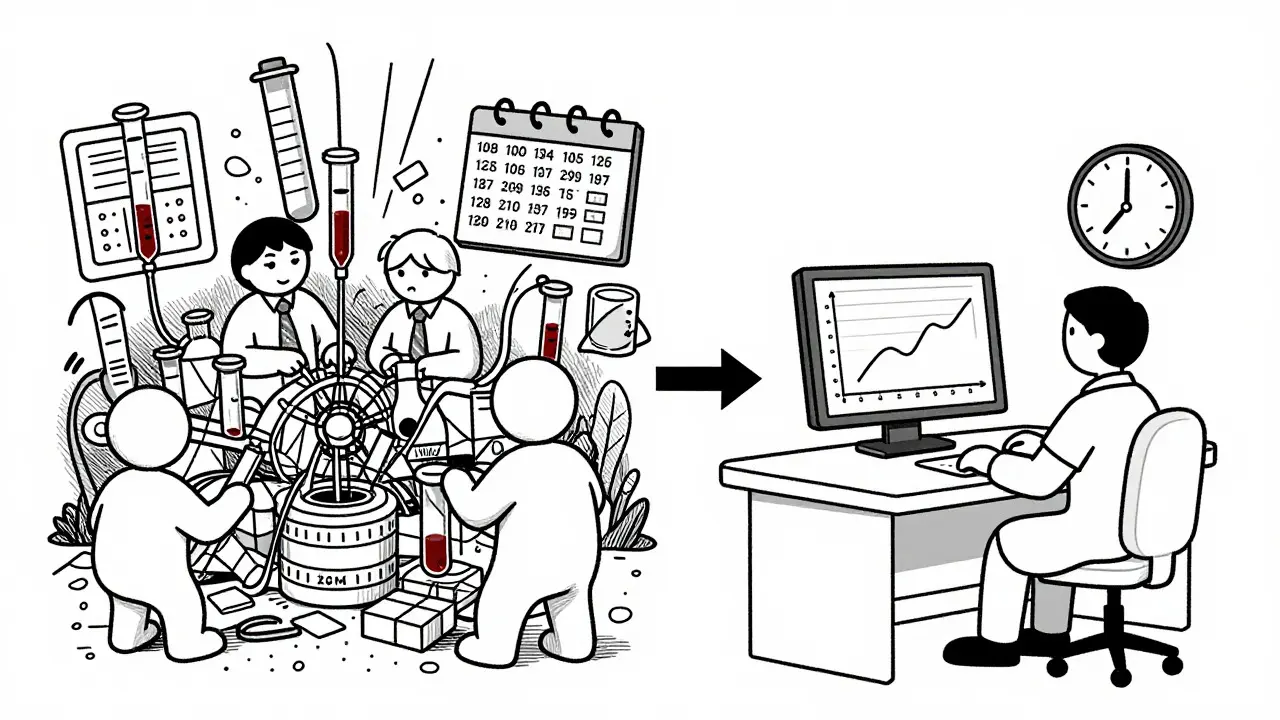
Industry surveys reveal why many attempts fail. A Complex Generics Organization survey found that 76% of companies cited insufficient formulation characterization as a challenge. Another 63% struggled with inadequate dissolution method discrimination. To avoid these pitfalls, start early. Engage with regulators for scientific advice before committing to full-scale studies. Teva Pharmaceutical reported that their IVIVC for extended-release oxycodone took 14 months and three formulation iterations, but ultimately saved five additional BE studies. That is a win worth the initial investment.

Comparison: IVIVC vs. Traditional Bioequivalence
| Feature | IVIVC-Supported Biowaiver | Traditional In-Vivo BE Study |
|---|---|---|
| Cost per Study | $1-2 million savings avoided | $500,000 - $2 million |
| Timeline | Reduces timeline by 6-12 months | Typically 3-6 months for conduct + analysis |
| Volunteers Required | None for post-approval changes | 24-36 healthy volunteers |
| Applicability | Modified-release, complex generics | All drug types, especially narrow therapeutic index |
| Regulatory Risk | Moderate (model validation required) | Low (direct evidence of equivalence) |
| Expertise Needed | Advanced PK modeling, dissolution engineering | Clinical trial management, nursing, data collection |
While traditional BE studies provide direct proof of equivalence, they are resource-intensive. IVIVC shifts the burden to pre-clinical rigor. If your lab work is flawless, the regulatory risk drops significantly. But if your dissolution method isn't discriminatory, you are building a house on sand.
Emerging Trends and Future Directions
The field is evolving rapidly. Two major trends are shaping the future of IVIVC: biorelevant dissolution testing and machine learning integration.
Biorelevant dissolution testing moves beyond standard buffer solutions. It incorporates physiological conditions like varying pH gradients and bile salt concentrations to better simulate the gastrointestinal environment. The American Association of Pharmaceutical Scientists forecasts that by 2025, 75% of new IVIVC submissions will use biorelevant methods for complex products. This approach addresses the top reason for failed submissions: inadequate physiological relevance.
Machine learning is also entering the scene. At a 2024 joint workshop, both FDA and EMA officials expressed openness to ML-enhanced IVIVC models, provided they maintain scientific transparency. These algorithms can handle complex, non-linear relationships that traditional linear regression struggles with. However, regulators remain cautious. They want to understand how the model makes its predictions, not just that it works. Black-box models without explainability may face hurdles.
Looking ahead, McKinsey & Company projects that IVIVC-supported biowaivers will account for 35-40% of all modified-release generic approvals by 2027, up from 22% in 2022. This growth is driven by regulatory harmonization and improved modeling tools. For companies willing to invest in the necessary expertise, the payoff is substantial.
Frequently Asked Questions
What is the main difference between Level A and Level C IVIVC?
Level A IVIVC provides a point-to-point correlation between in-vitro dissolution and in-vivo absorption, allowing prediction of the entire pharmacokinetic profile. Level C only correlates a single dissolution parameter (like % dissolved at 1 hour) with a single pharmacokinetic parameter (like Cmax), limiting its predictive scope.
Can IVIVC be used for immediate-release products?
Generally, no. Immediate-release products usually qualify for biowaivers through the Biopharmaceutics Classification System (BCS), which is simpler. IVIVC is primarily reserved for modified-release or complex products where BCS principles do not fully apply.
How long does it take to develop a valid Level A IVIVC model?
A typical Level A IVIVC development pathway takes 12-18 months. This includes 3-6 months for dissolution method development, 6-9 months for pharmacokinetic studies, and 3-6 months for model building and validation.
What are the most common reasons for IVIVC submission failure?
The top reasons include inadequate physiological relevance of dissolution methods (cited in 82% of failed cases), insufficient formulation space coverage (74%), and inadequate model validation strategies (68%). Ensuring your dissolution test mimics real-world GI conditions is critical.
Is IVIVC accepted by both FDA and EMA?
Yes, both agencies accept IVIVC for supporting biowaivers, particularly for modified-release products. However, the EMA places greater emphasis on demonstrating robustness across multiple physiological variables, so models should be designed to meet the stricter European standards to ensure global acceptance.
All Comments
Amy Zalkin August 24, 2026
ok so the part about skipping the six month trial with 30 volunteers is actually super cool to me
like who knew a beaker could basically do the heavy lifting for human safety checks? i always thought pharma was just all about big labs and white coats but this feels more like magic math stuff
the bit where they say it saves like $1-2 million is also wild because that is a lot of money just gone if you get it wrong
Alex Brown August 25, 2026
The philosophical implication here is profound: we are essentially trading empirical certainty for mathematical elegance. If the model holds, it suggests that biological systems, despite their chaotic reputation, possess an underlying order that can be captured by simple linear relationships. This is optimistic in the sense that it democratizes access to complex generics, yet it remains fragile; one outlier patient or a slight deviation in gut pH can shatter the correlation. We must remain humble before the complexity of life, even as we seek to simplify it through data.
Kaylyn Mello August 27, 2026
i totally agree with the point about the cost savings being the main driver
it makes so much sense why companies would jump on this bandwagon if it cuts months off the timeline
just curious how often these models actually fail though since the article says 76% have issues with formulation characterization which sounds like a lot
joyce Hogewoning August 28, 2026
oh my god did anyone else notice that the approval rate jumped from 15% to 42% in just four years?? that is insane right? i mean sure the article says its because of better modeling techniques but what if its just that the regulators got tired of saying no and started rubber stamping things because the industry lobbied them into submission? i feel like we should be skeptical about any sudden spike in success rates especially when the stakes are literally people taking medicine based on a computer prediction instead of actual blood tests
its giving major 'trust us we did the math' energy which is terrifying if you think about it
Thhomas Fox August 29, 2026
Nice breakdown of the levels. Level A really is the holy grail here. It’s not just about speed; it’s about precision. If you nail the dissolution method, the rest follows. Great read.
Owen John August 31, 2026
One wonders if this 'efficiency' is merely a smokescreen for Big Pharma to offload risk onto the consumer. The FDA's sudden embrace of ML-enhanced models smells of regulatory capture. When was the last time a black-box algorithm was truly auditable by the public? I suspect the 'biorelevant' testing is just a fancy term for proprietary lab conditions that favor incumbent manufacturers. The real story isn't science; it's consolidation. Enjoy your synthetic peace of mind while the giants tighten their grip on the supply chain.
Maneesh kv September 1, 2026
Great post but let me tell you from experience in India 🇮🇳 the reality is different! 😤
We struggle with basic dissolution equipment calibration let alone biorelevant media!
Why does FDA accept ML models but EMA wants robustness across variables?
It is unfair for developing nations! 💢
Need global harmonization NOW! 🔥
Stop making generics expensive with these strict rules! 👊
Lilian Binda September 2, 2026
this whole thing shows how western standards dictate everything for the rest of the world
why should nigeria wait for ema or fda validation when our own patients need these drugs now?
it is arrogant to assume our bodies react exactly like the models built in europe or america
we need local bioequivalence studies not imported waivers
stop copying the west blindly and start investing in our own research infrastructure
our health is not a side effect of their profit margins