Every year, over 1.5 million people in the U.S. end up in the emergency room because of something gone wrong with their medicine. Not because the drug was bad, but because someone misunderstood what to take, when to take it, or why. This isn’t rare. It’s common. And most of these mistakes are preventable - if patients know a few simple terms and feel confident enough to use them.
What Are the Eight Rights of Medication Safety?
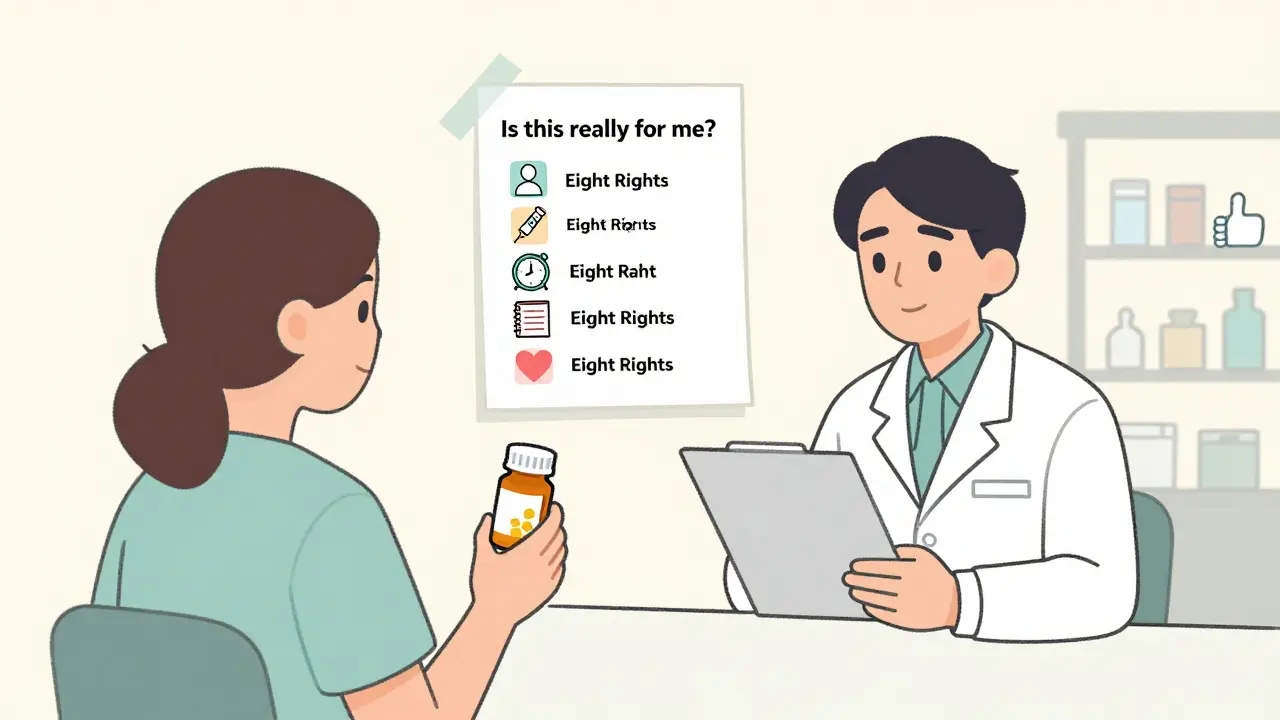
The foundation of medication safety isn’t a complicated algorithm or a high-tech app. It’s a simple list: the Eight Rights. These aren’t suggestions. They’re checklists you can use every time you pick up a prescription, get a shot, or refill a bottle.
- Right patient - Make sure the name on the bottle matches yours. Ask: "Are you sure this is for me?" Hospitals must check two things - your full name and date of birth - before giving you anything. Don’t let them skip this.
- Right medication - Know both the brand and generic name. If your doctor says "Lisinopril," but the label says "Zestril," that’s the same thing. But if it says "Lisinopril" and you were expecting "Lipitor," stop. Ask.
- Right dose - Is it 5 mg or 50 mg? A teaspoon or a tablespoon? For kids, even a small mistake can be dangerous. Always ask how to measure it correctly. Liquid medicines often come with a syringe - never use a kitchen spoon.
- Right route - Is this meant to be swallowed, injected, applied to the skin, or inhaled? If you’re told to take a pill orally, but the label says "for IV use only," that’s a red flag. One in eight serious errors happens because the route is wrong.
- Right time - Are you supposed to take this with food? Before bed? Every 8 hours? Setting a phone alarm helps. Studies show people who track their times reduce mistakes by over 30%.
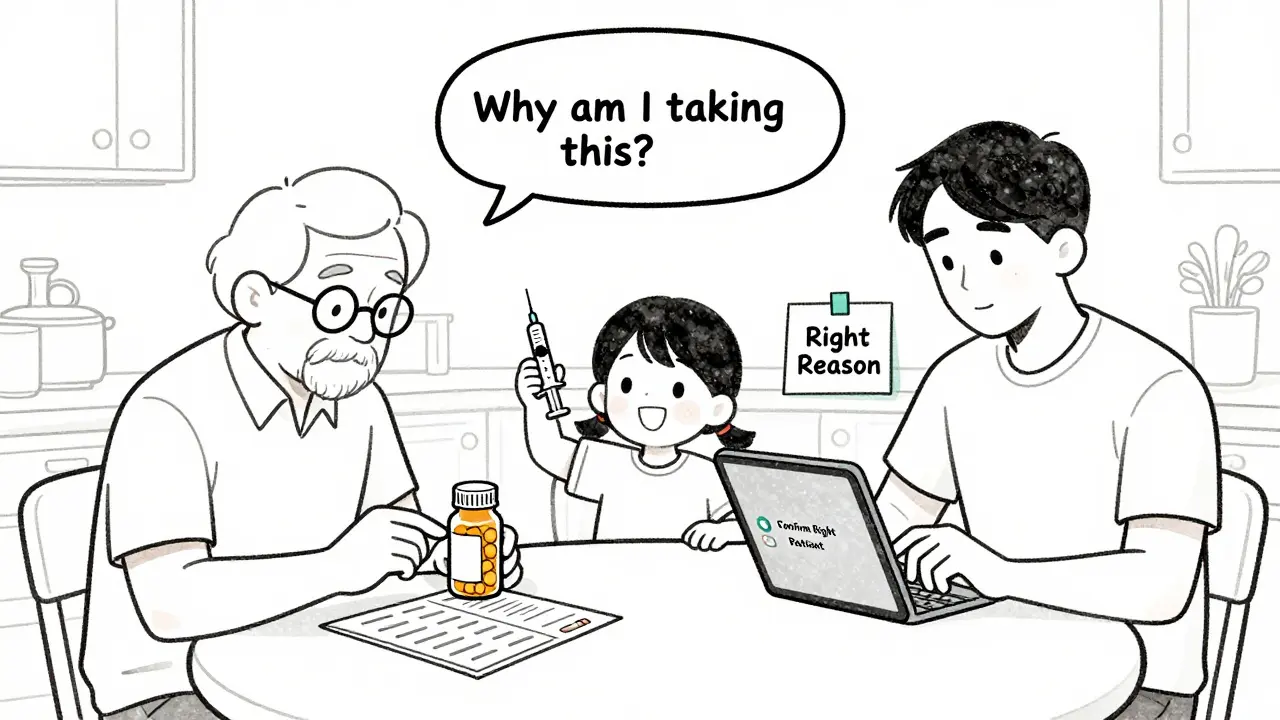
- Right reason - Why are you taking this? Not just "for blood pressure," but "to lower your systolic number so you don’t have a stroke." If your doctor can’t explain it clearly, ask again. Patients who understand why they’re on a drug are 28% less likely to take something they don’t need.
- Right documentation - Did the nurse write down that you got the shot? Did the pharmacist note your allergy? You should get a printed list of all your meds at discharge. Keep it. Update it. Bring it to every appointment.
- Right response - Are you feeling better? Worse? Any new rash, dizziness, or nausea? Track it. Tell your provider. Patients who monitor their reactions cut their risk of serious side effects by 35%.
What Is an Adverse Drug Event?
An adverse drug event - or ADE - is when a medicine causes harm. It’s not just a side effect. A side effect might be a dry mouth or drowsiness. An ADE is when that dry mouth leads to dehydration. When drowsiness causes a fall. When a drug interacts with another and sends your liver into shock.
The CDC says ADEs are one of the top preventable problems in healthcare. They happen because of errors - wrong dose, wrong drug, wrong patient - or because the medicine just doesn’t agree with your body. Allergies count. Overdoses count. Even taking too many pills because you forgot you already took one.
Here’s what you need to do: If you feel something unusual after starting a new drug - even if it seems minor - write it down. Call your pharmacist. Don’t wait until you’re in pain. Early reporting can stop a bad reaction before it becomes an emergency.
What Are High-Alert Medications?
Some medicines are more dangerous than others. Not because they’re weak - but because they’re powerful. These are called high-alert medications. If you mess up with these, the consequences can be deadly.
Examples include:
- Insulin (too much can crash your blood sugar)
- Blood thinners like warfarin or apixaban (too little can cause clots; too much can cause bleeding)
- Opioids like oxycodone or fentanyl (overdose risk is real)
- Intravenous potassium (can stop your heart if given too fast)
- Chemotherapy drugs
These aren’t rare. One in five hospital patients gets at least one. And according to the Institute for Safe Medication Practices, they’re involved in 67% of fatal medication errors.
What should you do? If you’re given one of these, ask: "Is this a high-alert drug?" Then ask your provider to double-check the dose with another nurse or pharmacist. Don’t be shy. These drugs are so risky that hospitals have extra safety steps for them - you have the right to demand those steps.
What Is a Close Call?
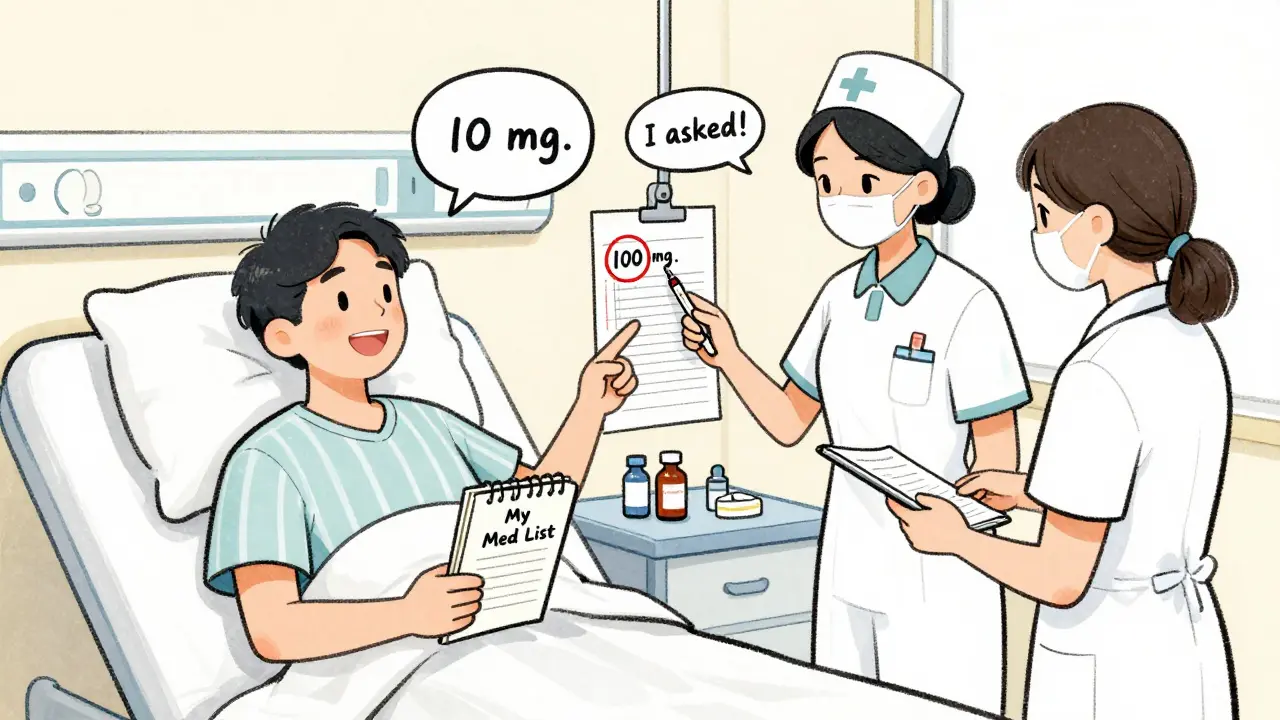
A close call is when something almost went wrong - but didn’t. Maybe the nurse caught the wrong dose before giving it. Maybe the pharmacist noticed the prescription said "10 mg" but the label said "100 mg." Maybe you spotted that the pill looked different than last time and asked about it.
These aren’t failures. They’re wins. And they’re proof that your attention matters.
The VA Patient Safety Glossary defines a close call as an event that "could have resulted in an accident, injury, or illness, but did not, either by chance or through timely intervention." That’s you. You’re the intervention.
Don’t brush off close calls. Tell your provider. Write it down. If you noticed a mistake, you’re not being difficult - you’re saving lives, including your own.
What Are Sentinel Events?
A sentinel event is the worst-case scenario. It’s when a medication error leads to death, permanent harm, or serious injury. The Joint Commission - the group that certifies hospitals - calls these "unexpected occurrences involving death or serious physical or psychological injury, or risk thereof."
Medication errors are one of the top causes of sentinel events. That’s why hospitals are required to report them. But you don’t have to wait for a tragedy to act.
If you hear the word "sentinel" in a hospital setting, it means something went terribly wrong. But you can help prevent it from ever getting there by using the Eight Rights every single time.
Why This Matters More Than Ever
In 2025, more people are taking more medicines than ever before. Older adults often juggle five, ten, even fifteen prescriptions. New drugs come out fast. Insurance changes mean switching brands. Telehealth visits mean less face time with your doctor.
But here’s the good news: Between 2018 and 2023, patient use of these safety terms rose 22%. And during that same time, the number of preventable adverse events dropped 17%.
Why? Because patients started asking questions. They started saying, "Wait - is this right?" They started writing things down. They started checking labels. And they stopped being afraid to speak up.
Medication safety isn’t just about doctors and pharmacists. It’s about you. You are the last line of defense. You’re the one holding the pill bottle. You’re the one who notices the smell, the color, the size, the timing. You’re the one who remembers you’re allergic to sulfa, even if the chart doesn’t.
How to Start Using These Terms Today
You don’t need to memorize all eight rights at once. Pick one. Start with "right reason."
Next time you get a new prescription, ask: "Why am I taking this? What’s it supposed to do?" Write the answer down. If you don’t understand, say so. Ask again. Use simple words.
Then move to "right dose." Check the number. Check the unit. Is it mg, mcg, mL? If it’s a liquid, ask for the syringe. Don’t guess.
Use a free app like Medisafe (used by over 8 million people) to track your meds. It reminds you when to take them and even asks you to confirm the right patient, right drug, right dose before you tap "take."
Bring your list to every appointment - even the dentist. Many people don’t realize dentists need to know about your blood thinners. Or that your heart medicine might interact with a painkiller.
And if you ever feel unsure - stop. Don’t take it. Call your pharmacist. They’re trained to catch these mistakes. And they won’t mind you asking.
What’s Changing Now
As of 2024, every U.S. hospital that uses Epic’s electronic health system must ask patients: "What is the reason you’re taking this medication?" before they leave the hospital. That’s because of the Joint Commission’s updated safety goals.
Pharmacies now offer multilingual safety sheets in 15 languages. Medication reconciliation - the process of making sure your list of drugs is accurate - is now standard at discharge.
And the CDC and FDA have set a goal: by 2030, 90% of patients should be able to name at least five of these safety terms. Right now, only 43% can. You can help change that number.
You don’t need to be a doctor. You don’t need a degree. You just need to care enough to ask. And to speak up.
What should I do if I think I received the wrong medicine?
Stop. Don’t take it. Call your pharmacy immediately. Have your prescription number and the pill description ready. Ask them to confirm the name, dose, and reason. If they say it’s correct but it still feels wrong, ask to speak to the pharmacist directly. Never hesitate - it’s better to be safe than sorry.
Can I trust the label on my pill bottle?
The label is your first line of defense, but it’s not foolproof. Errors happen - especially with similar-sounding names like Celebrex and Celexa. Always compare the label to your doctor’s prescription. If you’re unsure, call your pharmacist. They’re required to verify it’s correct before dispensing.
Do I really need to know the generic name of my drug?
Yes. Generic names are the actual chemical names. Brand names change based on who makes the drug. If you know the generic - like metformin instead of Glucophage - you can recognize it no matter which pharmacy you use or which insurance plan you have. It also helps you spot duplicates. You might be prescribed two different brand names that are actually the same drug.
What if my doctor doesn’t want to answer my questions?
You have the right to understand your care. If your doctor dismisses your questions, ask for a second opinion. Or ask to speak with a pharmacist. Many clinics have medication therapists who specialize in helping patients understand their prescriptions. Your safety matters more than their convenience.
Are there tools to help me remember all this?
Yes. Apps like Medisafe, MyTherapy, and Mango Health let you log your meds, set reminders, and even alert you if a new prescription might interact with something you’re already taking. You can also keep a simple paper list in your wallet - updated after every visit. Write the drug name, dose, reason, and time. Keep it with you.
All Comments
Erica Vest December 20, 2025
The Eight Rights of Medication Safety are non-negotiable. Every patient deserves to be treated as a partner, not a passive recipient. If you don’t know the difference between mg and mcg, you’re playing Russian roulette with your health. Always verify the dose, the route, and the reason. Pharmacies are required to counsel you-use that service. Write it down. Keep a physical list. Your life depends on it.
And yes, generic names matter. Metformin is metformin whether it’s Glucophage, Riomet, or a store brand. Brand names are marketing. Generics are science. Know your science.
Chris Davidson December 22, 2025
People die because they dont ask questions and hospitals dont care enough to make them
Kinnaird Lynsey December 23, 2025
So let me get this straight-now I’m supposed to be a pharmacist, a nurse, and a medical ethicist just to take my blood pressure pill? I get it, safety’s important. But let’s be real: most of us are exhausted, overworked, and confused. You can’t just dump a checklist on someone who’s already drowning.
Maybe the system should fix itself instead of putting the entire burden on patients who don’t even have time to eat lunch. Still… I’ll use the list. Because what else can I do?
Andrew Kelly December 25, 2025
They want you to memorize Eight Rights? What’s next? A quiz before you get your insulin? This is all a distraction. The real problem is pharmaceutical companies pushing drugs that shouldn’t exist. The FDA is corrupt. The doctors are paid kickbacks. The labels? Fabricated. You think they care if you know the difference between Lisinopril and Zestril? They care if you keep buying it.
And don’t get me started on ‘high-alert meds.’ That’s just a fancy term for ‘we know this could kill you but we’re still selling it.’ You’re not the last line of defense-you’re the last sucker.
My advice? Stop taking anything unless you’ve researched it on PubMed. And never trust a pharmacist who smiles too much. They’re paid to sell, not to save.
Anna Sedervay December 25, 2025
One must question the epistemological underpinnings of the so-called Eight Rights, as they presuppose a Cartesian dichotomy between patient and provider-a hierarchy that fundamentally undermines the phenomenology of embodied care. The notion that one can ‘verify’ one’s own identity via two data points (name and DOB) is a reductive technocratic illusion, a neoliberal fiction designed to absolve institutions of their moral responsibility.
Furthermore, the term ‘close call’ is linguistically infantilizing. It renders near-fatal systemic failures into benign anecdotes. One does not ‘catch’ a lethal error like a baseball. One must dismantle the entire apparatus of pharmaceutical capitalism. And yes, I do have a PhD in bioethics.
Also, you spelled ‘systolic’ wrong in the third paragraph. It’s ‘systollic’ if you’re using the Latin root. Just saying.
Matt Davies December 27, 2025
Man, this post is like a lighthouse in a storm of confusion. I’ve seen too many elderly folks on five meds, all in different bottles, all with different instructions, and no one ever checks if they’re overlapping. I had my aunt almost mix up her thyroid med with her blood pressure pill-same size, same color. She’s fine now, but barely.
Use the apps. Write it down. Ask the dumb questions. The pharmacist doesn’t mind. I promise. I’ve worked in one for 12 years. The ones who survive are the ones who speak up. You’re not annoying-you’re the reason someone didn’t end up in the ER.
Mike Rengifo December 27, 2025
I used to just swallow pills and hope for the best. Then I got hospitalized for a reaction to a new antibiotic. Turned out I was allergic to sulfa but the chart said 'no known allergies.' I didn't even know that was a thing until the nurse asked. Now I carry a card. I write everything down. I ask. It's not hard. It's just different.
Mahammad Muradov December 29, 2025
These so-called safety terms are merely symptoms of a broken system. In India, we don’t have apps or printed lists. We have family members who memorize the names, doses, and side effects. We have elders who cross-check prescriptions with the local pharmacist. We have trust built over decades, not digital reminders.
Why are Americans so dependent on checklists? Because they’ve lost community. You don’t need to know the Eight Rights-you need to know someone who cares enough to remind you.
Also, insulin is not a ‘high-alert’ drug. It’s a life-saver. The problem isn’t the drug. It’s the price. And the greed behind it.
Monte Pareek December 29, 2025
Listen. I’ve been a nurse for 27 years. I’ve seen people die because they didn’t ask. I’ve seen people live because they did. You think this is about memorizing terms? No. It’s about courage. It’s about refusing to be silent when something feels off.
I had a patient once-78-year-old woman, diabetic, on warfarin. She noticed the pill looked different. She didn’t say anything. I found out later she’d been taking double the dose for three days. Her INR was 9. She almost bled out.
She didn’t know the term ‘right dose.’ She just knew something felt wrong. And that’s all you need.
So stop reading lists. Start trusting your gut. Ask. Again. And again. And if someone rolls their eyes? Walk out. Find someone who listens. Your life isn’t a footnote in a chart. It’s your life. Fight for it.
And yes, use Medisafe. It saved my mom’s life. I’m not kidding.
Elaine Douglass December 31, 2025
I just started taking something new and I was scared to ask what it was for because I didn't want to sound dumb but then I asked and the pharmacist drew me a little picture of how it works in the body and I cried because no one ever explained it like that before
Takeysha Turnquest January 2, 2026
The Eight Rights are not a checklist. They are a revolution. A quiet uprising of the powerless against the machinery of medical arrogance. Every time you say ‘Is this really for me?’ you are striking a blow against the commodification of human life.
We are not patients. We are not subjects. We are witnesses. We are the ones who hold the bottle. We are the ones who feel the tremor in our hands, the strange taste, the silence where the doctor should have spoken.
When you ask about the right reason, you are not asking for information-you are demanding dignity.
And if you don’t feel that? Then you haven’t been sick enough yet.
Jedidiah Massey January 3, 2026
Let’s be real-this is all performative safety theater. The system doesn’t want you to know the difference between generic and brand-it wants you to keep buying the expensive version. And don’t get me started on ‘medication reconciliation.’ That’s just a fancy word for ‘we lost your list, but we’ll pretend we didn’t.’
Pro tip: If you’re on more than 5 meds, you’re probably being overmedicated. Ask your doctor: ‘If I stopped everything, what would I absolutely need to survive?’ That’ll shut them up. 😎
Also, Epic EHR is a dumpster fire. I work in IT. I’ve seen the code. They auto-populate meds based on ‘similar patients.’ You think your list is accurate? It’s not. It’s AI hallucinating your prescriptions. 🤖