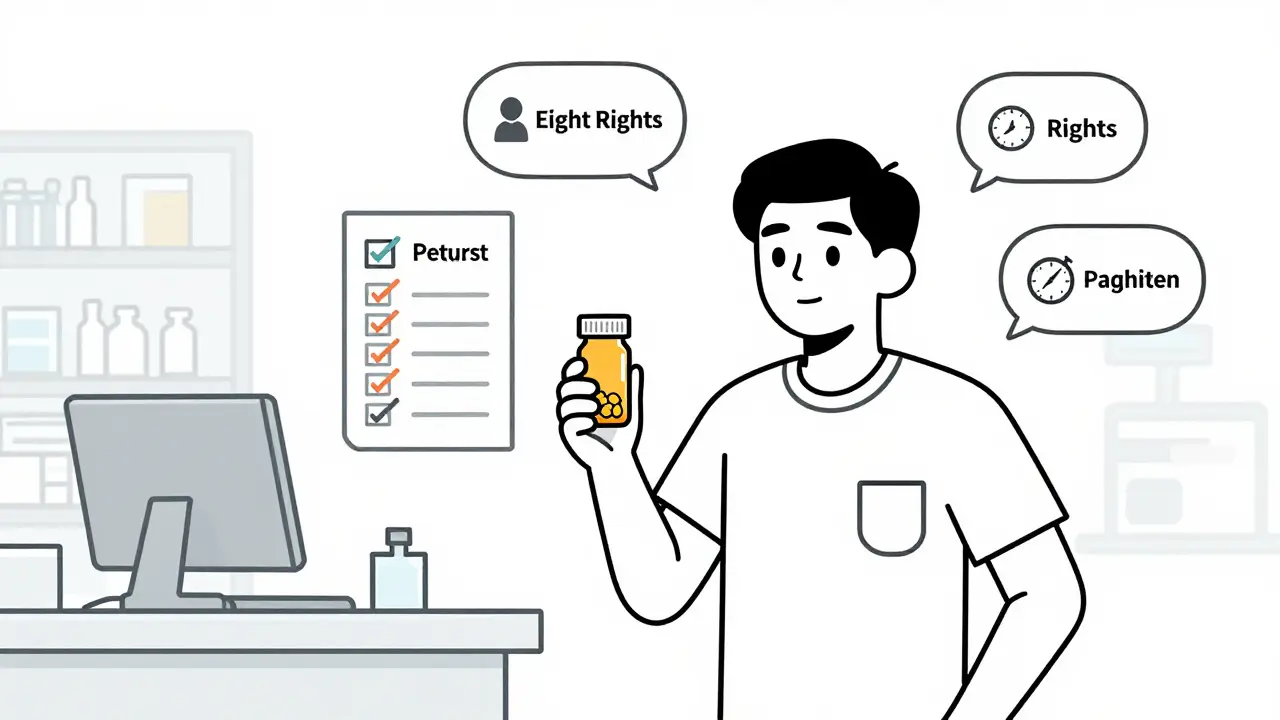
Every year, more than 1.5 million people in the U.S. end up in the emergency room because of medication mistakes. Many of these aren’t accidents-they’re preventable. The biggest reason? Patients don’t know the basic safety terms doctors and nurses use. If you’re taking pills, injections, or even vitamins, you need to understand these terms. Not just to follow instructions, but to protect yourself.
What Are the Eight Rights of Medication Safety?
The foundation of medication safety isn’t a complicated algorithm or high-tech gadget. It’s a simple list called the Eight Rights. This isn’t something only nurses learn in school. It’s something you should know too. These rights are checkpoints-questions you can ask every time you get a new medication.
- Right patient - Are you sure the medicine is meant for you? Hospitals and clinics must check your name and date of birth before giving you anything. But if you’re picking up a prescription at the pharmacy, don’t assume they’ve double-checked. Say: "Can you confirm this is for me?"
- Right medication - The name on the bottle should match what your doctor ordered. Generic names (like metformin) and brand names (like Glucophage) can be confusing. Always ask: "Is this the same as what my doctor said?"
- Right dose - A pill isn’t just a pill. A dose is how much you take, and how often. Too little won’t help. Too much can hurt you. If it’s liquid, know the units: milligrams (mg), milliliters (mL). Ask your pharmacist to show you how to measure it.
- Right route - Is it supposed to be swallowed, injected, applied to the skin, or inhaled? Giving a pill by mouth when it’s meant for an IV can be deadly. ISMP reports 12% of serious errors happen because the route is wrong. Always confirm: "How am I supposed to take this?"
- Right time - Some meds need to be taken with food. Others on an empty stomach. Some every 8 hours. Others once a day. Missing or doubling up can cause problems. Use your phone’s alarm or a simple paper log. Studies show tracking this cuts dosing errors by 31%.
- Right reason - This is the most overlooked. Why are you taking this? Not just "for blood pressure"-but what’s the exact problem it’s fixing? If your doctor says "it’s for inflammation," ask: "Which part? My joints? My heart?" ACOG found that patients who understood their reason for taking a drug reduced inappropriate use by 28%.
- Right documentation - Did the nurse write down that you got your pill? Did the pharmacy log it? This isn’t about paperwork-it’s about continuity. If you switch doctors or go to the ER, they need to know what you’ve taken. Keep your own list.
- Right response - What should you feel? What side effects are normal? What’s a warning sign? If you start feeling dizzy after a new blood pressure med, that’s not normal. Track how you feel. The CDC says patients who monitor their response reduce severe reactions by 35%.
What Is an Adverse Drug Event (ADE)?
Don’t confuse side effects with adverse drug events. Side effects are common and expected-like dry mouth from an antihistamine. An adverse drug event (ADE) is when a medicine causes harm. That could be an allergic reaction, an overdose, a dangerous interaction, or even a mistake in how it was given.
The CDC calls ADEs a preventable public health crisis. In 2023, they were linked to nearly 1 in 5 emergency visits for older adults. Many of these happen because patients didn’t know what to watch for. If you start having trouble breathing, swelling, chest pain, or sudden confusion after starting a new drug-don’t wait. Call your doctor or go to urgent care. Don’t assume it’s "just a side effect."
What Are High-Alert Medications?
Some drugs are riskier than others. These are called high-alert medications. They’re not dangerous because they’re bad-they’re dangerous because a small mistake can kill you.
Examples include:
- Insulin (too much causes low blood sugar, which can lead to coma)
- Blood thinners like warfarin or apixaban (a missed dose or extra dose can cause bleeding or clots)
- Opioids like oxycodone or morphine (even a little extra can stop your breathing)
- Intravenous potassium (if given too fast, it can stop your heart)
ISMP says these drugs cause 67% of fatal medication errors. If you’re on one of these, be extra careful. Ask: "Is this a high-alert drug? What should I watch for?" Don’t be shy. Your life depends on it.

What’s a Close Call? Why It Matters
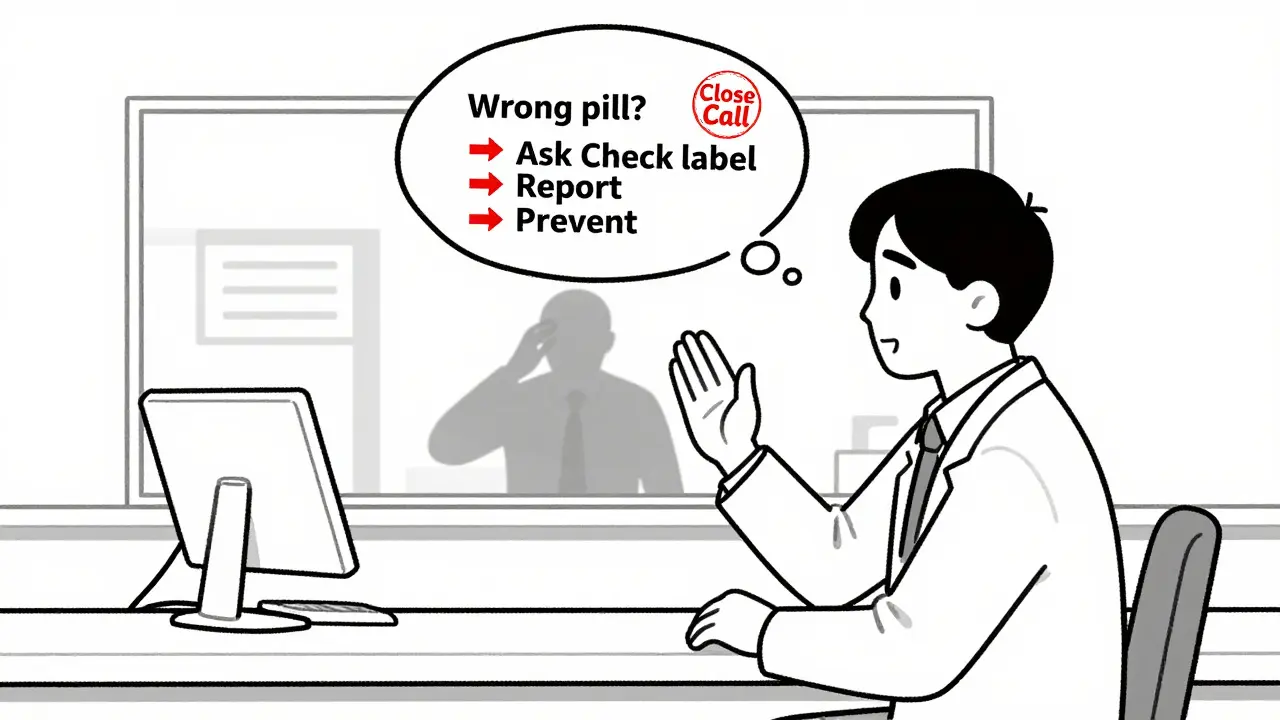
A close call is when something almost went wrong-but didn’t. Maybe the pharmacist caught a wrong dose before handing it over. Maybe you noticed the pill looked different and asked about it. That’s not bad luck. That’s safety in action.
Most people ignore close calls. They think, "Thank goodness nothing happened." But those moments are clues. They tell you what’s broken in the system. If you catch a mistake-even a tiny one-tell someone. Report it to your pharmacist, doctor, or hospital. You’re not causing trouble. You’re preventing the next person’s tragedy.
What Are Sentinel Events?
These are the worst-case scenarios. The sentinel events defined by the Joint Commission are unexpected, serious outcomes-like death or permanent injury-that shouldn’t happen in a safe healthcare system.
A medication error that leads to death? That’s a sentinel event. A child given the wrong dose of chemotherapy? That’s a sentinel event. Hospitals are required to report these. But you don’t have to wait for them to report it. If you believe a mistake caused harm, speak up. Ask for the incident report. Know your rights.
Why This Matters More Than Ever
In 2024, over 78% of U.S. hospitals use digital systems that now require doctors to confirm the "right reason" before prescribing. Apps like Medisafe, used by 8.7 million people, now ask you to verify each of the Eight Rights before reminding you to take your pill.
But technology won’t fix everything. If you don’t understand the terms, you won’t know what to look for. The CDC found that patients who could name at least five of these safety terms were 50% less likely to have a preventable medication error. That’s not a small number. That’s life or death.
Health literacy is still a problem. Only 12% of U.S. adults have strong health literacy. That means most people don’t fully understand their prescriptions. That’s why you need to ask. Again. And again. Until it makes sense.
What You Can Do Today
You don’t need a medical degree to stay safe. You just need to speak up. Here’s what to do right now:
- Write down every medication you take-name, dose, reason, and time. Keep it in your wallet or phone.
- Before you take any new pill, ask: "Is this the right patient, right drug, right dose, right route, right time, right reason?"
- If you’re on insulin, blood thinners, or opioids, ask your pharmacist to explain the warning signs of overdose or reaction.
- Use a pill organizer or app. Set alarms. Track how you feel.
- If something feels off, don’t ignore it. Call your doctor. Go to the pharmacy. Say: "I don’t feel right. Can we check this?"
Medication safety isn’t the job of your doctor or pharmacist alone. It’s yours too. The system will make mistakes. But if you know these terms, you become the last line of defense. And that’s powerful.
What’s the difference between a side effect and an adverse drug event?
A side effect is a known, expected reaction-like drowsiness from allergy medicine. An adverse drug event (ADE) is harm caused by a medication that wasn’t expected or was due to an error-like an allergic reaction, overdose, or wrong drug given. ADEs are preventable. Side effects aren’t always.
Why do I need to know the "right reason" for my medicine?
Knowing why you’re taking a drug helps you spot mistakes. If your doctor prescribed a blood pressure pill but you don’t have high blood pressure, that’s a red flag. Studies show patients who understand their reason for taking a medication reduce inappropriate use by 28%. It also helps you know if the drug is working-or if something’s wrong.
What should I do if I think I got the wrong medicine?
Don’t take it. Call your pharmacist immediately. Compare the pill to your prescription or previous bottle. Look up the drug name online to check the color and shape. If it doesn’t match, the pharmacy made a mistake. Report it. They’ll replace it and fix their process. Your action might prevent someone else’s mistake.
Can I trust my doctor to catch all medication errors?
Doctors are busy. They may not catch every interaction or dosage error, especially if you see multiple specialists. That’s why you need to be your own advocate. Use the Eight Rights checklist every time you get a new prescription. You’re not questioning your doctor-you’re helping them do their job better.
How do I know if a medication is high-alert?
Ask your pharmacist directly: "Is this a high-alert medication?" Common ones include insulin, blood thinners, opioids, IV potassium, and chemotherapy drugs. If it is, ask for a printed warning sheet and what symptoms to watch for. High-alert doesn’t mean avoid it-it means double-check it.
All Comments
Mike Rengifo December 18, 2025
Been on warfarin for 5 years. Learned the hard way that "right route" isn’t just for IVs. Took a pill meant for injection once. Didn’t know the difference. Ended up in the ER with a swollen arm. Now I ask every time. No shame in it.
Elaine Douglass December 20, 2025
I just started taking metformin and honestly I was terrified. But I wrote down all the meds I take on my phone and showed my pharmacist. She smiled and said "finally someone who asks." Feels good to be heard.
Erica Vest December 21, 2025
The Eight Rights are foundational, but they’re useless if you don’t know how to articulate them. Patients often say "I don’t want to bother the doctor"-but that’s the exact mindset that kills. You’re not bothering them; you’re completing their job. Every pharmacist I’ve worked with prefers a patient who asks questions. It reduces liability, improves outcomes, and frankly, makes their day easier.
Also, the "right reason" is the most underutilized. I’ve seen patients on statins for cholesterol who didn’t know they had high LDL. They thought it was for "heart health" in a vague way. That’s not understanding-that’s hoping. Knowledge is the only reliable safety net.
And yes, digital systems help, but they’re only as good as the input. If you don’t know what a high-alert drug is, you won’t flag it. The app won’t pop up a warning if you’re not literate in the terminology. Health literacy isn’t optional anymore. It’s survival.
Keep a physical list. Update it every time you see a new provider. Bring it to every appointment-even if they say they have your records. They don’t. They’re overwhelmed. You’re the only one who knows your full history.
And don’t let anyone tell you you’re being "difficult." If your insulin dose changed and you didn’t get a new prescription slip, you’re not being paranoid-you’re being smart. That’s not a conspiracy. That’s medicine.
Side effects are annoying. ADEs are life-ending. Learn the difference. Write it down. Say it out loud. Repeat it. Your life isn’t a guessing game.
And if you’re on opioids? Don’t wait for dizziness. If your breathing feels shallow, call 911. Don’t wait for your doctor’s office to open. That’s not overreacting. That’s what the CDC says.
Technology didn’t save you. Your awareness did.
Kinnaird Lynsey December 22, 2025
Wow. So now I’m supposed to be a medical detective just to not die from my blood pressure pill? Cool. I’ll just add "learn the Eight Rights" to my daily to-do list next to "pay taxes" and "remember to breathe."
Also, why do I need to know if potassium is IV or oral? Isn’t that the pharmacist’s job? Or is this just another way to make patients feel guilty for not being doctors?
Chris Davidson December 22, 2025
People need to stop treating meds like candy. You take something without knowing what it is you’re asking for trouble. The system is broken but you’re the last line. Period. End of story. No excuses. Just do it.
Matt Davies December 23, 2025
I’ve been a nurse for 22 years and I still get chills reading this. It’s like someone handed me a flashlight in a pitch-black hospital hallway. The Eight Rights? They’re not just for nurses-they’re for grandmas, college kids, single parents working two jobs. This isn’t a lecture. It’s a lifeline. Thank you for writing this. Seriously. Someone needs to print this on a postcard and hand it out with every script.
Monte Pareek December 25, 2025
Look I’ve been in the ER three times because of meds and I’m telling you right now if you’re not using the Eight Rights checklist you’re playing Russian roulette with your liver. I had a cousin who took two different painkillers because she didn’t know they both had acetaminophen. She ended up with liver failure. She’s on a transplant list now. Don’t be her. Write it down. Say it out loud. Text it to your sister. Do whatever it takes. Your life is not a demo. You don’t get a second chance when your heart stops because you thought "it’s just a side effect." I used to think asking questions made me look dumb. Now I know it’s the only thing that saved me. I carry a laminated card in my wallet with the Eight Rights printed on it. My pharmacist knows me by name now. He gives me extra time. He thanks me. That’s not weird-that’s power. You think you’re bothering them? No. You’re making them better at their job. That’s not aggression. That’s accountability.
And if you’re on insulin? Don’t just trust the pen. Know your numbers. Know your symptoms. Know your emergency plan. I carry glucagon in my purse. My daughter knows how to use it. That’s not paranoia. That’s love.
Stop waiting for someone else to fix this. You’re the only one who knows what’s in your body. Own it. Speak up. Do it now. Not tomorrow. Now.
Anna Sedervay December 25, 2025
It is truly disheartening to observe the systemic erosion of medical authority and the consequent democratization of pharmacological knowledge among the lay populace. One cannot help but wonder whether the proliferation of such "Eight Rights" is not, in fact, a symptom of a deeper malaise-an epistemological collapse wherein the patient, armed with fragmented mnemonics, presumes to interrogate the very architects of their care. Is this not the logical culmination of a culture that elevates anecdote over evidence, and self-diagnosis over specialization? One wonders: if a layperson must verify the "right reason" for their antihypertensive, then what becomes of the physician’s clinical judgment? The answer, I fear, is not empowerment-but disintegration.
And yet, I shall not be so cruel as to deny that some patients, in their earnestness, may indeed benefit from such scaffolding. But let us not confuse pedagogy with policy. The real issue lies in the abdication of responsibility by institutions who have outsourced their duty to educate to the vulnerable themselves. This is not a solution. It is a surrender.
Moreover, the term "high-alert medication"-how dreadfully reductive. As if the danger resides in the molecule rather than in the administrative negligence that permits its misadministration. The real villain is not the patient who forgets to ask. The villain is the hospital that fails to implement barcode scanning. The villain is the pharmacy that allows untrained clerks to dispense warfarin without counseling. The villain is the system.
But no. Let us blame the patient. Again.
Andrew Kelly December 25, 2025
Okay but what if the whole "Eight Rights" thing is just a distraction? What if the real problem is that Big Pharma pays doctors to prescribe these drugs in the first place? I’ve seen the documents. They don’t care if you live or die. They care about the bottom line. That’s why they make you memorize these terms-to make you feel like you’re in control while they keep selling you poison. Insulin? Made by three companies. Opioids? Created by a family that went to jail. You think your "right reason" matters when your doctor gets a bonus for prescribing more pills? Wake up. This isn’t safety. It’s a placebo for guilt.
And don’t even get me started on apps like Medisafe. They track your pills but sell your data. You think they care about your health? They care about your clicks. Your location. Your heart rate. They’re building profiles. They’re selling them. Your "right documentation"? It’s being scraped by insurers who’ll raise your rates next year. You’re not protecting yourself. You’re giving them the keys.
So yeah. Ask your questions. Write it down. Take the pill. But know this: you’re not fighting the system. You’re feeding it.
Mahammad Muradov December 26, 2025
You people are naive. In India, we don’t have pharmacies that ask you questions. We have shopkeepers who hand you pills based on what the doctor scribbled. If you don’t know what the medicine is, you don’t take it. Simple. No apps. No checklists. Just common sense. You think you need to know "right route"? In rural India, people swallow pills meant for injection because they don’t know the difference. They die. You think your checklist saves you? It doesn’t. It just makes you feel smart while the real system is broken beyond repair. Stop pretending you’re in control. You’re not. You’re just lucky.
Takeysha Turnquest December 27, 2025
Every time I take a pill, I feel like I’m signing a contract with the universe. One wrong dose and the stars shift. The body is a temple, yes-but it’s also a battlefield. And every pill? It’s a soldier sent in without a map. I used to think medicine was science. Now I know it’s magic. And magic requires ritual. The Eight Rights? That’s my incantation. I whisper them before I swallow. I don’t just take the pill-I consecrate it. I ask: Who am I? What is this? Why am I here? How do I feel? And if I don’t get answers? I don’t take it. Not because I’m afraid. Because I’m sacred.
Mike Rengifo December 28, 2025
My mom just called me after reading this. Said she’s been taking her blood thinner at night instead of morning for three years. Didn’t know it mattered. She’s gonna call her pharmacist tomorrow. I’m proud of her.