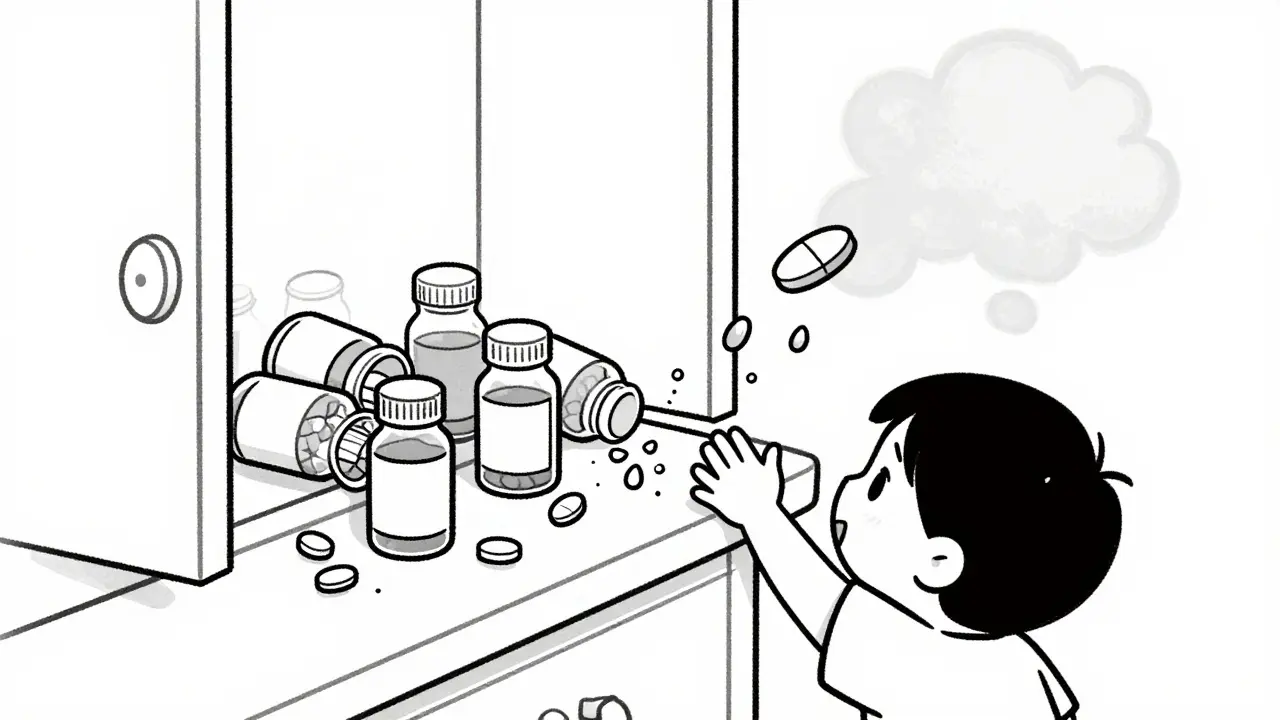
Every household in the UK keeps medicines-painkillers, antibiotics, heart pills, inhalers, insulin. But how many of us actually store them safely? Most people keep them in the bathroom cabinet, on the kitchen counter, or in a purse. That’s not just careless-it’s dangerous. Every year, thousands of children accidentally swallow pills they find lying around. Teens grab painkillers from the medicine cabinet when they’re feeling stressed. And counterfeit drugs? They’re showing up more often than you think, disguised as real prescriptions bought online or handed out by unlicensed sellers.
Why Your Medicine Cabinet Is a Risk
The bathroom might seem convenient, but it’s one of the worst places to store medication. Humidity from showers and baths can wreck your pills. Aspirin turns into vinegar and salicylic acid within two weeks. Ampicillin loses 30% of its strength in just seven days at 75% humidity. Insulin degrades 15% per hour if left at room temperature. These aren’t hypothetical risks-they’re documented facts from the FDA and MedlinePlus. And it’s not just about potency. Leaving pills in open cabinets means easy access for kids, teens, or visitors. According to the Substance Abuse and Mental Health Services Administration (SAMHSA), 70% of teens who misuse prescription drugs get them from their own home. In many cases, they grab them within minutes of deciding to use. A locked cabinet isn’t a luxury-it’s a barrier that stops misuse before it starts.What Makes a Medicine Safe to Store?
Safe storage isn’t just about locking things up. It’s a system. There are four key elements: location, container, temperature, and access control. Start with the container. Always keep medicines in their original bottles. Why? Because those labels have the name, dosage, expiration date, and warnings. If you transfer pills to a pill organizer, you lose that critical info. The FDA says 78% of medication errors happen because people can’t tell what they’re taking. Original containers also come with child-resistant caps-unless you’ve twisted them shut properly, they won’t work. Listen for the click. If you don’t hear it, the cap isn’t locked. Next, location. Avoid bathrooms, kitchens, and cars. Heat, moisture, and sunlight all degrade drugs. Bedrooms are better. A dresser drawer, high up and out of reach, is a good start. But if you have young children, toddlers, or grandchildren visiting often, that’s not enough. You need a locked solution.Locked Storage: The Only Real Protection
The American Academy of Pediatrics, the CDC, and the EPA all agree: locked storage is the gold standard. Unlocked cabinets reduce accidental poisoning risk by only 45%. Locked storage? It cuts it by 92%. You don’t need an expensive safe. A simple lockbox that meets ASTM F2090-19 standards works. Gun safes, fireproof document boxes, even a small lockable tool chest-any of these can do the job if they’re truly locked. The key is that they resist tampering by children aged 4 to 5 for at least 10 minutes, as tested under ASTM F2057-20. Install it at least 5 feet off the ground, where kids can’t reach it. For people with arthritis or mobility issues, a combination lock with large dials or a voice-activated smart lock can be a good compromise. The Arthritis Foundation recommends these for users who need quick access but still want to keep pills away from children. One Reddit user, u/MedSafetyMom, shared how a Gunvault MicroVault on her nightstand cut her anxiety about her 3-year-old accessing her thyroid meds by 90%. Another, u/PainPatient87, uses a wall-mounted safe at 6 feet high-out of his toddlers’ reach but easy for him to grab during flare-ups.Counterfeit Drugs: The Hidden Threat
Fake medicines are a growing problem. They might look real, but they contain no active ingredient-or worse, toxic chemicals like fentanyl, rat poison, or industrial dyes. The FDA has found counterfeit versions of popular drugs like Viagra, Ozempic, and even insulin sold online. Many come from unregulated websites that don’t require prescriptions. How do you know if your medicine is real? Buy only from licensed UK pharmacies-high street chains like Boots or Lloyds, or registered online pharmacies with the GPhC logo. Never buy from social media ads, Facebook groups, or websites with no physical address. If the price seems too good to be true, it is. Check the packaging. Real medicines have tamper-evident seals, clear printing, and batch numbers. If the pills look different-wrong color, shape, or texture-don’t take them. Report suspicious products to the MHRA (Medicines and Healthcare products Regulatory Agency). They track counterfeit drugs and shut down illegal sellers.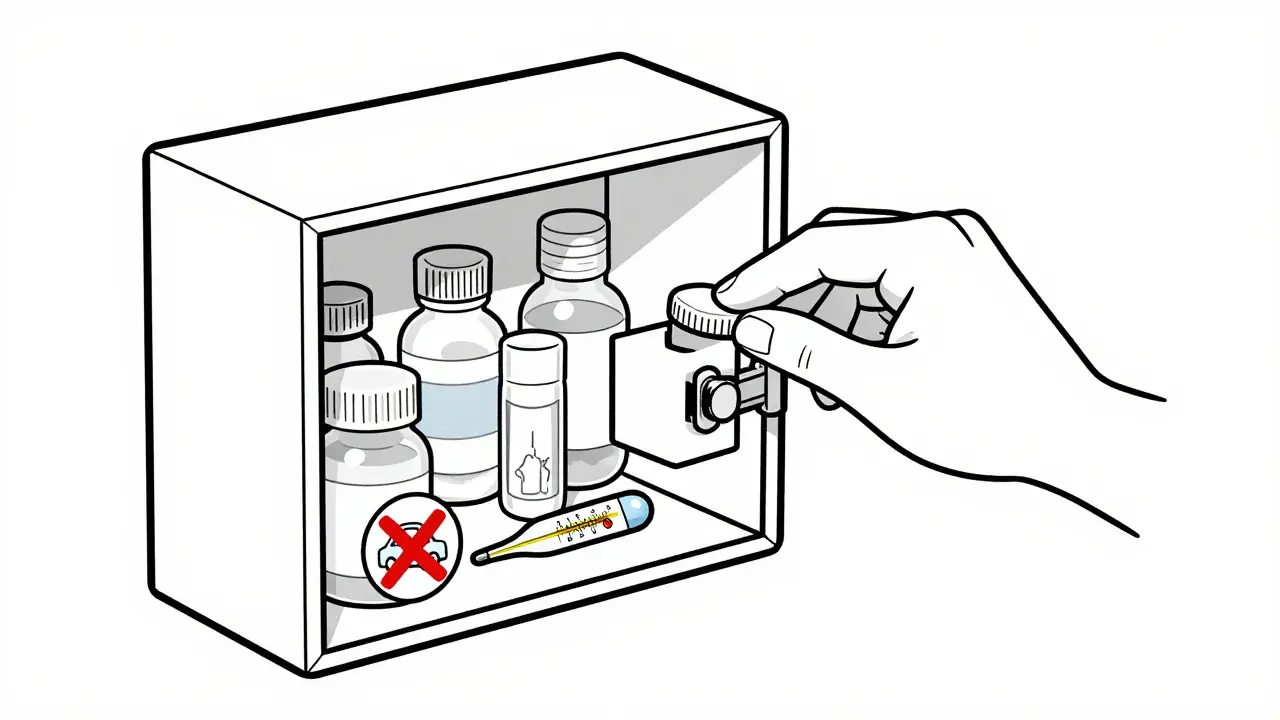
Refrigerated and Special Medications
Some drugs need cold storage: insulin, certain antibiotics, biologics, and naloxone (Narcan). But your fridge isn’t a safe place unless you lock it. Store these in a separate, locked container inside the fridge-not in the door, where temperatures fluctuate. Keep them away from food to avoid contamination. Naloxone is especially critical. If someone in your home is at risk of opioid overdose, this drug can save their life. But it only works if you can grab it in under 10 seconds. That’s why NACoA’s 2025 guidelines say it must be stored in an accessible but secure spot-like a wall-mounted lockbox next to the front door, not buried in a drawer.What You Should Do Right Now
Here’s a simple 4-step plan to protect your home:- Do a home audit. Go through every room. Find every pill bottle, patch, inhaler, or liquid. Write down what you have and where it’s stored.
- Choose one secure location. Pick one locked box or cabinet. Move all medications there. Get rid of extra containers. Less clutter = fewer mistakes.
- Lock it properly. Twist child-resistant caps until they click. Use a lock on the box or cabinet. Test it-can a 4-year-old open it? If yes, upgrade.
- Check every 3 months. Toss expired or unused meds. Don’t flush them. Use a pharmacy take-back drop-off. The UK has over 1,000 permanent collection points-Boots, Lloyds, and NHS pharmacies all participate.
What Not to Do
Don’t leave pills on the nightstand after taking them. That’s how 42% of accidental ingestions happen. Don’t store them in purses, coat pockets, or drawers your kids can open. Don’t rely on child-resistant caps alone-they’re not foolproof. Don’t ignore expiration dates. Old medicine can be toxic.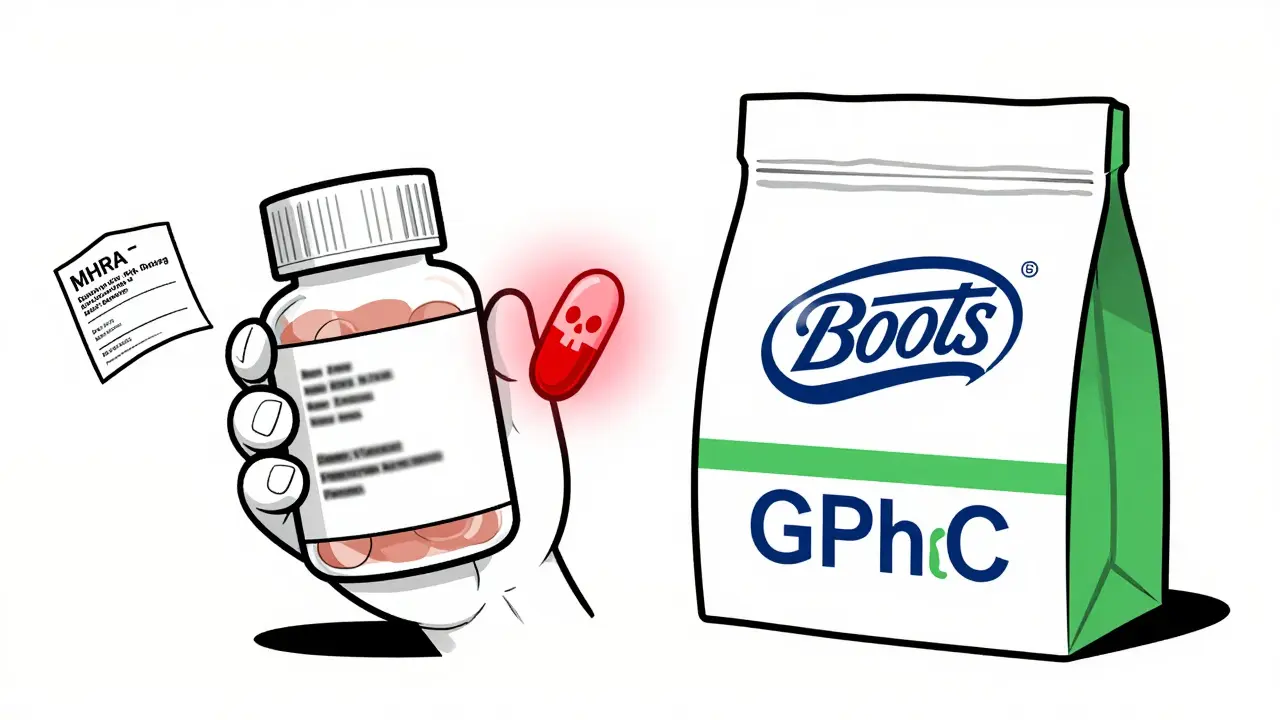
Why This Matters Beyond Your Home
Improper storage doesn’t just hurt your family. It costs the NHS millions. Accidental poisonings in children lead to emergency visits, hospital stays, and long-term damage. Counterfeit drugs spread dangerous substances through communities. When you store your meds safely, you’re not just protecting your kids-you’re helping reduce the burden on healthcare, stopping drug diversion, and keeping fake medicines out of circulation. The data is clear: households with locked storage see 83% fewer emergency visits for medication exposure. And by 2030, universal adoption could prevent over 400,000 hospital visits annually in the UK alone.FAQ
Can I store all my medications in one place?
Yes, consolidating all your medications into one locked location is the safest approach. It reduces confusion, makes inventory checks easier, and prevents accidental access. Keep only what you’re currently using in that spot. Store backup or seasonal meds elsewhere, but still locked.
What if I have arthritis and can’t twist child-resistant caps?
Many pharmacies offer easy-open caps upon request. You can also use a pill bottle opener tool, which costs under £5. For long-term solutions, consider a smart lockbox with a keypad or fingerprint access. The Arthritis Foundation recommends combination locks with large, easy-to-turn dials as a good middle ground between security and accessibility.
How do I know if my medicine is counterfeit?
Buy only from registered UK pharmacies-physical stores or those with a GPhC logo online. Check the packaging for clear printing, correct spelling, and tamper-evident seals. If pills look different than usual-wrong color, smell odd, or don’t dissolve properly-don’t take them. Report suspicious products to the MHRA via their website or by calling 020 3080 6000.
Is it safe to keep painkillers in my car?
No. Car temperatures can hit 120°F (49°C) in summer and drop below freezing in winter. Heat and cold destroy most medications. Insulin, aspirin, and antibiotics are especially vulnerable. Always keep medicines at room temperature in a dry, dark place inside your home.
How do I dispose of old or unused meds safely?
Never flush them or throw them in the trash. Take them to any NHS pharmacy, Boots, or Lloyds that has a take-back bin. The UK has over 1,000 permanent drop-off locations. Some local councils also host annual collection events. This keeps harmful chemicals out of water systems and prevents misuse.
Should I lock up over-the-counter drugs too?
Yes. Paracetamol, ibuprofen, and cold medicines are often the first pills kids grab. They’re not harmless. A single overdose of paracetamol can cause liver failure. Locking them up is just as important as locking up prescription drugs.
All Comments
Dan Mack January 16, 2026
The government is hiding the truth about meds being laced with nano-trackers to monitor us
They want you to lock them up so they can track your every move through the pill bottle RFID chips
I found a whistleblower video on Telegram-look up "MedSafe Program 2025"
That’s why they push "child-resistant caps"-it’s not for kids, it’s for control
They’re turning your medicine cabinet into a surveillance hub
And don’t get me started on the insulin-those are micro-drones disguised as vials
They’re watching you take your pills
Wake up, sheeple
Gloria Montero Puertas January 17, 2026
Oh, darling, how quaint-storing medication in a "locked box"? How utterly... pedestrian.
Have you considered the aesthetic implications? A discreet, matte-black, biometrically secured, climate-controlled vault-preferably with a built-in humidity sensor calibrated to 45% RH and UV-filtered glass?-is the only acceptable solution for discerning individuals.
My personal regimen includes a custom-fitted, hand-blown crystal vial with a laser-engraved batch code, stored in a vault beneath my heirloom mahogany dresser, which itself is bolted to the foundation and monitored via encrypted IoT.
And please, for the love of Hippocrates, do not use a "gun safe"-that’s the sort of thing people who still believe in "American individualism" do.
Also, your "pharmacy take-back bins"? They’re all owned by Big Pharma. The real solution is home incineration with a certified catalytic converter.
Sohan Jindal January 17, 2026
They’re lying about the pills
They say humidity ruins them but that’s just to scare you
Real Americans don’t need locks
My grandpa kept his heart pills in his pocket for 30 years
He lived to 92
Now the feds want you to lock up your meds like you’re a criminal
It’s socialism
Locking pills = locking freedom
My kids know better
They know not to touch stuff that ain’t theirs
Why can’t you trust your own family?
It’s not the pills that are dangerous-it’s the fear they’re selling you
Frank Geurts January 17, 2026
Allow me to extend a most thoughtful and respectfully articulated appreciation for the meticulousness of this exposition.
The integration of empirical data from the FDA, CDC, and MHRA-coupled with the nuanced delineation of storage protocols-is not merely informative; it is a triumph of public health communication.
I have, in fact, implemented the four-step protocol in my residence, and the psychological relief afforded by the presence of a locked, wall-mounted, ASTM-certified storage unit-positioned precisely 5 feet 3 inches above the floor-is immeasurable.
Moreover, the emphasis on purchasing only from GPhC-registered pharmacies reflects an understanding of regulatory integrity that is, regrettably, all too rare in contemporary discourse.
May this message reach every household in the Commonwealth-and beyond.
Arjun Seth January 19, 2026
You think locking pills is the answer?
What about the root cause?
People are in pain
They’re lonely
They’re broke
And you want to lock the medicine away like it’s a sin?
Why not fix the system that makes people need pills in the first place?
Why not give them jobs? Homes? Therapy?
Locking bottles doesn’t heal trauma
It just hides it
And then you blame the kid for opening the box
But who made the box necessary?
Who made the pain real?
Stop policing pills
Start healing people
Mike Berrange January 19, 2026
So you’re telling me that after reading this entire 2,000-word manifesto on medication storage, the only actionable step is to buy a lockbox?
What about the psychological dependency on pharmaceuticals?
The overprescribing culture?
The fact that 60% of chronic pain patients develop tolerance within six months?
And yet you offer a mechanical solution to a systemic collapse?
It’s like telling someone with a broken leg to buy better crutches instead of addressing the fall.
You’ve turned a medical crisis into a home organization checklist.
And you call this public health?
Pathetic.
Amy Vickberg January 19, 2026
I just finished doing my home audit and moved everything into a lockbox I found at Target for $18.
It’s not perfect, but it’s locked.
My 5-year-old tried to open it this morning and gave up after 2 minutes.
I feel so much calmer.
And I threw out 12 expired bottles I’d been holding onto "just in case."
Thank you for this.
It’s simple, but it matters.
Nishant Garg January 21, 2026
In India, we have a saying: "The house that keeps its poison locked is the house that breathes free."
But here’s the truth-our elders stored everything in clay pots, tied with string, on the highest shelf.
No locks. No tech. Just wisdom.
They taught the children: "This is not candy. This is not a toy. This is medicine. It gives life-or takes it."
And somehow, we raised generations without a single incident.
Maybe the real solution isn’t the box-it’s the story we tell.
Teach your children why the bottle matters.
Not what it’s locked in.
But why it’s sacred.
That’s the real safety.