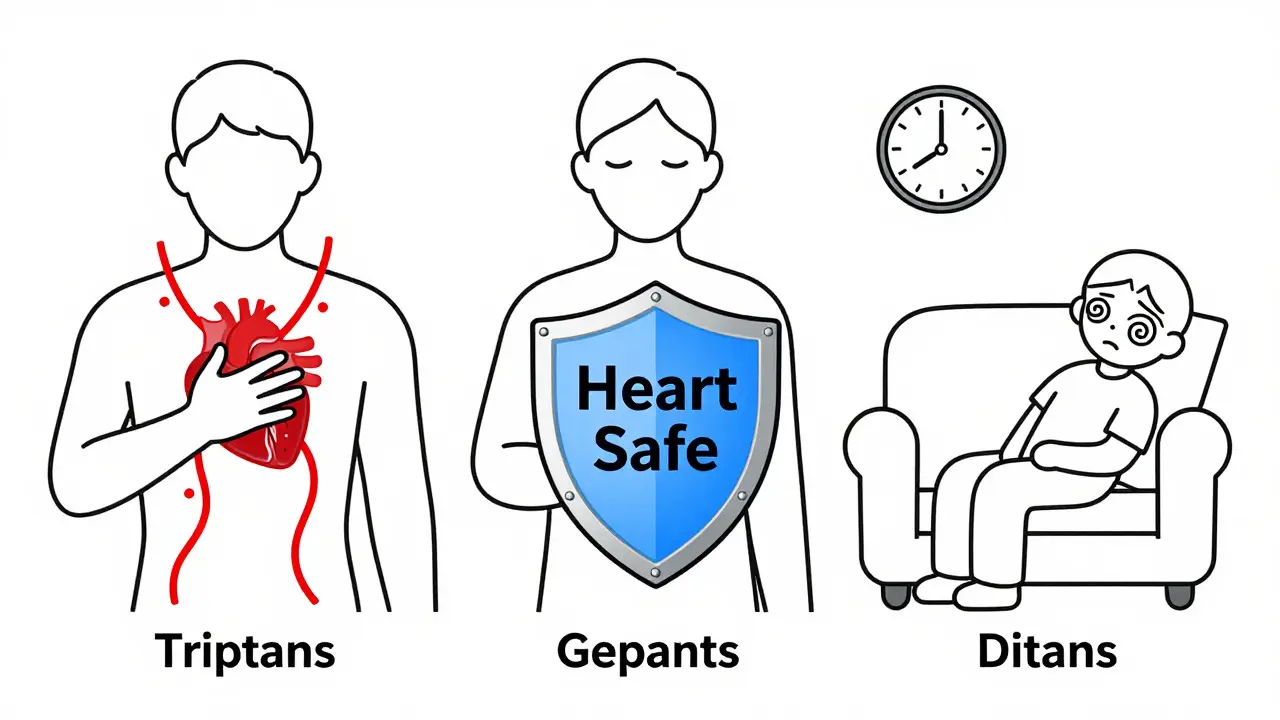
That sudden wave of nausea and light sensitivity is enough to make anyone desperate for relief. But when you reach for your migraine medication, are you trading one problem for another? For decades, Triptans were the gold standard. Now, newer options like Gepants and Ditans are changing the game. The big question isn't just which drug works fastest-it's which one keeps you safe while doing it.
Why Migraine Safety Profiles Matter More Than Ever
Migraines affect over 1 billion people worldwide. That’s a lot of headaches to manage. In the past, we had limited choices. You either took general painkillers that often failed or used Triptans, which worked well but came with specific warnings. Today, the landscape has shifted dramatically. We have three distinct classes of acute migraine treatments: Triptans, Gepants, and Ditans. Each targets the brain differently, and each carries a unique set of risks. Understanding these differences is crucial because what causes a headache in one person might be a dangerous side effect in another.
The core issue is balancing efficacy with safety. A drug that stops pain in 30 minutes is useless if it leaves you too dizzy to drive home or causes chest tightness that mimics a heart attack. Recent data from a major 2021 network meta-analysis published in JAMA Network Open analyzed 64 clinical trials involving nearly 47,000 participants. This study provides the clearest picture yet of how these drugs compare in real-world safety scenarios.
Triptans: The Old Guard with Cardiovascular Caveats
Triptans are a class of serotonin receptor agonists (5-HT1B/1D) introduced starting with sumatriptan in 1991. They revolutionized treatment by specifically targeting the biological pathways of migraines. Drugs like sumatriptan (Imitrex), rizatriptan (Maxalt), and eletriptan (Relpax) remain the most prescribed options globally, holding about 62% of the market share as of late 2023.
How do they work? They constrict blood vessels in the brain and block pain pathways. This mechanism is effective but creates a specific safety profile. Because they cause vasoconstriction (narrowing of blood vessels), they carry a warning for patients with cardiovascular issues. If you have high blood pressure, coronary artery disease, or a history of stroke, Triptans might not be right for you. The American Academy of Family Physicians explicitly advises caution here.
Beyond heart health, Triptans have a very recognizable side effect profile. Many users report:
- Tingling sensations (paresthesia) in 8-15% of cases
- Flushing or warmth in the face and neck (5-12%)
- Dizziness or lightheadedness (7-14%)
- A feeling of heaviness or tightness in the chest (3-8%)
That chest tightness is particularly notorious. It’s usually harmless-a sensation known as "triptan sensation"-but it can feel terrifying if you haven’t been warned. Some patients stop taking them entirely because they mistake this side effect for cardiac distress. Additionally, injection forms of sumatriptan cause discomfort at the site for 40% of users, and nasal sprays often leave an unpleasant aftertaste for about a quarter of patients.
Gepants: The Safer Alternative for Heart Health
If Triptans squeeze blood vessels, Gepants are CGRP receptor antagonists that block pain signals without affecting blood vessel constriction. This is a critical distinction. Gepants, including ubrogepant (Ubrelvy) approved in 2019 and rimegepant (Nurtec ODT) approved in 2020, do not constrict blood vessels. This makes them significantly safer for patients with cardiovascular risk factors.
The safety data supports this advantage. The same JAMA Network Open meta-analysis found that Gepants had the lowest risk of adverse events among all three classes. Compared to placebo, the odds ratio for adverse events was much lower for Gepants than for Triptans or Ditans. Specifically, Triptans showed a higher risk of any adverse event compared to rimegepant (odds ratio 1.43) and ubrogepant (odds ratio 1.38).
What does this mean for your daily life? Fewer scary side effects. Nausea occurs in only 4-6% of ubrogepant users and 3-5% of rimegepant users. Drowsiness affects just 2-4% of patients. Hypersensitivity reactions are rare, occurring in about 0.1% of rimegepant users. There is no chest tightness. No tingling. No flushing.
However, there is a trade-off. Gepants generally act slower than Triptans. While Triptans often provide relief within 2 hours, Gepants may take longer to kick in. Their half-lives are longer though-ubrogepant lasts 5-7 hours, and rimegepant lasts 10-12 hours. This means Gepants might offer better sustained relief over 24-48 hours, reducing the chance of the migraine returning later in the day. Also, be careful with drug interactions. Rimegepant should not be taken with strong CYP3A4 inhibitors (like ketoconazole) because exposure to the drug can increase by 4.5-fold.
Ditans: Effective but Sedating
Then there is the third option: Ditans are 5-HT1F receptor agonists represented currently by lasmiditan (Reyvow). Approved in October 2019, Lasmiditan offers a middle ground. Like Gepants, it does not constrict blood vessels, so it is safe for those with heart conditions. Unlike Gepants, it acts on serotonin receptors similar to Triptans, which contributes to its faster onset.
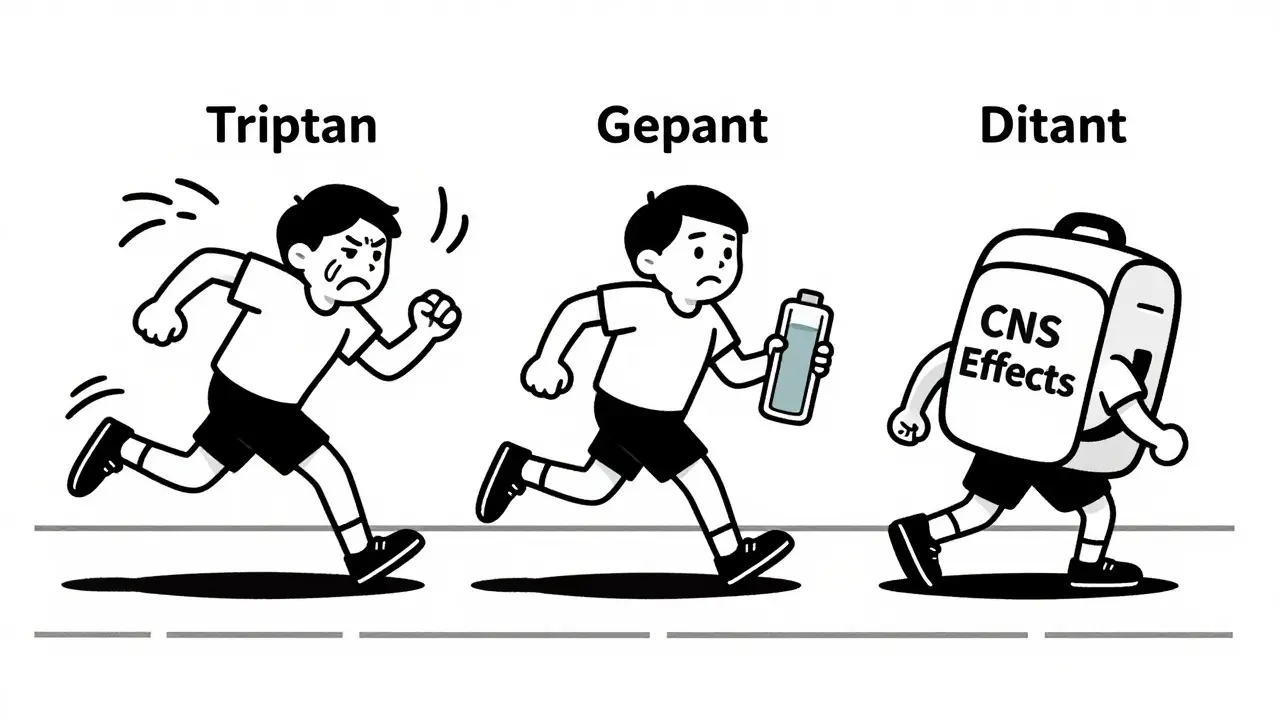
But Lasmiditan comes with a heavy price tag in terms of central nervous system (CNS) effects. The JAMA Network Open analysis identified Ditans as having the highest risk of adverse events among all treatments (odds ratio 2.87 compared to placebo). Why? Because it hits the brain hard.
In the SAMURAI clinical trial, 18.8% of users taking the 100mg dose reported dizziness, compared to 8.5% on placebo. Other common side effects include:
- Paresthesia (tingling): 9.4%
- Sedation/drowsiness: 7.8%
- Vertigo: 5.6%
- Incoordination: 3.2%
- Cognitive changes: 2.8%
User reviews reflect this reality. On Drugs.com, Lasmiditan averages a lower rating than Gepants, with many users describing feeling "drunk" or "out of it" for hours. One user noted, "Felt completely out of it for 6 hours after taking Reyvow - can't function at work." This leads to a strict practical limitation: the FDA requires a warning that patients should not drive or operate machinery for at least 8 hours after dosing. Studies confirm significant driving impairment at 5 hours post-dose. If you need to get back to work or pick up kids quickly, Ditans might not be the best fit despite their efficacy.
Comparative Safety Overview
| Feature | Triptans | Gepants | Ditans |
|---|---|---|---|
| Cardiovascular Risk | Higher (Vasoconstriction) | Low (No Vasoconstriction) | Low (No Vasoconstriction) |
| Common Side Effects | Chest tightness, tingling, flushing | Nausea, mild drowsiness | Dizziness, sedation, vertigo |
| Driving Restriction | No | No | Yes (Wait 8 hours) |
| Onset Speed | Fast (30-60 mins) | Slower (1-2+ hours) | Moderate (1-2 hours) |
| Adverse Event Odds Ratio* | Intermediate | Lowest | Highest (2.87 vs placebo) |
*Based on JAMA Network Open 2021 meta-analysis.
Real-World Usage and Patient Experiences
Numbers tell one story, but patient voices tell another. Market data shows Triptans still dominate with 62% usage, but Gepants are rising fast, jumping from 2% market share in 2020 to 28% by late 2023. Ditans remain niche at 3%, likely due to the sedation issue.
On platforms like Reddit’s r/Migraine community, discussions highlight these trade-offs. Users frequently praise Sumatriptan for its speed: "Works within 30 minutes and gets me back to normal." However, negative reviews often cite the chest pressure: "Experienced severe chest pressure with first dose... never using it again." For Gepants, the feedback is positive regarding tolerability: "No chest pressure like with triptans, just takes longer to work." This cleaner profile is why many patients switch, even if they have to wait a bit longer for relief. Conversely, Lasmiditan discussions are polarized. While some find it effective when Triptans fail, the CNS effects are a major barrier. Posts titled "Reyvow made me feel drunk without alcohol" gain significant traction, underscoring the practical difficulty of managing daily responsibilities while under the influence of the drug.
Practical Safety Guidelines for Patients
To navigate these options safely, consider these actionable steps:
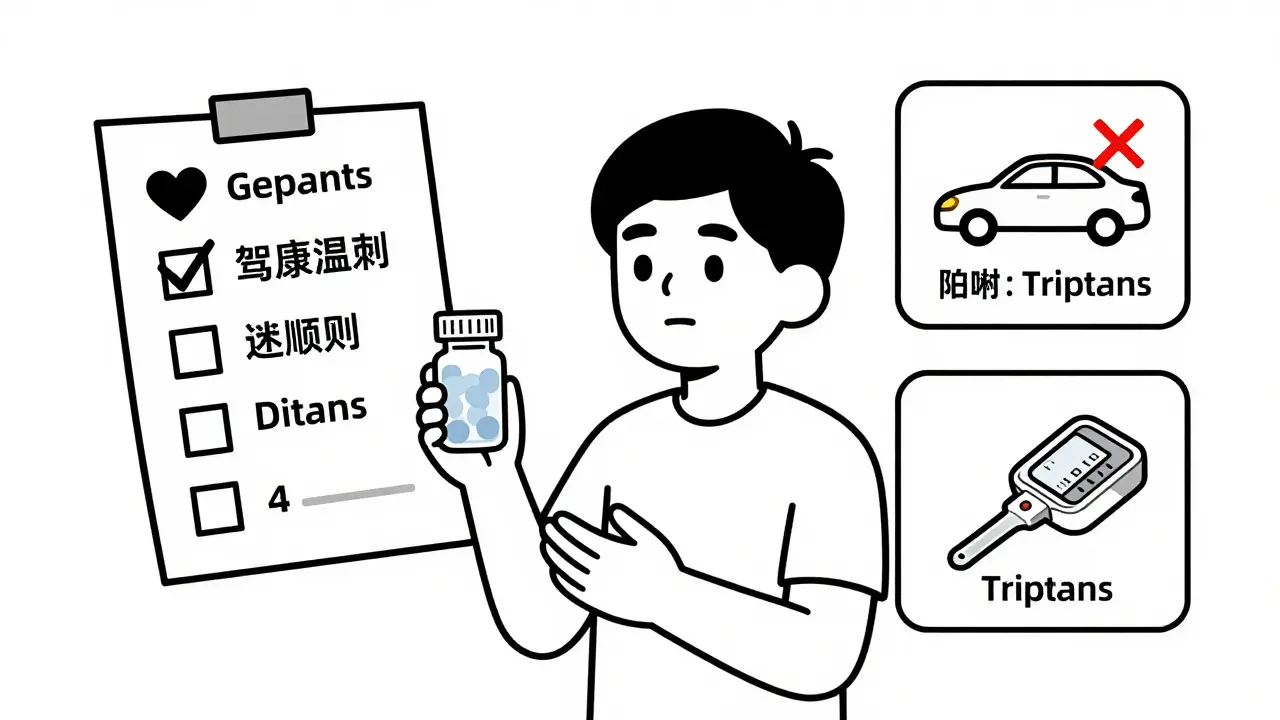
- Assess Your Heart Health: If you have hypertension, arrhythmia, or a history of stroke, avoid Triptans. Consult your doctor about Gepants or Ditans instead.
- Plan Your Day: If you choose Lasmiditan, plan to stay home. Do not schedule meetings, driving, or operating heavy machinery for at least 8 hours after taking the dose.
- Watch for Interactions: If taking Rimegepant, check if you are on strong CYP3A4 inhibitors. Avoid combining Dihydroergotamine with Triptans within 24 hours to prevent additive vasoconstriction.
- Start Low: For Triptans, start with the lowest effective dose to minimize side effects like tingling or flushing. Almotriptan and Frovatriptan tend to have fewer minor adverse effects than other Triptans.
- Monitor Seizure Risk: The Medical Letter cautions that Lasmiditan should be avoided in patients with a history of seizures or those taking medications that lower the seizure threshold.
Frequently Asked Questions
Are Gepants safer than Triptans for people with heart problems?
Yes. Gepants do not constrict blood vessels, whereas Triptans do. This makes Gepants a preferred option for patients with cardiovascular risk factors such as high blood pressure or coronary artery disease, according to the American Headache Society guidelines.
Can I drive after taking Lasmiditan (Reyvow)?
No. The FDA label for Lasmiditan explicitly warns patients not to drive or operate machinery for at least 8 hours after dosing due to significant risks of dizziness, sedation, and cognitive impairment.
Why do Triptans cause chest tightness?
Triptans work by activating 5-HT1B receptors, which causes blood vessels to constrict. This mechanism can lead to a sensation of heaviness or tightness in the chest, throat, or jaw. While usually benign, it can mimic cardiac symptoms and should be discussed with a doctor if new or severe.
Which migraine medication has the fewest side effects?
According to a 2021 JAMA Network Open meta-analysis, Gepants demonstrated the lowest risk of adverse events compared to Triptans and Ditans. Common side effects like nausea and drowsiness occur in a small percentage of users (typically under 6%).
Do Ditans help with migraine pain?
Yes, Ditans like Lasmiditan are effective at reducing migraine pain. However, their utility is limited by significant central nervous system side effects, including dizziness and sedation, which affect nearly 20% of users at higher doses.
Is it safe to mix Triptans with other migraine meds?
Caution is required. Triptans should not be used within 24 hours of dihydroergotamine due to the risk of excessive vasoconstriction. Always consult your healthcare provider before combining acute migraine treatments.
All Comments
Gary Hull July 27, 2026
you guys are all missing the point. it's not about safety, it's about control. big pharma wants you on the new stuff because they can charge more for it.
Kieran Healy July 27, 2026
I've been taking ubrogepant for about six months now and honestly, it's been a game changer for me. I used to be terrified of the chest tightness with sumatriptan, so switching felt like a relief even if it takes a bit longer to kick in. Does anyone else find that the nausea is really minimal compared to the older meds? Just curious if my experience is normal or if I'm just lucky. :)
Mildred Fierce July 28, 2026
The data presented here is superficial at best. You ignore the long-term implications of CGRP blockade entirely. While short term adverse events are lower, we have no idea what chronic inhibition does to vascular health over decades. It is reckless to call them 'safer' without longitudinal studies spanning twenty years minimum. Most patients are too impatient to wait for science to catch up to marketing.
Trey Newkerk July 28, 2026
You speak of safety as if it is an absolute truth, but it is merely a social construct designed to keep us docile. The pain itself is the teacher. By numbing the signal with these synthetic compounds, we sever our connection to the body's wisdom. Lasmiditan makes you drunk? Good. Perhaps that intoxication is closer to reality than the cold clarity of a triptan. We are afraid of feeling anything, even the side effects, because they remind us we are alive. The sedation is not a bug; it is a feature of consciousness returning to its rightful state of oblivion.
John Anderson July 30, 2026
Stop whining. Take the pill. Get better. Simple.
Sinead Doyle July 30, 2026
typo alert: rimegepant is not just a drug, its a trojan horse for neurodegenerative pathways. look into the patent filings from 2018. they knew about the cognitive fog but buried it. the FDA is compromised by industry lobbyists who own the senate. dont trust the meta-analysis, its funded by the very companies selling the 'safe' alternative. wake up sheeple. :)
Charles PINSON July 30, 2026
One must appreciate the nuance here. The average layperson reads this and thinks they are doctors. The distinction between vasoconstriction and receptor antagonism is subtle yet profound. Most people here will simply pick the cheapest option and complain when it fails. True understanding requires reading the raw clinical trial data, not this sanitized summary. It is amusing how quickly people abandon critical thinking when their head hurts.
Padraic Cepek August 1, 2026
This whole debate is useless. American healthcare is broken anyway. Why do we need three types of drugs when we can't afford one? The system is rigged against the little guy. Foreign countries get generics while we pay premium prices for branded nonsense. Fix the economy first then worry about migraine subtypes.
Patrick Plummer August 1, 2026
Really?? Are you sure about that?? I mean... surely there must be more to it?! The statistics seem... well... rather dubious don't you think?? Who exactly conducted this analysis?? And why should we trust them??
Samuel Friday August 2, 2026
Your analysis lacks depth. The correlation between dizziness and efficacy is often overlooked by the uninitiated. Those who suffer the most gain the most insight. The sedation of Reyvow is not a failure but a necessary sacrifice for those who seek true relief. You commoners fear the dark, but only in darkness can one see the stars. Or in this case, the absence of pain. But you probably wouldn't understand such complexity.
Kevin Burke August 3, 2026
We must consider the ethical dimensions of pain management. Is it right to alter our consciousness to avoid suffering? The guru within each of us knows that pain is a path. Yet, society demands productivity. Thus, we compromise. Choose wisely, for your choice reflects your soul's readiness to face the void.
neal vince August 4, 2026
According to the pharmacokinetic profiles cited, the half-life differences are negligible for acute treatment purposes. The primary differentiator remains cardiovascular history. Patients without cardiac issues should continue using triptans due to established efficacy and cost. Newer agents offer marginal benefits at significantly higher costs. This is basic economics applied to medicine.
Emily Schor August 6, 2026
I agree that individual variation plays a huge role. What works for one person might cause severe side effects for another. It seems important to work closely with a healthcare provider to find the right balance. Thank you for sharing this detailed comparison.