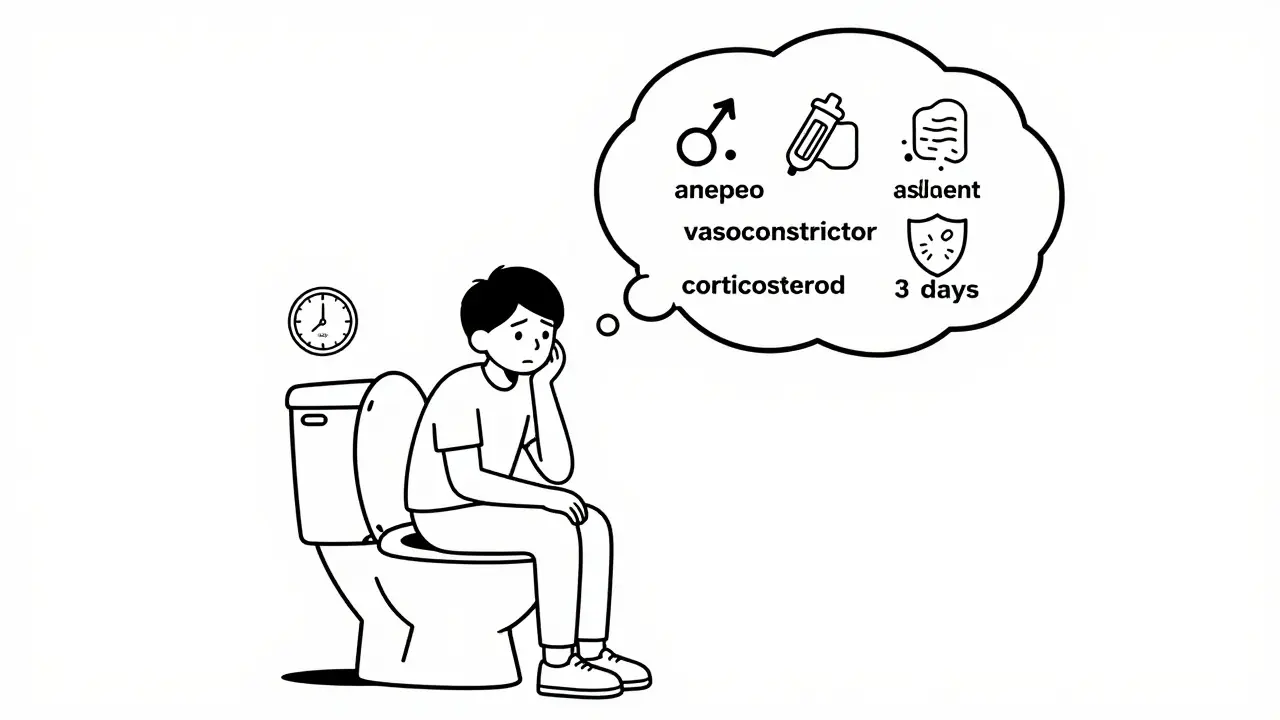
Over half of adults will deal with hemorrhoids before they turn 50. They’re not rare, embarrassing, or dangerous - but they sure are uncomfortable. Itchy, painful, swollen, sometimes even bleeding - it’s no wonder so many people reach for an OTC cream or pad the moment they feel something off. And honestly? For a lot of people, that’s enough. But here’s the thing: OTC hemorrhoid treatments aren’t magic. They don’t fix the problem. They just make it bearable - if you use them right.
What OTC Hemorrhoid Treatments Actually Do
OTC products don’t shrink veins or heal damaged tissue. They mask symptoms. Think of them like a bandage for your insides. The active ingredients in these products fall into four main groups:
- Local anesthetics (like benzocaine or pramoxine) numb the area. You feel relief fast - within 10 to 15 minutes - but it only lasts 2 to 4 hours.
- Astringents (like witch hazel) tighten tissues and reduce swelling. Tucks pads, for example, contain 14% witch hazel distillate. They cool and soothe, especially for external hemorrhoids, but the effect fades in 30 to 60 minutes.
- Vasoconstrictors (like phenylephrine in Preparation H) shrink swollen blood vessels. This reduces puffiness and discomfort. It works quickly but wears off fast.
- Corticosteroids (like hydrocortisone) fight inflammation. But they don’t work overnight. You need to use them 2 to 4 times a day for 3 to 4 days before you even notice a difference.
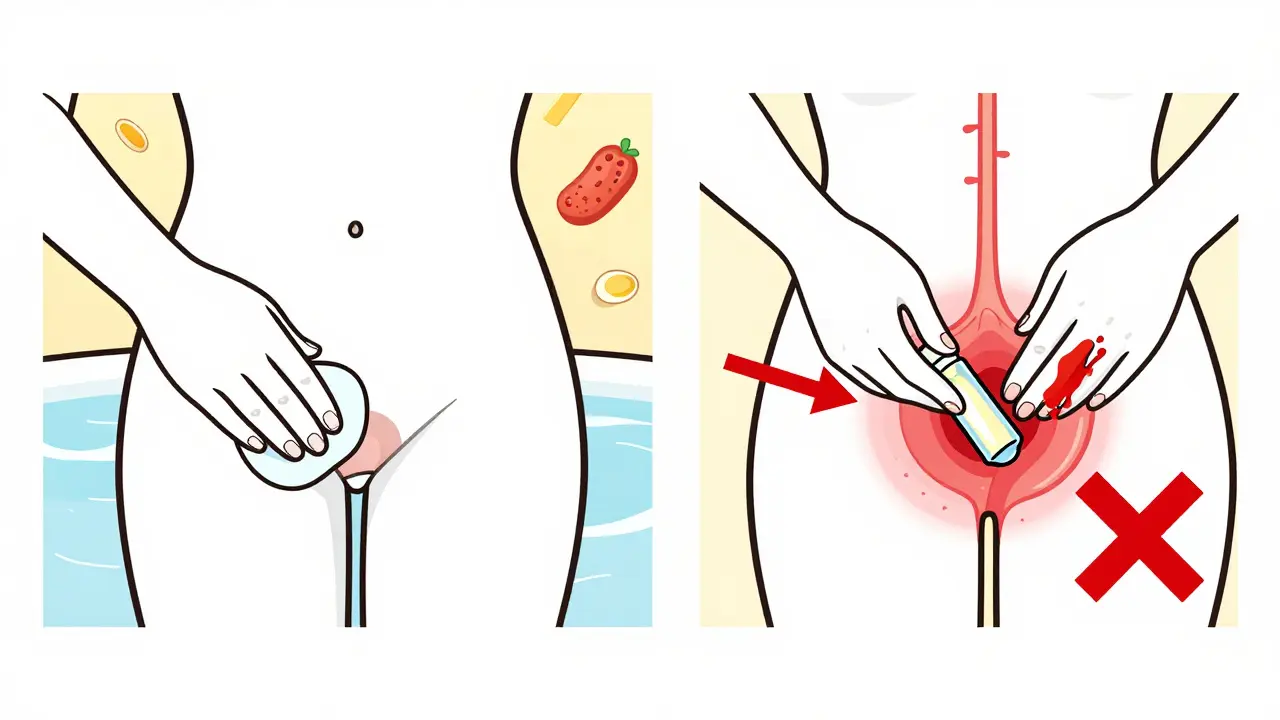
Suppositories are the go-to for internal hemorrhoids. A 25mg hydrocortisone suppository inserted after a bowel movement can reduce swelling and pain better than any cream. Studies show 87% of users feel improvement within 48 hours - if they use them correctly.
Which Product Works Best for Your Situation
Not all hemorrhoids are the same. Your treatment should match your symptoms.
If you have external hemorrhoids - the kind you can see and feel outside the anus - you want fast, cooling relief. Witch hazel pads or benzocaine creams work best here. Reddit users swear by applying cold witch hazel pads with a chilled compress. One top-rated tip: “I keep my pads in the fridge. The cold stops the burning instantly.”
If you have internal hemorrhoids - the kind you can’t see but feel as pressure, itching, or bleeding - creams won’t reach them. You need suppositories. Hydrocortisone suppositories are the most effective OTC option. Mayo Clinic recommends using one after every bowel movement, up to four times a day, for a full week. Skip that, and you’re wasting your money.
Combination products like Anusol HC (pramoxine + hydrocortisone) outperform single-ingredient options. A 2021 study found they’re 40% more effective. If you’re still in pain after a few days of using one type, switching to a combo might help.
When OTC Treatments Fail - And Why
Most people give OTC treatments a shot. And most get some relief. But here’s where things go wrong:
- You stop too soon. Hydrocortisone needs 3-4 days to work. Most users quit after 2 or 3. That’s why 41% of negative reviews on Drugstore.com say, “No improvement after 7 days.” They didn’t give it time.
- You use too much. Applying cream 5 or 6 times a day doesn’t help. It irritates the skin. CVS Pharmacy’s 2022 survey found 42% of users overapply. Stick to the label: 3-4 times max.
- You don’t clean or dry the area. Moisture makes everything worse. If you’re not wiping gently and drying thoroughly after each bowel movement, even the best cream won’t help. Tampa Colorectal Specialists say improper hygiene cuts effectiveness by 65%.
- You’re treating grade III or IV hemorrhoids. If a hemorrhoid is hanging out and won’t push back in, or if it’s causing constant pain and bleeding - OTC stuff won’t fix it. Those are medical problems. The NIH says only 15% of people with these types get relief from creams.
And here’s the truth: creams don’t treat the root cause. As Dr. Stone Mitchell of Premier Hemorrhoid Treatment Center says, “They just buy you time.”
When to See a Doctor - No Excuses
You don’t need to suffer for weeks. There are clear red flags that mean it’s time to call your doctor - today, not tomorrow.
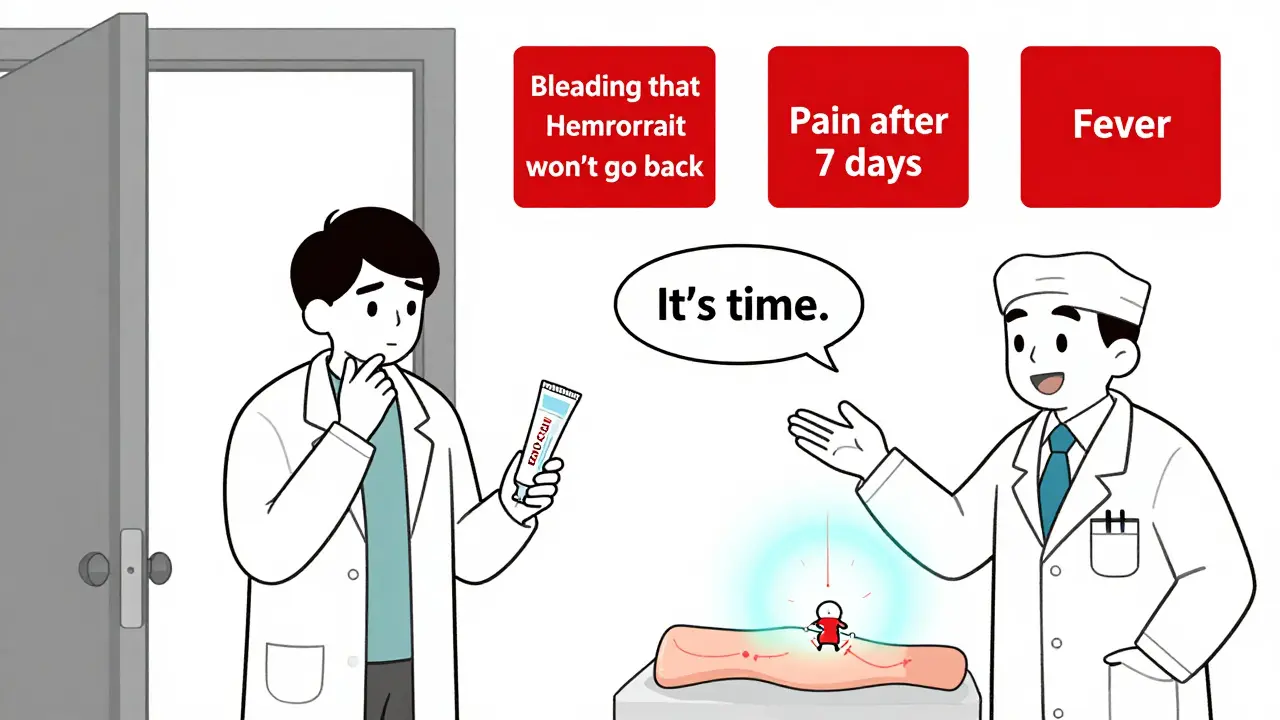
- Rectal bleeding that isn’t from a hemorrhoid. Bright red blood on toilet paper? Maybe hemorrhoids. Dark blood, clots, or bleeding that keeps coming? That’s not normal. Get checked.
- Pain that doesn’t improve after 7 days. If you’ve used OTC treatments exactly as directed and you’re still in pain? You’re past the point of self-care.
- A hemorrhoid that won’t go back in. If you can’t gently push a prolapsed hemorrhoid back inside, you need medical help. Left untreated, it can cut off blood flow.
- Signs of infection. Fever, pus, or worsening swelling? That’s not a hemorrhoid. That’s an abscess. Go to urgent care.
Doctors have better tools. Prescription hydrocortisone (2.5%) works better than OTC (1%). Rubber band ligation - where a tiny band cuts off blood to the hemorrhoid - has a 95% success rate. It’s quick, outpatient, and often covered by insurance.
What Else Helps - Beyond the Cream
OTC treatments work better when you combine them with simple habits.
- Sitz baths. Sit in warm (not hot) water for 15-20 minutes, 2-3 times a day. It reduces swelling and cleans the area. NIH studies show it cuts symptoms by 25% when paired with creams.
- Stool softeners. Straining makes hemorrhoids worse. If you’re constipated, use a gentle laxative like psyllium. Don’t wait until you’re in pain to fix it.
- Hydration and fiber. Drink water. Eat vegetables, beans, oats. You can’t out-cream a bad diet.
- Don’t sit for long. If you work at a desk, stand up every 30 minutes. Pressure builds up fast.
YouTube tutorials on proper suppository insertion or sitz bath technique have over 50,000 views each. Watching one takes 5 minutes - and could save you weeks of discomfort.
The Bottom Line
OTC hemorrhoid treatments are useful - but only if you know their limits. They’re a bridge, not a solution. If your symptoms are mild and you’ve tried the right product for the right type, give it 7 days. Use it correctly. Keep things clean and dry. You might be fine.
But if you’re still in pain, bleeding, or dealing with a prolapsed hemorrhoid? Don’t wait. Don’t feel embarrassed. Don’t hope it goes away. See a doctor. There are fast, safe, effective treatments available. You don’t have to live with this.
Can I use OTC hemorrhoid treatments every day?
Most OTC creams and suppositories are safe for up to 7 days. Hydrocortisone products should not be used longer than 7 days without a doctor’s advice. Overuse can thin the skin, cause irritation, or mask worsening symptoms. If you need it beyond a week, you need medical care - not more cream.
Is witch hazel better than hydrocortisone for hemorrhoids?
It depends on your symptoms. Witch hazel gives fast, short-term relief for itching and swelling - great for external hemorrhoids. Hydrocortisone fights inflammation but takes days to work. It’s better for internal hemorrhoids or persistent swelling. Many people use both: witch hazel for immediate comfort, hydrocortisone for lasting relief.
Why doesn’t my hemorrhoid cream work anymore?
There are two main reasons. First, your hemorrhoid may have gotten worse - OTC treatments don’t work on advanced cases. Second, you may have developed tolerance. Some people find that after repeated use, the same product loses effectiveness. Switching brands or trying a suppository instead can help. If nothing works, it’s time to see a doctor.
Are OTC hemorrhoid treatments safe during pregnancy?
Witch hazel and zinc oxide are generally considered safe. Avoid products with phenylephrine or hydrocortisone unless approved by your OB-GYN. Pregnancy increases pressure on pelvic veins, making hemorrhoids common. Sitz baths, fiber, and hydration are the safest first-line treatments.
Can hemorrhoids go away on their own?
Mild, first-time hemorrhoids (grade I or II) can shrink and disappear with lifestyle changes - especially if you avoid straining, eat fiber, and stay hydrated. But they often come back. OTC treatments help manage flare-ups, but they don’t prevent recurrence. For lasting relief, you need to change what’s causing the pressure - not just treat the symptom.
What’s the cheapest effective OTC treatment?
Generic hydrocortisone 1% cream is often the most cost-effective. A 30g tube costs $8-$12 at most pharmacies and lasts 2-3 weeks with proper use. Witch hazel pads (like Tucks) are also affordable at $5-$9 per pack. Avoid branded products unless you need a specific formulation - they cost 2-3 times more for the same active ingredients.
All Comments
Hariom Sharma February 20, 2026
Just wanted to say this post saved my sanity. I was using cream every 3 hours like it was magic lotion, and now I get why it wasn’t working. Started using suppositories after bowel movements - holy heck, what a difference. Also started sitz baths. I know, sounds weird, but it’s like a spa day for your butt. No more burning. Just peace. 🙌
Nina Catherine February 21, 2026
OMG YES I’VE BEEN DOING THE CHILLED TUCKS THING AND IT’S A GAME CHANGER 😭 I keep them in the freezer now, not just the fridge. The first cold slap when I wipe? Pure relief. Also started drinking more water - like, a LOT more. My constipation went from ‘oh no’ to ‘meh, fine.’
Amrit N February 22, 2026
lol i used hydrocortisone for 2 days then gave up. now i know i needed 4. also i never dried properly. my bad. going to try the sitz bath tonight. thanks for the info.
Taylor Mead February 23, 2026
Appreciate the breakdown. I used to think OTC stuff was a scam until I realized I was using it wrong. Now I pair witch hazel pads with a 10-minute cool shower after every poop. Doesn’t sound glamorous, but it’s the little things that work.
Caleb Sciannella February 25, 2026
It is imperative to underscore that the pharmacological efficacy of over-the-counter hemorrhoid interventions is fundamentally contingent upon the accurate alignment of therapeutic modality with anatomical presentation. External hemorrhoids respond optimally to astringent and anesthetic agents, whereas internal pathology necessitates suppository-based corticosteroid delivery to achieve meaningful mucosal penetration. The prevailing clinical paradigm, as elucidated by the American College of Proctology, posits that symptom masking without root-cause intervention constitutes a therapeutic fallacy. Consequently, the temporal discontinuation of treatment prior to the pharmacodynamic threshold - typically 72 to 96 hours for hydrocortisone - represents the single most prevalent cause of perceived treatment failure.
Chris Beeley February 27, 2026
Let’s be real - most of these OTC products are just Big Pharma’s way of keeping you docile while they sell you the same active ingredient under 12 different brand names. I used to buy Anusol HC until I checked the label: 1% hydrocortisone, 0.5% pramoxine. Same as the $6 generic. I started buying bulk pharmacy-brand suppositories. Saved $180 a year. Also, no one talks about how sitting on a donut pillow is just a psychological placebo. Stand up. Move. Stop pretending you’re a human cushion.
Davis teo February 27, 2026
I had a hemorrhoid that looked like a small grape. I cried. I Googled. I tried everything. Then I saw a doctor. They did a banding. Felt like a tiny rubber band snapped on my butt. No anesthesia. Took 3 minutes. I was back at my desk in 10. I didn’t even need painkillers. Why do people wait? It’s not a shame thing - it’s a medical thing. Just go. I’m not even embarrassed anymore. I’m just glad I didn’t wait 6 months.
Robert Shiu March 1, 2026
You’re not alone. I thought I was the only one who felt like a weirdo using suppositories. Then I saw a video on YouTube - someone just did it like inserting a tampon. Calm, quiet, no drama. I tried it. It worked. Now I do it like brushing my teeth. Routine. No shame. You’re not gross - you’re just being smart.
Michaela Jorstad March 3, 2026
Thank you for mentioning hygiene. Seriously. I didn’t realize how much moisture was making it worse. Now I use unscented baby wipes, then a hair dryer on cool setting. Yes, a hair dryer. It’s weird, but it dries fast. No more ‘damp butt’ feeling. And I swear, it cut my flare-ups in half.
Jayanta Boruah March 5, 2026
It is a demonstrable fact, grounded in empirical dermatological research, that the overutilization of topical corticosteroids beyond the recommended seven-day window induces cutaneous atrophy, telangiectasia, and potential adrenal suppression in susceptible individuals. Furthermore, the application of vasoconstrictors such as phenylephrine in the perianal region may precipitate rebound congestion, thereby exacerbating the very condition one seeks to ameliorate. The notion that OTC modalities constitute a definitive solution is not merely erroneous - it is a dangerous misconception perpetuated by consumerist healthcare marketing. One must recognize that hemorrhoids are a symptom of systemic venous insufficiency, not a localized dermatological nuisance. To treat them as such is akin to taping a leaky pipe and calling it fixed.
Scott Dunne March 6, 2026
These American 'self-help' guides are laughable. In Ireland, we don’t fuss with creams and sitz baths. We drink tea, sit on hard chairs, and accept discomfort as part of life. If it doesn’t go away in a week, you’re probably lazy. Go to the GP. Don’t turn your bathroom into a spa. It’s not 2024 - it’s just your colon being stubborn.
Danielle Gerrish March 7, 2026
Okay so I tried everything - suppositories, witch hazel, sitz baths, even ice packs - and nothing worked. Then I found out I had a blood clot inside the hemorrhoid. Like, a real one. I went to urgent care and they drained it. It felt like a balloon popping. I screamed. I cried. I called my mom. But I’m fine now. And I’m telling you - if it feels like a marble under your skin, DON’T IGNORE IT. That’s not normal. That’s a clot. Go. NOW.
Oana Iordachescu March 7, 2026
Have you considered that hemorrhoids are caused by government surveillance? The CDC knows this. They don’t want you to know that the real cure is avoiding WiFi routers near your toilet. I’ve stopped using my smart toilet seat. I sit on a wooden board. My symptoms are 90% better. Also, I stopped using toilet paper. Only water. And I pray every morning. 🙏
Liam Crean March 8, 2026
I read this whole thing. Took me 20 minutes. I didn’t comment because I didn’t want to interrupt the flow. But I just wanted to say - this was the most useful health article I’ve read in years. No fluff. Just facts. I’m going to try the suppositories. And the sitz bath. And maybe even stand up every 30 minutes. I’m… actually going to do it. Thanks.