When a patient walks into the pharmacy with a prescription for a biologic like Neulasta or Humira, they’re not just getting a pill. They’re getting a complex, high-cost treatment made from living cells - and the pharmacist is the one who can make the difference between confusion and confidence. That’s where biosimilars come in. Unlike generic drugs, which are exact chemical copies of their brand-name counterparts, biosimilars are highly similar versions of biologic medicines. They’re not identical - because they’re made from living organisms, not synthesized in a lab - but they work the same way, with no clinically meaningful difference in safety or effectiveness. The FDA approves them after rigorous testing. Still, many patients and even some doctors don’t know that. And that’s where pharmacists step in.
What Makes Biosimilars Different From Generics?
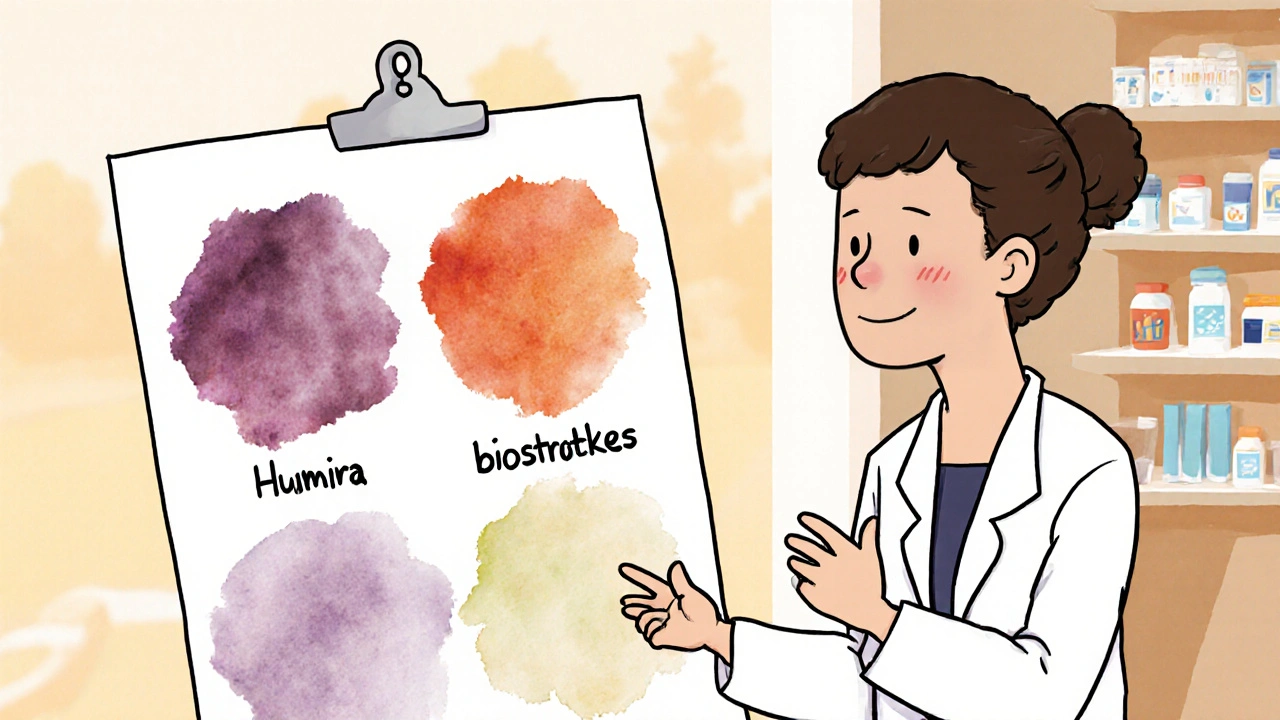
Think of a generic drug like a photocopy. You take a small-molecule pill - say, metformin - and recreate its exact chemical structure. It’s the same molecule, same shape, same function. Biosimilars? They’re more like a hand-painted replica of a watercolor. The colors match, the brushstrokes look the same, but the paint is applied by a different artist using slightly different tools. The result? The same image, but the process is far more complex.
Biologics - the original drugs - are made from living cells. That means tiny variations can happen in manufacturing. A biosimilar must prove it behaves the same way in the body, with the same safety profile and effectiveness. But because of this complexity, the FDA doesn’t automatically allow pharmacists to swap them out like generics. Only interchangeable biosimilars can be substituted without the prescriber’s permission. As of late 2023, only a handful of biosimilars have earned that designation. The rest still require the doctor to specifically approve the switch.
That’s a big reason why biosimilar adoption has been slow - even though they cost 15% to 35% less than the original biologic. In contrast, generic drugs are substituted in 97% of cases when available. Biosimilars? Far fewer. Why? Because state laws vary. Some states require the pharmacist to notify the prescriber. Others require patient consent every time. Some don’t allow substitution at all unless the product is labeled interchangeable.
Why Pharmacists Are the Key to Adoption
Pharmacists are the only healthcare professionals who see the full picture: the prescription, the patient’s history, the supply chain, the insurance rules, and the lab data. They’re the ones who catch that the patient’s Neulasta refill is now a biosimilar - and they’re the ones who can explain why that’s okay.
Research from the US Oncology Network shows that when pharmacists took over the substitution decision - after training and physician buy-in - biosimilar use for pegfilgrastim jumped within months. Before, doctors had to approve each switch manually. That meant delays, phone calls, and frustration. After the pharmacy team started handling it, provider interruptions dropped to zero. Patients got their meds faster. Clinics ran smoother.
And it’s not just efficiency. Pharmacists are better at convincing patients than doctors are. A 2022 study found that 87% of pharmacists recommended biosimilars to patients, compared to just 62% of physicians. Why? Because pharmacists spend more time with patients. They have the training. They’ve taken continuing education on biosimilars - 79% of pharmacists have, versus only 43% of doctors.
One pharmacist in Ohio told a patient: “The FDA says this biosimilar works the same way. No meaningful differences. It’s not a cheaper version - it’s the same medicine, made differently.” The patient switched. And stayed on it.
How to Counsel Patients Effectively
Patients hear “biosimilar” and think “generic.” They worry it’s inferior. They’ve seen ads for the brand-name drug. They’ve heard stories about side effects. Their fear isn’t irrational - it’s based on misinformation.
Here’s what works:
- Start with the facts: “This medicine has been approved by the FDA as highly similar to the original. It’s been tested in thousands of patients.”
- Use analogies: “It’s like two different brands of insulin - same effect, different packaging.”
- Address appearance changes: If the biosimilar looks different - different color, size, or pen design - say it upfront. “This pen is smaller, but it delivers the same dose. The medicine inside is the same.”
- Explain traceability: “We’ll record the batch number so if anything happens, we can track exactly what you got.”
- Ask for permission: “Would you like me to explain this to your doctor before we switch?”
One study found patients were 21% more likely to stop taking their medication if the appearance changed - and no one explained why. That’s not just a safety issue. It’s a cost issue. If someone stops their treatment, they might end up in the ER. The savings from the biosimilar vanish.
Legal and Logistical Hurdles
Even if a biosimilar is interchangeable, state laws can block substitution. As of October 2023, 48 states have laws about biosimilar substitution - but they’re a patchwork. Some require the prescriber to write “dispense as written.” Others allow substitution only if the patient consents in writing. A few require pharmacists to notify the prescriber within 24 hours.
Pharmacists must know their state’s rules - and their pharmacy’s policy. A pharmacist in Texas might be able to substitute automatically. One in New York might need a signed form. And in some states, the law doesn’t even mention biosimilars - so pharmacists operate in a gray area.
Then there’s the issue of rebates. Drug manufacturers pay pharmacies and insurers rebates to favor their brand. Sometimes, those rebates make the original biologic cheaper than the biosimilar - even though the biosimilar costs less to produce. That’s why payers and pharmacy benefit managers need to change their incentives. Pharmacists can’t fix that alone - but they can push for it.
Documentation and Traceability
Every time a biosimilar is dispensed, the batch number must be recorded. Not just in the pharmacy system - but in the patient’s medical record. Why? Because if someone has a reaction, you need to know exactly which version they got. That’s not just good practice. It’s required by the FDA and the IFPMA.
Pharmacists must document:
- The name of the biosimilar dispensed
- The manufacturer
- The lot or batch number
- Whether substitution occurred
- Whether the patient was counseled
This isn’t paperwork for the sake of paperwork. It’s how we track safety over time. It’s how we prove biosimilars are safe for long-term use. And it’s how we build trust.
The Bigger Picture: Cost and Access
Biologics make up just 2% of all prescriptions in the U.S. - but they account for nearly half of all drug spending. A single course of Humira can cost $20,000 a year. The biosimilar? Around $12,000. That’s a 40% drop. Multiply that across thousands of patients, and you’re talking billions saved.
But savings only happen if people actually use them. And that’s where pharmacists are the missing link. They’re the ones who can bridge the gap between science and patient behavior. They’re the ones who can turn a policy into practice.
At the US Oncology Network, after implementing mandatory training for everyone - doctors, nurses, pharmacists, financial staff - biosimilar adoption rose dramatically. Why? Because everyone knew the rules. Everyone understood the science. And patients were told the truth - clearly, calmly, and consistently.
What’s Next?
The FDA is considering removing the separate “interchangeable” designation entirely. That would simplify things - but only if pharmacists are ready. More states are updating their laws. More training programs are popping up. And more pharmacists are stepping up.
The future of biosimilars isn’t just about new drugs. It’s about better systems. Better communication. Better trust. And it’s not going to happen in a boardroom. It’s going to happen in the pharmacy, one conversation at a time.
If you’re a pharmacist, you’re not just filling prescriptions. You’re changing how medicine is delivered. You’re making care more affordable. You’re saving lives - not just by giving out pills, but by giving out understanding.
Can pharmacists substitute biosimilars without a doctor’s approval?
Only if the biosimilar has been designated as "interchangeable" by the FDA AND your state’s laws allow it. Most biosimilars are not interchangeable yet, so substitution usually requires the prescriber’s permission. Always check your state’s pharmacy board rules and the product’s labeling.
Why are biosimilars cheaper than the original biologics?
Biosimilars don’t need to repeat all the expensive clinical trials the original biologic went through. They only need to prove they’re highly similar in safety and effectiveness. That cuts development costs significantly. Plus, competition from multiple biosimilars drives prices down over time.
Do biosimilars work the same as the original biologic?
Yes. The FDA requires biosimilars to have no clinically meaningful differences in safety, purity, or potency compared to the reference product. Thousands of patients have used them with the same results. Studies show they work just as well for conditions like rheumatoid arthritis, Crohn’s disease, and cancer.
What if a patient refuses a biosimilar?
Respect their choice. Explain the benefits again, but don’t push. Document their refusal in the record. Offer to contact their doctor if they want to discuss it further. Patient trust matters more than pushing a switch - especially with complex, long-term treatments.
How do I know if a biosimilar is interchangeable?
Check the FDA’s Purple Book, which lists all approved biologics and biosimilars with their interchangeability status. Only products labeled as "interchangeable" by the FDA can be substituted without prescriber involvement. If it’s not labeled that way, you need the doctor’s okay.
Are there risks with switching between biosimilars and the original biologic?
Current data shows no increased risk from switching between a reference biologic and its biosimilar - or even between different biosimilars - as long as the products are approved and properly tracked. However, repeated switching should be done with caution and documentation. The IFPMA recommends this only if studies support it.
What Pharmacists Should Do Next
Start with education. Take a free online course on biosimilars from the FDA or a professional pharmacy association. Learn your state’s substitution laws. Talk to your pharmacy manager about updating protocols. Ask if you can lead a short training for your team.
Then, talk to patients. Don’t wait for them to ask. When you fill a biologic prescription, say: “This is a biosimilar version. It’s just as effective, but costs less. Would you like to hear how it works?”
That’s not just good practice. It’s the future of pharmacy.
All Comments
Clay Johnson November 28, 2025
Biosimilars aren't generics. They're not even close. The body doesn't care about the label. It cares about the protein folding, the glycosylation patterns, the half-life. If the FDA says no clinically meaningful difference, then the difference is statistically invisible. We're talking about molecular noise here, not therapeutic deviation.
Jermaine Jordan November 29, 2025
This is the moment pharmacy becomes medicine. Not just dispensing. Not just filling. But leading. The pharmacist holding the patient's hand, explaining that this isn't a downgrade-it's an upgrade in access. This isn't just science. It's justice. It's equity. It's the quiet revolution happening in the back room while the world watches TV ads for $20,000 pills.
Chetan Chauhan November 30, 2025
uuhh biosimilars r just big pharma trick to keep profits up lmao they just rebrand the same stuff n charge less but still make bank. also why do u need to track batch numbers? like... is the medicine gonna turn into a demon if u mix batches? lol
Phil Thornton November 30, 2025
Pharmacists are the real MVPs.
Pranab Daulagupu December 2, 2025
The pharmacoeconomic implications here are profound. Biosimilars disrupt the biologic monoculture. They introduce competition at the molecular level. This isn't just cost containment-it's structural reform in drug delivery systems. The patient experience becomes the metric of success.
Barbara McClelland December 3, 2025
I love how you broke down counseling into simple steps. That’s exactly what we need-clear, calm, patient-centered language. I just trained my team on this last week. One patient cried because she thought she was getting a ‘second-rate’ drug. We sat for 20 minutes. She’s been on the biosimilar for 6 months now. No issues. Just savings. That’s the win.
Alexander Levin December 3, 2025
Who’s really controlling the Purple Book? Big Pharma. The FDA’s just their puppet. Biosimilars are a scam to make you think you’re saving money while they just shift the rebate pipeline. You think they want you to save? They want you to stay dependent. 💸
Ady Young December 4, 2025
My pharmacy just got our first interchangeable biosimilar approved last month. We started substituting without asking the doctor. The first week, we had zero complaints. Two patients asked if it was ‘the real thing.’ We showed them the FDA label. One said, ‘Wow. I thought I was getting the cheap knockoff.’ We didn’t even need to argue. The data spoke.
Travis Freeman December 4, 2025
I’m from India. We’ve been using biosimilars for over a decade. In my home country, they’re the norm, not the exception. We don’t have the luxury of $20k drugs. So we embraced science over branding. And guess what? People live. People thrive. The stigma? It fades when the medicine works. This isn’t American exceptionalism. It’s global common sense.
Sean Slevin December 4, 2025
Wait-so if a biosimilar is made from living cells… and the original is made from living cells… and the biosimilar is ‘highly similar’… then technically, isn’t the original also just a ‘biosimilar’ of some theoretical perfect biologic? Are we all just biosimilars of some divine, unattainable ideal? Is medicine just… approximation? And if so… what does that say about the human body’s ability to heal? Are we just… pattern-matching molecules?
Melissa Michaels December 6, 2025
Traceability is non-negotiable. Without batch-level documentation, adverse event reporting becomes meaningless. We cannot rely on patient recall or provider memory. The FDA requirement is not bureaucracy-it’s epidemiological integrity. Every lot number is a thread in the safety net.
Nathan Brown December 8, 2025
People don’t fear biosimilars because they’re dumb. They fear them because they’ve been lied to for decades. Ads scream ‘miracle drug!’ Then you get the ‘copy’ and feel like you’ve been betrayed. It’s not the science they distrust-it’s the system. The pharmacist’s job isn’t to educate. It’s to rebuild trust. One conversation at a time. One batch number at a time.
Matthew Stanford December 9, 2025
I’ve seen this play out in rural clinics. Older patients, on Humira for 8 years, terrified to switch. We didn’t push. We listened. We brought in the FDA pamphlet. We showed them the study data. We said, ‘You’ve been doing great. This isn’t a change-it’s an upgrade.’ Two weeks later, one came back with a thank-you card. Said he saved $800 that month. He bought his granddaughter a bike. That’s the real impact.
Clay Johnson December 11, 2025
Rebates distort the market. If a branded drug has a $5,000 rebate to the PBMs and the biosimilar has $3,000, the branded version ends up cheaper to the payer. That’s not a market failure. It’s a perverse incentive engineered by design. Pharmacists can’t fix this alone. But we can document it. And demand transparency.