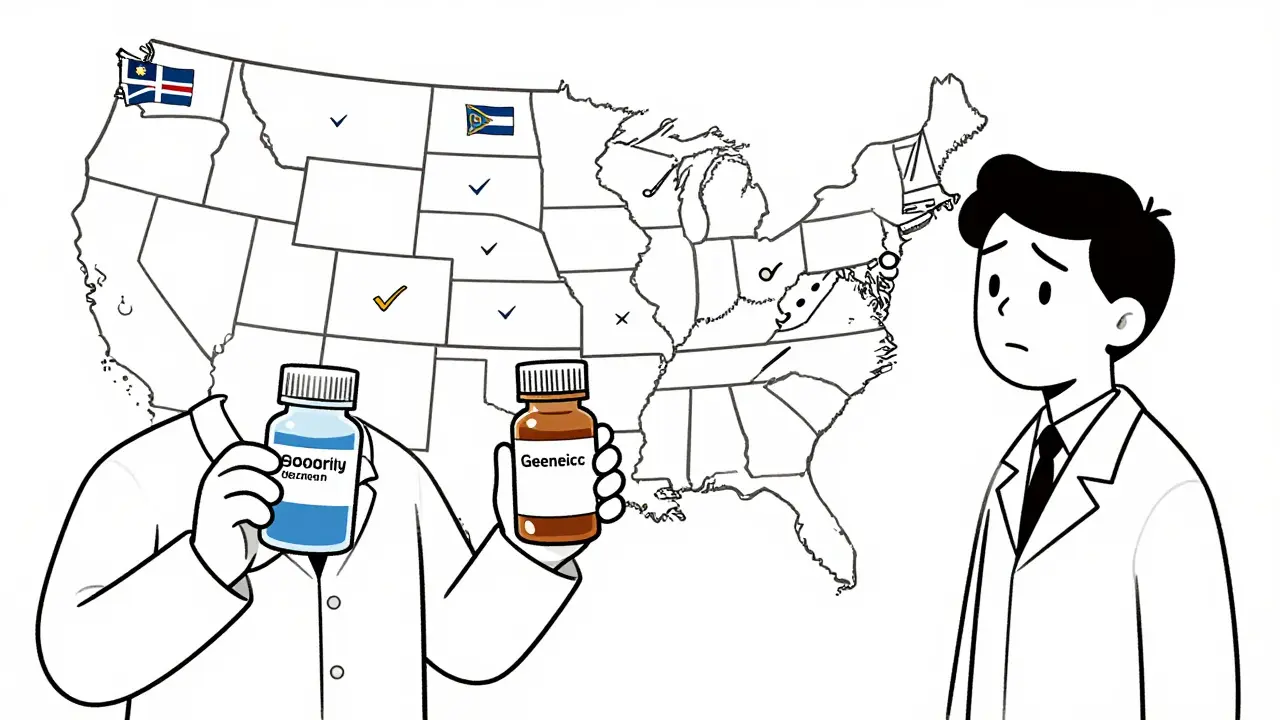
When a pharmacist hands you a pill bottle with a different name than what your doctor wrote, it’s not a mistake. It’s generic substitution-a legal process that swaps a brand-name drug for a cheaper, therapeutically equivalent version. But here’s the catch: the rules for when this can happen change depending on which state you’re in. In one state, the pharmacist must substitute unless you or your doctor say no. In another, they can’t substitute at all without your written permission. And in some places, they’re not even allowed to tell you they did it. This isn’t confusion-it’s a patchwork of 51 different systems (50 states plus Washington, D.C.) that make managing prescriptions a nightmare for pharmacists and patients alike.
How Generic Substitution Works (And Why It Matters)
Generic drugs are chemically identical to their brand-name counterparts. They have the same active ingredients, dosage, strength, and route of administration. The only differences are the name, color, shape, and price-often 80% lower. The FDA approves them through the Orange Book, which rates drugs as either “A” (therapeutically equivalent) or “B” (not equivalent). When a pharmacist substitutes, they’re relying on that rating. The goal is simple: cut costs. From 2008 to 2017, generic drugs saved the U.S. healthcare system $1.68 trillion. In 2023, generics made up 90.2% of all prescriptions filled but only 18% of total drug spending. That’s billions saved every year. But those savings only happen if substitutions actually occur-and that’s where state laws come in.Mandatory vs. Permissive Substitution Laws
There are two main types of state laws. Mandatory substitution means the pharmacist must switch to a generic unless the prescriber writes “dispense as written” or the patient refuses. Nineteen states have this rule. That includes New York, Florida, and Illinois. In these states, the default is substitution. The burden is on the doctor or patient to stop it. The other 31 states and D.C. follow permissive substitution. Here, pharmacists can substitute, but they don’t have to. The decision is often left to the pharmacist’s judgment, the pharmacy’s policy, or the patient’s preference. In these places, substitution happens less often-not because generics are less safe, but because the law doesn’t push for it. The difference isn’t just legal-it’s financial. States with mandatory laws see 8.7% higher generic utilization rates and $55 less in per capita prescription costs each year. That’s not a small gap. It’s the difference between a family paying $1,042 or $1,097 annually for prescriptions.Consent, Notification, and Liability: The Hidden Rules
Even within the same category, laws vary wildly. Take consent. Only seven states and D.C. require patients to give explicit permission before a substitution. That means in 43 states, a pharmacist can swap your brand-name blood pressure pill for a generic without asking you. In most cases, that’s fine-generics are safe. But for drugs with narrow therapeutic windows-like warfarin, lithium, or thyroid meds-getting it wrong can be dangerous. Notification is even messier. Thirty-one states and D.C. require pharmacists to tell patients they received a generic. Twenty states don’t. In states without notification, patients often don’t realize they got a different drug until they see the receipt or notice the pill looks different. A 2021 study from the Institute for Safe Medication Practices found that 22% of substitution-related medication errors happened in states that didn’t require patient notification. Then there’s liability. Twenty-four states offer no legal protection to pharmacists who substitute generics. That means if something goes wrong-even if the generic was FDA-approved-the pharmacist could be sued. In Connecticut, one pharmacist told Pharmacy Times she refuses to substitute warfarin because she has no liability shield. “I’d rather risk a patient being upset than risk losing my license,” she said.Biosimilars: The New Wild West
Biosimilars are the next frontier. Unlike small-molecule generics, they’re made from living cells-not chemicals. They’re more complex, harder to replicate, and more expensive. But they’re also life-saving for people with cancer, rheumatoid arthritis, and Crohn’s disease. Here’s the kicker: 45 states treat biosimilars differently than small-molecule generics. Forty-five states require the prescriber to be notified after a biosimilar is substituted. California demands that notice be entered into an electronic system accessible to the doctor within five days. Thirty-eight states require patient notification. Forty-eight states allow doctors to block substitution entirely by writing “dispense as written.” And yet, none of the 56 U.S. jurisdictions (including Puerto Rico) treat biosimilars the same way. That’s a problem. Biosimilar adoption is stuck at just 14.3% of eligible prescriptions, even though 32 have been approved by the FDA. Experts blame the regulatory chaos. “Inconsistent state laws are the single greatest barrier to biosimilar adoption,” said FDA Commissioner Robert Califf in 2024.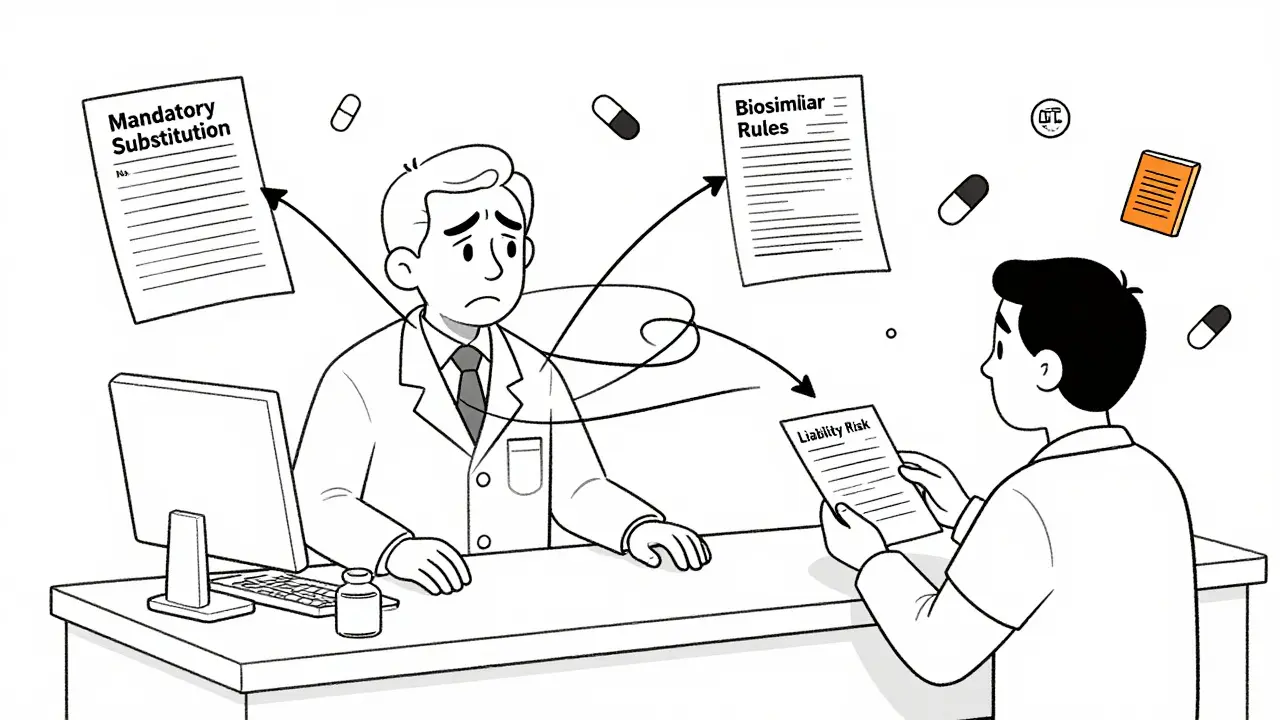
What Pharmacists Actually Deal With
Imagine you’re a pharmacist working in a multi-state telepharmacy. You fill prescriptions for patients in California, Texas, Ohio, and Maine. Each state has different rules on consent, notification, formulary lists, and liability. You spend 15 to 20 minutes a day just checking state laws. That’s 8.2 hours a month. For new pharmacists, it takes 4 to 6 weeks of training before they can confidently handle substitutions across states. Only 28 states have fully integrated substitution rules into their electronic health records (EHRs). In the other 23, pharmacists have to manually look up rules, print out state guidelines, or call pharmacy boards. A 2024 Health Affairs study found that these manual steps lead to 17% more errors. Independent pharmacies are hit hardest. A 2023 survey found 68% of independent pharmacists reported substitution-related errors, compared to 42% at chain pharmacies. Why? Chains have legal teams, compliance software, and centralized training. Independent pharmacies? They’re doing it alone.How States Handle Formularies: Positive vs. Negative
Some states use a positive formulary: they list the specific generic drugs that can be substituted. Others use a negative formulary: they list the drugs that can’t be substituted. California, for example, relies strictly on the FDA’s Orange Book. If it’s rated “A,” it’s substitutable. New York allows broader therapeutic equivalence judgments-meaning a pharmacist can substitute even if the Orange Book doesn’t list it, as long as clinical evidence supports it. Oklahoma is an outlier. You can’t substitute anything without written authorization from the prescriber or the patient’s insurer. That’s not just restrictive-it’s outdated. It turns a simple, safe, cost-saving practice into a paperwork nightmare.What’s Changing in 2025 and Beyond
The system is breaking under its own weight. In 2024, the National Association of Boards of Pharmacy launched a project to reduce 51 different laws down to just three regional models by 2027. That’s the first real step toward sanity. Nineteen states introduced reform bills in 2023-2024. Nine of them-Texas, Illinois, Pennsylvania among them-passed laws to align biosimilar rules with small-molecule rules. That’s progress. The Congressional Budget Office estimates harmonized laws could save $14.3 billion over ten years. But the roadblocks are real. Pharmacy chains spend $1.2 million per state annually just to stay compliant. That’s $61.2 million nationwide. And 72% of pharmacy leaders now support federal preemption-meaning the federal government sets the rules, not the states. For now, though, you’re stuck with the patchwork.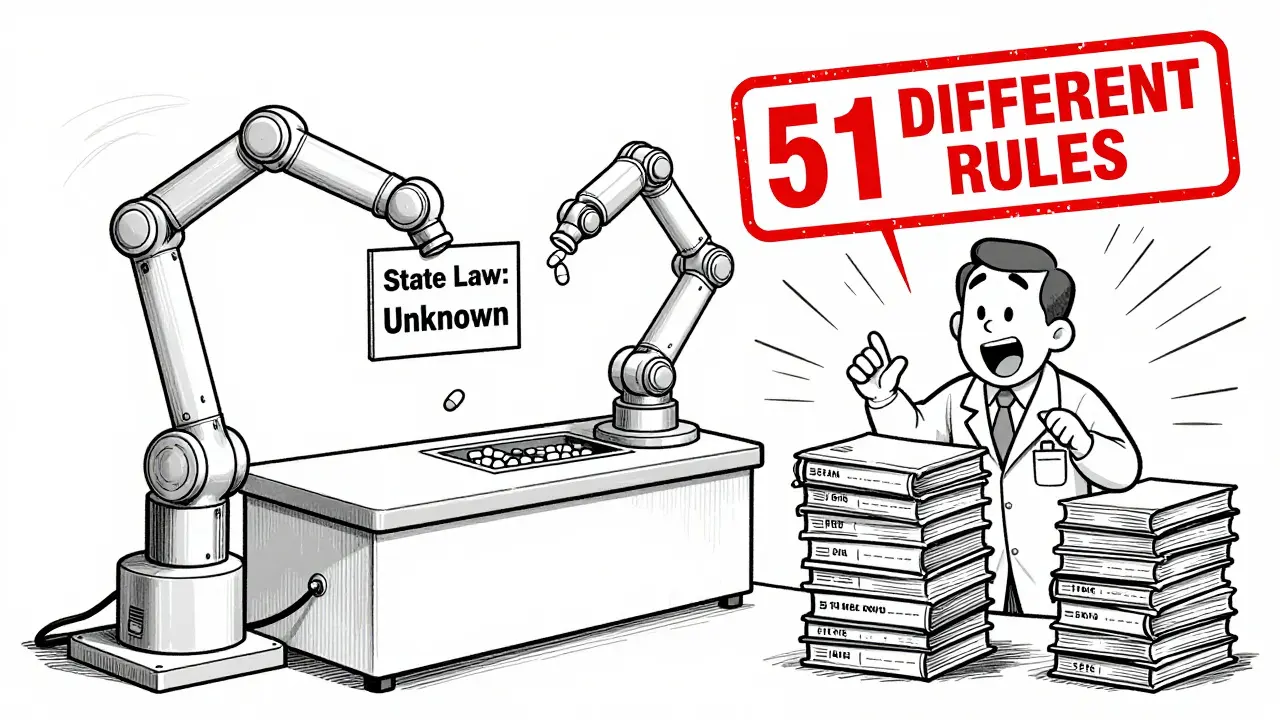
What Patients Should Know
You have rights, even if your state doesn’t make them obvious.- Ask if your prescription was switched. You’re entitled to know.
- Ask if the generic is FDA-approved. Look for the “A” rating in the Orange Book.
- Speak up if you’re on a drug with a narrow therapeutic window-warfarin, thyroid meds, seizure drugs, or immunosuppressants. Don’t assume substitution is safe without confirmation.
- Check your receipt. If the name changed and you weren’t told, ask why.
- Ask your doctor to write “dispense as written” if you want to avoid substitution entirely.
What Pharmacists Should Do
If you’re a pharmacist, here’s how to survive:- Use the National Association of Boards of Pharmacy’s free online tool-but don’t trust it blindly. It’s incomplete for biosimilars.
- Invest in software like ScriptPro SP 200 that auto-updates state rules. It cuts errors by 37%.
- Document every substitution. Date, time, drug name, patient notification, prescriber notification-all of it.
- Know your state’s liability protections. If you have none, refuse substitutions on high-risk drugs.
- Train your staff. One error can cost you your license.
Can a pharmacist substitute my brand-name drug without telling me?
Yes, in 20 states and without any legal obligation to notify you. In most of those states, substitution is allowed but not required. If you’re in a state without mandatory notification, you might not realize your prescription was switched until you see the pill looks different or your co-pay drops. Always check your receipt and ask if a substitution occurred.
Do I need to give permission for a generic substitution?
Only in seven states and Washington, D.C. In those places, pharmacists must get your explicit consent before switching. In the other 43 states, your consent isn’t legally required. The default assumption is that you want the cheaper option unless you or your doctor say otherwise.
Are biosimilars treated the same as regular generics?
No. Biosimilars are biologic drugs made from living cells, not chemicals. Because they’re more complex, 45 states impose stricter rules than for small-molecule generics. Most require the prescriber to be notified after substitution, and many require patient notification too. None of the 56 U.S. jurisdictions treat biosimilars identically to generics, which is why their adoption is still below 15% despite FDA approvals.
Can my doctor stop a generic substitution?
Yes. In all 50 states and D.C., a prescriber can write “dispense as written” (DAW) on the prescription to block substitution. This is the most reliable way to ensure you get the brand-name drug. Some doctors do this out of habit, but it’s often unnecessary. If you’re concerned about switching, ask your doctor to use DAW code 1 or write the phrase directly on the script.
Why do some pharmacies refuse to substitute certain drugs?
Three main reasons: liability, complexity, or policy. In states without legal protection, pharmacists may refuse substitutions on high-risk drugs like warfarin or epilepsy meds. Some pharmacies have internal policies that restrict substitution for certain conditions. Others simply don’t have the software to verify state rules in real time. It’s not about safety-it’s about risk management.
Is there a federal law that overrides state substitution rules?
No. Pharmacy practice is regulated at the state level, not federal. The FDA approves generics and biosimilars, but it doesn’t control who can substitute them or under what conditions. That’s why you have 51 different rulebooks. There’s growing support for federal preemption, but no law has passed yet. Until then, your state’s rules are the final word.
All Comments
Diana Dougan January 30, 2026
So let me get this straight-pharmacists in 20 states can swap my $300 brand-name pill for a $50 generic without telling me? And I’m supposed to be grateful? Lol. I’ve seen the pills. One’s purple, one’s blue. They don’t even look the same. Who’s the real scammer here-the drug company or the state legislature?
Shubham Dixit January 31, 2026
This entire system is a colonial relic of American medical bureaucracy. In India, we have a single national formulary managed by the National Pharmaceutical Pricing Authority. Generics are standardized, affordable, and universally accepted. No one needs to check 51 different rulebooks. Why does America insist on turning healthcare into a bureaucratic obstacle course? It’s not innovation-it’s dysfunction dressed up as federalism.
KATHRYN JOHNSON February 2, 2026
The fact that 43 states do not require patient consent for generic substitution is a violation of bodily autonomy. This is not a cost-saving measure-it is medical paternalism under the guise of efficiency. Every patient deserves informed consent. Period.
Sazzy De February 3, 2026
i just always check the bottle before i leave the pharmacy. if it looks different i ask. easy. no big deal. my grandma used to say if you don’t ask you don’t get
Blair Kelly February 4, 2026
Let’s be real. This isn’t about patient safety. It’s about pharmacy chains maximizing profit margins by avoiding liability. The fact that 24 states offer zero legal protection to pharmacists means they’re forced to play Russian roulette with high-risk drugs. Meanwhile, the FDA approves these generics, but the states won’t shield the people actually handing them out. It’s a setup for lawsuits, not savings.
Rohit Kumar February 4, 2026
There is a deeper philosophical question here: who owns the right to health? Is it the state, the pharmacist, the doctor, or the patient? In a system where cost is prioritized over clarity, we have surrendered agency to bureaucracy. The patchwork of laws reflects not just legal fragmentation but a societal failure to treat medicine as a human right rather than a commodity.
Lily Steele February 6, 2026
i used to work in a pharmacy and honestly the hardest part was keeping up with the rules. one day you’re in california the next in texas. it’s wild how much time we spent just double checking instead of helping people. software helps but not everyone can afford it
Gaurav Meena February 8, 2026
I have seen many patients in rural India struggle to afford even basic medications. The idea that generics can save billions is not just a statistic-it’s a lifeline. I urge American policymakers to look beyond state borders and consider what true access means. Technology can bridge gaps, but compassion must lead the way.
Jodi Olson February 8, 2026
The regulatory fragmentation is not merely inefficient it is ethically indefensible when considering the systemic inequities it perpetuates among low income patients who lack the resources to advocate for themselves
Carolyn Whitehead February 9, 2026
i never thought about this until my cousin had a bad reaction to a generic seizure med. now she always asks for the brand. i just wish more people knew it was okay to ask
Amy Insalaco February 11, 2026
The current paradigm is a textbook case of pathological regulatory pluralism-an epistemic cacophony wherein state-level pharmacopeias operate as decentralized, non-interoperable subsystems with incompatible ontologies of therapeutic equivalence. The absence of a unified semantic framework for substitution protocols is not a logistical oversight-it is a structural failure of governance architecture.
Beth Beltway February 12, 2026
Let’s cut the crap. This isn’t about savings. It’s about corporate greed disguised as public policy. The pharmaceutical industry lobbied for this mess so they could keep their brand-name prices high while outsourcing liability to pharmacists. And now we’re supposed to be impressed that generics are 80% cheaper? That’s not innovation-it’s exploitation with a side of bureaucratic confusion.
Marc Bains February 14, 2026
This is why we need community-based health advocates. If you’re a pharmacist in a small town, you shouldn’t have to Google state laws every time you fill a script. Train local volunteers. Create regional hubs. Empower patients to ask. Change doesn’t come from Washington-it comes from the counter.
kate jones February 14, 2026
The Orange Book’s ‘A’ rating is not a guarantee of clinical equivalence-it’s a chemical equivalence. For drugs with narrow therapeutic windows, therapeutic substitution requires clinical judgment, not algorithmic compliance. Pharmacists are trained to assess this, but the current regulatory framework treats them as clerks, not clinicians. We need to elevate their role, not constrain it.