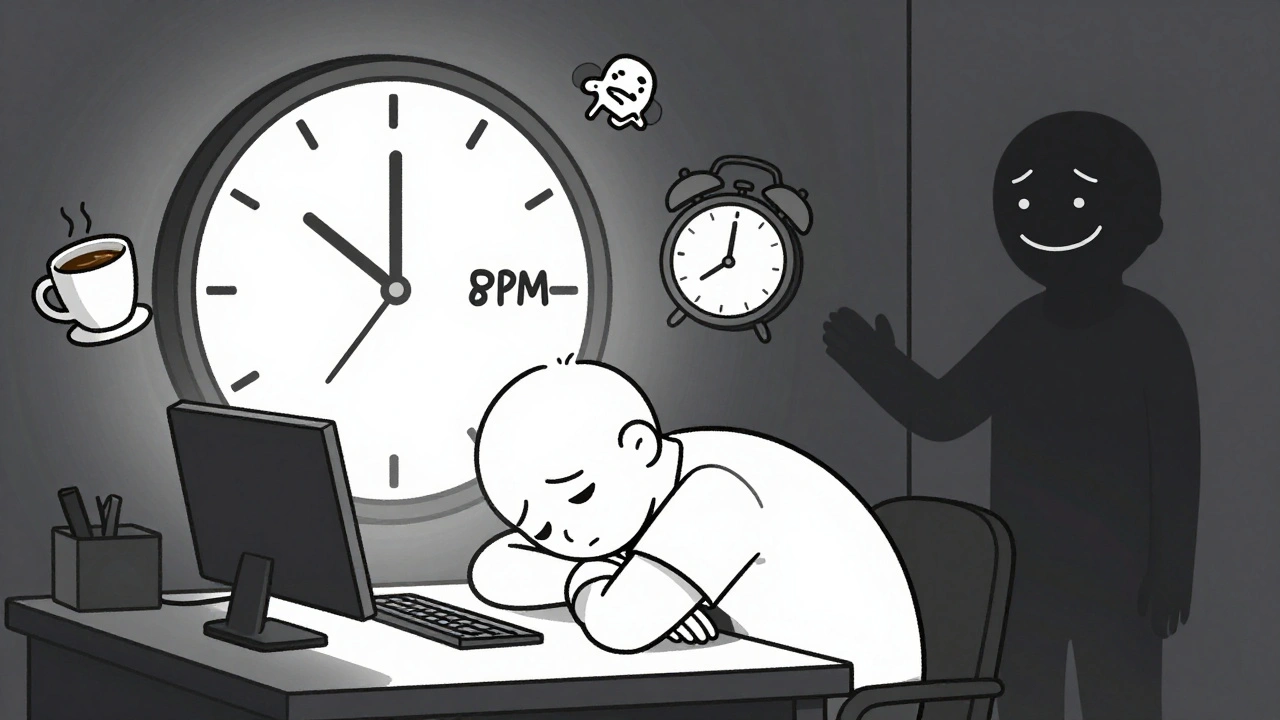
By 2025, nearly one in four workers globally says they’re burned out very often or always. That’s not just tiredness. It’s emotional collapse. It’s staring at your screen at 8 p.m. and feeling nothing. It’s dreading Monday before Sunday even ends. And it’s not your fault.
What Burnout Really Looks Like
Burnout isn’t a buzzword. It’s a medical diagnosis-recognized by the World Health Organization since 2019 under code QE1A.0. It’s not laziness. It’s not poor time management. It’s a direct result of chronic workplace stress that’s been ignored too long.The three signs are clear:
- You’re constantly exhausted, even after sleep.
- You feel detached from your work-like you’re just going through the motions.
- You’ve lost confidence in your abilities, even if you used to be great at your job.
According to Gallup’s 2023 data, 63% of people experiencing burnout report chronic fatigue. Over 40% struggle with sleep. More than half say they can’t focus. These aren’t vague feelings. They’re measurable symptoms. And they don’t go away with a vacation.
Why Burnout Happens: It’s Not Just ‘Too Much Work’
Most people think burnout comes from working long hours. But research shows it’s more about how work is organized-not how many hours you log.The Job Demands-Resources model, developed by psychologists Arnold Bakker and Evangelia Demerouti, identifies six key drivers:
- Excessive workload (cited by 67% of employees)
- Lack of control over your tasks or schedule (49%)
- Insufficient rewards-pay, recognition, or appreciation (42%)
- Breakdown of community-feeling isolated or unsupported (38%)
- Absence of fairness in how decisions are made (34%)
- Conflicting values-when your work feels meaningless or unethical (29%)
Notice something? None of these are about how hard you work. They’re about how your workplace treats you.
Prevention Starts With Managers-Not Yoga Mats
Too many companies hand out mindfulness apps and call it a day. That’s like giving aspirin to someone with a broken leg.The real fix? Managers who care. Gallup’s research shows managers account for 70% of the difference in whether employees feel engaged or burned out. Teams led by managers who regularly have five key conversations-about strengths, purpose, wellbeing, growth, and recognition-see 41% lower burnout rates.
What do those conversations look like?
- “What’s one thing you’re proud of this week?”
- “What part of your job feels draining? Can we adjust it?”
- “What do you need to feel supported?”
It’s not about being a therapist. It’s about being present. This is Calmer’s 2024 guide found that companies restructuring 1:1s to include mental health check-ins saw 28% higher retention.
Psychological safety matters too. Google’s Project Aristotle proved that teams where people feel safe to speak up, make mistakes, or say “I’m overwhelmed” have 47% less burnout. That’s not soft leadership. That’s smart leadership.

Boundaries Are Non-Negotiable
You can’t outwork burnout. But you can out-organize it.Employees who set clear boundaries-like no emails after 6 p.m.-experience 39% lower burnout, according to the American Psychological Association. Simple. But hard to do if your company rewards constant availability.
Companies like Salesforce and Microsoft are now using AI tools to track workload distribution. These systems flag when someone is consistently working late, taking few breaks, or getting pinged after hours. They don’t spy. They protect.
“Digital sunset” policies-where systems automatically shut down after work hours-have reduced after-hours communication by 31% and lowered burnout by 26%.
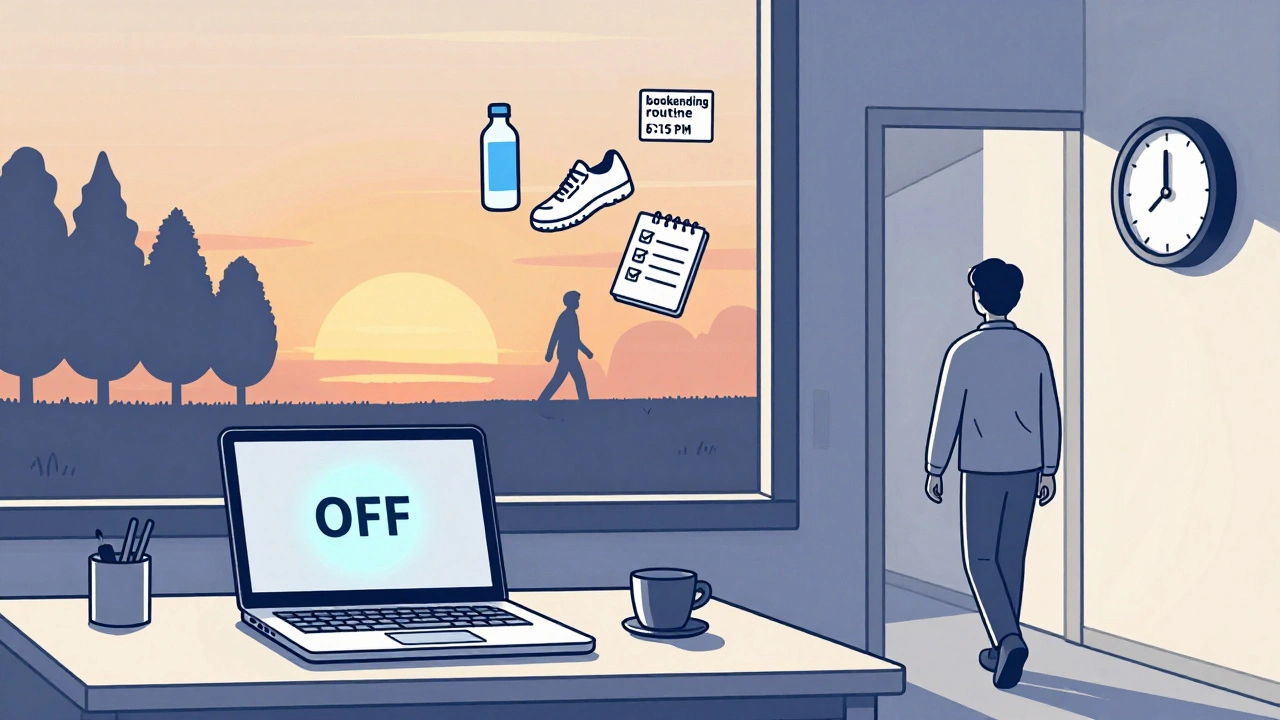
Remote workers benefit from “bookending routines”: a 15-minute walk before and after work. MIT’s 2024 study found this simple habit cut stress levels by 22%. It signals your brain: work starts here. Work ends here.
Small Daily Habits That Actually Help
Individual actions aren’t magic, but they’re necessary. Here’s what works:- Time-blocking: Schedule deep work in 90-minute chunks, then take a 10-minute break. Neurobloom Colorado’s study showed this improved task completion by 28% and cut burnout symptoms by 22%.
- Micro-breaks: Step away every 90 minutes. Harvard Business Review found this boosts productivity by 13% and lowers burnout markers by 17%.
- Move more: Walking meetings are used by 68% of Fortune 500 companies. On average, they reduce sedentary time by 27 minutes a day.
- Hydrate and eat: Companies that provide protein snacks and water stations report 19% fewer fatigue-related absences.
These aren’t perks. They’re survival tools.
Recovery Isn’t a Weekend Off
If you’re already burned out, rest won’t fix it. Recovery needs structure.Gallup’s three-phase model works:
- Recognition: Use tools like the Q12 survey to spot signs early-before someone quits.
- Intervention: Immediately reduce workload. Give temporary role adjustments. Don’t wait.
- Restoration: Return with protected time. No urgent emails. No extra meetings. Just space to heal.
Strategic disengagement is powerful. A 48- to 72-hour digital detox-no work emails, no Slack, no checking in-leads to a 63% drop in emotional exhaustion, per the APA’s 2024 guide.
And timing matters. Spring Health found employees who seek help within 14 days of noticing burnout symptoms recover 82% faster than those who wait.
Try this: Keep an “accomplished list.” Every night, write down three things you actually completed-not what’s left to do. Gratitude practices like this speed up return-to-productivity by over three weeks, according to Keystone Partners.
Why Most Programs Fail (And How to Fix It)
Sixty-eight percent of workplace burnout initiatives fail. Why?- They’re treated as HR fluff, not business priorities.
- Managers aren’t held accountable.
- They’re launched with fanfare, then forgotten after six months.
The companies that win? They tie wellbeing to performance reviews. In successful programs, 30% of a manager’s evaluation now includes team wellbeing metrics-up from just 12% in 2021.
They also bake it into onboarding. One healthcare provider added 4.5 hours of burnout prevention training for new hires. Adherence jumped 52%.
The best timeline? 30-60-90 days:
- Day 30: Build psychological safety. Let people speak up.
- Day 60: Run your first workload audit. Adjust based on data.
- Day 90: Make it part of culture-not a program.
Organizations following this plan see 44% higher success rates.
The Future Is Predictive, Not Reactive
The next wave of burnout prevention isn’t about fixing people. It’s about predicting risk.By late 2025, 65% of Fortune 500 companies will use AI to analyze email patterns, calendar usage, and login times to flag employees at risk-with 82% accuracy.
Heart Rate Variability (HRV) monitors, used in pilots at Google and Intel, are showing 29% greater burnout reduction than traditional methods. They measure your body’s stress response in real time.
And the 4-day workweek? It’s not a fantasy anymore. Companies like Basecamp and Shopify are proving it works. Pollack Peacebuilding predicts 37% of tech firms will adopt it by 2025.
But the biggest shift? From “We offer counseling” to “We redesigned your job so you don’t need it.”
You’re Not Broken. Your System Is.
Dr. Christina Maslach, who created the gold-standard burnout measurement tool, says it plainly: “Burnout is not an individual failure. It’s a systems failure.”That means if you’re burned out, it’s not because you’re weak. It’s because your workplace doesn’t respect your humanity.
Dr. Adam Grant puts it even sharper: “Permission to say no” reduces burnout by 34%. But fewer than 15% of organizations actually give that permission.
Self-care isn’t wrong. But it’s not enough. The American Psychiatric Association found self-care programs only address 20% of burnout causes. Real change requires policy, accountability, and culture.
So if you’re feeling it-exhausted, numb, disconnected-you’re not alone. And you’re not failing. You’re signaling a problem that needs fixing.
Start small. Say no. Block your time. Walk before work. Ask your manager: “What’s one thing we can change to make this job sustainable?”
And if you’re in charge? Stop handing out meditation apps. Start asking harder questions. Fix the system. Your people-and your bottom line-will thank you.
All Comments
Michael Robinson December 8, 2025
It’s not about working harder. It’s about working in a world that doesn’t care if you live or just exist.
They call it burnout like it’s a glitch you can reset. But it’s the sound of a system grinding people down until they’re quiet.
I used to think rest was the answer. Turns out, rest without change is just a pause before the next crash.
They give you yoga mats and call it care. Meanwhile, your manager still expects you to reply at midnight.
Real healing starts when we stop blaming ourselves and start blaming the machine.
It’s not laziness. It’s resistance.
And resistance is the only sane response to a world that treats humans like batteries.
Maybe the real burnout is pretending this is normal.
We’re not broken. We’re awake.
precious amzy December 9, 2025
One is compelled to observe that the prevailing discourse on burnout, while superficially cogent, remains fundamentally reductive in its ontological framing.
One must interrogate the epistemological underpinnings of the Job Demands-Resources model-it presumes a Cartesian separation between labor and self, a fallacy perpetuated by neoliberal managerialism.
Indeed, the invocation of ‘psychological safety’ as a panacea is an aestheticized capitulation to performative empathy-a linguistic veneer over structural violence.
One cannot help but note the irony that corporations, having extracted value from the proletariat for centuries, now commodify ‘wellness’ as a tax-deductible PR tactic.
It is not the individual who requires recalibration, but the very architecture of capital accumulation that renders human flourishing anathema.
One might ask: if burnout is a systemic failure, why are the architects of the system rewarded with bonuses?
Until the labor theory of value is resurrected and recentered, all ‘solutions’ are merely palliatives for the dying.
Yoga mats, indeed.
Rich Paul December 10, 2025
bro the whole burnout thing is just people not managing their time lol
everyone’s so extra now, like ‘oh i’m so tired’ but you checked your phone 47 times after 6pm
ai tools? nah, just stop being a zombie and set a damn boundary
my boss doesn’t even text me after 5 and i’m still crushing it
also hydration bro. drink water. not just coffee and energy drinks
also, microbreaks? yeah, just get up and stretch. your spine will thank u
stop treating your job like your whole identity. it’s a job. not your soul.
also, why are we letting companies make us feel guilty for needing sleep? 🤦♂️
Ruth Witte December 11, 2025
YES YES YES 💪🔥
My manager asked me last week, ‘What’s one thing you’re proud of?’ and I cried. Not because I was sad-because someone finally ASKED.
That one question changed my whole week.
And I started walking before work now 🚶♀️☀️-I feel like a human again.
Also, I wrote down 3 wins every night. One was ‘I didn’t cry during a Zoom call.’
That’s a win now. 😭❤️
Stop giving us apps. Start giving us space.
And if you’re a manager? Just. Talk. To. People.
We’re not robots. We’re people with hearts that break silently.
Thank you for saying this out loud. 🙏
Noah Raines December 12, 2025
Y’all are overthinking this.
It’s simple: if your job makes you feel like garbage, leave.
No one’s stopping you. You’re not trapped.
Companies don’t care. They’ll replace you in 2 weeks.
So why stay? Why let them drain you?
I quit my last job because my boss said ‘just push through.’
Now I work freelance. I set my own hours. I sleep.
It’s not about better policies. It’s about not playing their game.
Stop waiting for permission. Take your power back.
And yeah, walk before work. But also-walk away from the job that’s killing you.
Simple. Hard. True.
Chris Marel December 13, 2025
I come from a place where people work 12 hours a day just to eat.
Here, burnout is about having too much pressure.
It’s strange to see how privilege shapes the conversation.
I’m not saying your pain isn’t real.
But when we only talk about boundaries and apps, we forget that for many, the problem isn’t culture-it’s survival.
Maybe the real solution is to stop treating burnout like a first-world problem.
And maybe, just maybe, we need to build systems that don’t require people to be heroes just to survive.
Thank you for writing this. It helps me feel less alone.
Even if my fight looks different, I see you.
Evelyn Pastrana December 14, 2025
Oh honey, they gave you a meditation app and called it ‘wellness’? Sweetie, that’s like giving a drowning person a snorkel.
Meanwhile, your manager’s ‘check-in’ is a Slack emoji and a ‘you got this!’
And yet, you’re still expected to be ‘engaged’ after 72 hours straight.
Let’s be real-this isn’t about self-care.
This is about capitalism pretending it cares while it keeps the profit margins high.
But hey, at least your company has a ‘mental health day’… that you’re too afraid to take.
Let’s stop pretending this is a personal failure.
It’s a corporate crime.
And you? You’re not broken.
You’re just not stupid.
Arun Kumar Raut December 16, 2025
I’ve seen this in my team back home. One person stopped speaking for three weeks. Just nodded. Didn’t say a word.
We didn’t notice until they didn’t show up for work.
It’s not about the hours. It’s about the silence.
My manager started asking, ‘What do you need?’ not ‘What’s wrong?’
It changed everything.
People started sharing. Not because they had to. Because they felt safe.
One guy said he needed to leave at 5 to pick up his kid. We made it happen.
He came back smiling.
It’s not hard. Just listen.
And don’t wait for a program.
Just be human. That’s all it takes.
Carina M December 17, 2025
The entire discourse is marred by a profound epistemological incoherence.
One is left to wonder whether the invocation of ‘psychological safety’ is a euphemism for the abdication of managerial responsibility.
It is patently absurd to suggest that micro-breaks or hydration stations constitute meaningful intervention in the face of structural exploitation.
Moreover, the suggestion that AI-driven HR analytics constitute ‘predictive’ prevention is a grotesque mischaracterization-this is surveillance dressed in wellness semantics.
And to imply that ‘permission to say no’ is a radical innovation is to ignore the centuries of labor organizing that preceded it.
One must ask: if burnout is a systemic failure, why are the architects of the system not held to account?
Instead, we are offered glittery apps and forced gratitude journals.
This is not reform. This is aestheticized oppression.
And until the labor contract is rewritten-not through performative check-ins, but through collective power-this will remain a farce.
Michael Robinson December 17, 2025
You know what’s wild? The people who built this system? They’re the ones who get the medals.
They get the bonuses. The promotions. The TED Talks.
Meanwhile, the people who keep it running? They’re told to ‘take care of themselves.’
And if they break? They’re replaced.
It’s not about fixing individuals.
It’s about dismantling a machine that’s designed to break people.
And the scariest part?
Most of us still believe we’re the problem.
Not the system.
Not the bosses.
Not the endless meetings.
Just… us.
That’s the real burnout.